
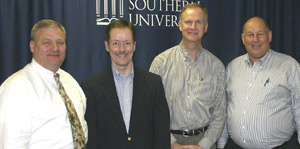
 With speaker Chuck Lawless (second from left) are, from left, Skip Owens, director of denominational relations, and directors of missions Bobby Bailey, Screven Association, and Edgar Boles, Charleston Association.
“If you are doing the mission of the church, the enemy will come after you,” Chuck Lawless told about 50 lowcountry ministers and lay leaders at the Spiritual Warfare Conference March 14 at Charleston Southern University.
“The enemy knows where we are vulnerable. He hits us at both our weaknesses and our strengths,” said Lawless, dean at the Billy Graham School of Missions, Evangelism and Church Growth of Southern Baptist Seminary. Lawless added that church leaders must be careful not to depend on their strengths because “strengths unguarded can become a source of pride in our own efforts, and the enemy is never alarmed if we do ministry in our own power.”
The Spiritual Warfare Conference was the first of three held in South Carolina. It was sponsored by the South Carolina Baptist Convention and hosted by Charleston and Screven Associations. Lawless also led the conference in Easley and Lexington on March 15 and 16, respectively.
“The purpose of this conference is to enhance the ministry of the local church and association. Not only is our culture a challenge, but there is also a greater challenge with spiritual warfare in growing the local congregations,” said Skip Owens, director of denominational relations at CSU.
Lawless said the enemy specifically targets church leaders, explaining that Satan wants to distract leaders from their quiet time because “preaching and leading must come out of the overflow of the interactions with the Father.” Because of these blatant attacks on leaders, church members should consistently pray for their ministers, he urged.
Lawless describes leaders who threaten the enemy as broken leaders – those who depend fully on God. Leaders need to be reduced so that all that is seen is God’s strength. Leaders must be willing to ask God to draw out sin, unforgiveness and bitterness in their lives, he said.
The primary task of the church is to reach lost people, he reminded those in attendance. Concerned that churches are satisfied with transfer growth – members moving from one church to another – Lawless challenged, “Are we reaching people for Christ or just transferring sheep?”
Emphasizing that “transfer growth causes complacency in evangelism,” Lawless noted, “Church members see people joining the church and the church building filling up. This lulls the members to sleep.”
Contact with nonbelievers lessens as we immerse ourselves in the church world, Lawless underscored, encouraging participants to be involved in the lives of nonbelievers.
“One of the enemy’s sole schemes is to get us so in love with other Christians that we don’t even see nonbelievers,” said Lawless. “As a church, we can live in our own world.”
In comparing new Christians in a church to having a new baby in a home, Lawless observed that a family would not dream of not preparing for and caring for a new family.
Churches should be just as ready to care for the new Christian, he said. “We must be ready on day one to walk alongside them,” Lawless stated. “Ultimately, it comes down to investing time with new believers.”
Christians need to be aware that new believers are a prime target for the enemy. They are lonely because they no longer fit in their old world, he noted, but they feel they do not fit in the Christian world either. Some may begin to doubt their salvation, he added, and the church often gives them no tools with which to fight these new battles.
Church leaders must teach new Christians, as well as all church members, how to have faith during the battles, Lawless urged. The enemy wants us to fail; to either “mess up or give up,” he said, emphasizing the importance of asking God, “What is it you want to teach me in this battle?”
The Spiritual Warfare Conference convinced Bobby Bailey that “God can do his best work in us during our brokenness.”
“I was convicted of my need to pray to the Father that he would break me of pride and help me see my need to put him in complete charge of my life,” said the director of missions for Screven Baptist Association.