
With the busiest hurricane season on record behind and the predictions of similar patterns ahead, more than 150 disaster relief leaders gathered in Columbia recently to ensure South Carolina is prepared for what may lie ahead.
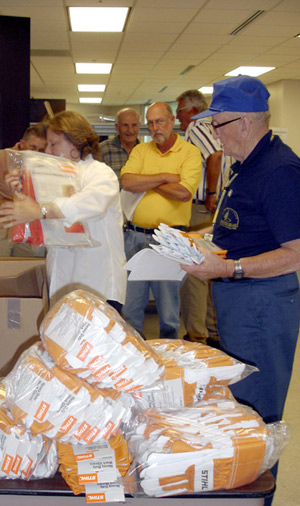 Volunteer Disaster Relief units receive supplies for the coming hurricane season.
In an unprecedented meeting, all area disaster relief heads, known as “blue hats,” gathered to discuss ways to better ready the more than 80 teams scattered throughout the state.
“There is always concern that our unit leaders are doing things in the same way, that we are using the same protocol,” said Cliff Satterwhite, director of disaster relief in South Carolina.
Citing the consistency of State Emergency Preparedness drills, Satterwhite noted that the interest in assisting the victims of Hurricane Katrina led to a growing concern nationally that all volunteers were well trained and ready for any impending disaster. He pointed to the readiness and constant retraining of state law enforcement and other emergency personnel as examples.
“We had a lot of people who gave of their time and meant well, but didn’t follow all of the safety procedures,” he said.
In a simulated hurricane “Judi,” blue hats from more than 50 of South Carolina’s 80 units received training on media relations, onsite communication tools and standard operating protocol. Attendees also received a feel for the daily operations of the state command post.
In order to ensure that all teams possess the appropriate and functioning safety gear, every unit present at the training received an unanticipated gift of new equipment. In December, South Carolina disaster relief received a $1 million gift from an anonymous donor, which was used to purchase a supply of Bibles and evangelistic tracts for each unit. Chain-saw units also received much-needed chaps, work gloves and hard hats. Feeding teams received industrial-size can openers. Normally, units are responsible for purchasing the appropriate equipment.
“Disaster relief is such an entr?e to the gospel, and, first and foremost, the donor wanted to be sure all teams were equipped to lead people to Christ,” noted Satterwhite.
An additional Red Cross training opportunity was offered for large- to medium-size churches up to 70 miles from the coast encouraging and equipping churches to become shelters for the displaced during a disaster. Representatives learned the basic needs and requirements for approved Red Cross shelters.
With interest in disaster relief at an all-time high, Satterwhite is encouraged by the shape of South Carolina’s units, which he partly credits to the “reciprocal nature” of the ministry.
“I can point to almost every unit in the state that has formed because something has happened in their community. There has been something that has brought people up and caused them to say, ‘I can do that.'”
Still, Satterwhite cautioned that all volunteers should be retrained every two to three years to ensure that all units are fully prepared for the unknown.
When asked if South Carolina disaster relief was ready for this hurricane season, Satterwhite optimistically responded, “We are more ready than we would be if we did not try to be.”