
Villagers stand in a small huddle around a stack of 50-kilogram bags of rice, speaking the Tamashek language in heated tones.
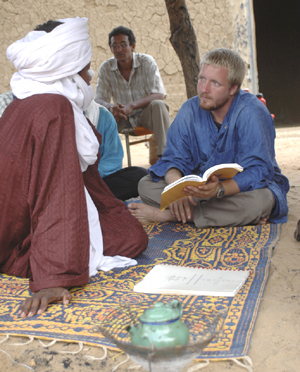 Journeyman Nate Gunter strikes up a conversation with a Tuareg man in Niger. In keeping with African culture, Gunter spends many afternoons drinking tea and talking with other villagers.
“This is the hardest part,” says Nate Gunter, a journeyman missionary working in Bankilare, Niger. “They’re saying it’s just not enough.”
After working among the Tuareg people group in the bush village of Bankilare for two years, Gunter says he became accustomed to people begging for food, medicine and money. But it wasn’t until he returned from a three-week conference in July 2005 that Gunter says he realized the despondency of the situation.
“I started asking around town and found out that some people out in the bush encampment areas had already died from hunger,” Gunter says. “Many were sick. Many had been eating grass for a couple of months and had developed sicknesses related to nutrition. It was at that point I came back to Niamey and met with my supervisors and said, ‘We need to do something about this.'”
Answering the call
During his senior year at Hannibal-LaGrange College in Hannibal, Mo., Gunter struggled with the decision of how to use his college degree. While juggling the demands of classes, ministry and work, Gunter says he contemplated everything from church work, to seminary, to military service.
“The more I prayed about it and sought God’s heart, the more He made it clear He was not going to close any of the doors, but was going to ask me to just look to Him and follow Him through the right one,” Gunter says.
As he considered his options, Gunter says he kept returning to the IMB’s Journeyman Program, which allows 20-something singles with a bachelor’s degree to serve a two-year term in overseas missions. As he continued to pray about his decision, Gunter says God began to lay the black Tamashek people on his heart.
Commonly recognized as the “slave class” of the Tuareg people, the black Tamashek stood out to Gunter as a welcoming, unassuming people.
“Their culture definitely prizes relationships with friends and with family far above materialistic things, advancing their social status, anything like that,” Gunter says.
As a result of the changing political and cultural climate of the Tuareg people group over the past 50 years, Gunter says he believes now is the opportune time to evangelize them.
Feeding the hungry
Faced with the devastating effects of hunger in Bankilare in July 2005, Gunter journeyed to Niamey to speak with Warren and Sharon Hessling, strategy coordinators for the Tuareg team, about the necessity of a hunger relief program in the village.

They came up with a plan to distribute 30 metric tons of rice in 25-kilogram portions to families in and around Bankilare. Gunter worked with his supervisors to begin a program involving registration cards and receipts.
“There’s no way we can preach to people when they’re starving,” Warren Hessling says. “I’m sure we can’t solve all the problems of poverty in the world, but we have to deal with those right in front of us, as much as we are able at least.”
To meet both the spiritual and physical needs of those living in the Bankilare area, Gunter and Hessling arranged for a Tuareg Christian to minister to those receiving the rice during the distributions.
Mohammed, a local Tuareg pastor from the city of Niamey, frequently spoke with villagers who came to receive rice. He says the distribution was important to get people’s attention so he could call them to Christ.
Though Bankilare villagers typically experience a “hungry season” between the months of August and October, Gunter attributes much of the 2005 famine to an invasion of desert locusts. Two weeks before the 2004 harvest, he sat outside his mud-brick hut in Bankilare and watched a swarm of locusts devastate Bankilare’s millet crop.
With the lingering effects of no harvest in 2004, the 2005 “hungry season” hit hard.
But that need for food brought hundreds of people in for the rice distributions – hundreds who heard the gospel for the first time. And Gunter was able to lead Moussa*, a Bankilare storekeeper, to Christ through his relief efforts.
At first, Moussa disagreed with Gunter about who should receive the rice and returned home, resolving never to speak to him again.
“Afterward, I had a dream, and in the dream a man said to me ‘I am Jesus. I ask you to hold Nate’s hand,'” Moussa says.
When he awoke, he prayed that Gunter would visit him.
“When Nate came and I explained to him what happened, I was at peace with him,” Moussa says. “That is when I found myself at peace with Christ.”
Looking back on the distribution, Gunter says he now can see how God used the project to further the gospel.
“It’s come quickly and it’s gone quickly,” Gunter says. “But I feel we’ve done a lot of good, and we’ve definitely been able to open several doors, I think, for future gospel ministry opportunities in the area.”
*Name changed for security reasons.
Editor’s note: Nate Gunter completed his?two-year journeyman service at the end of 2005.?The West Africa missionary teams need more young men to help take the gospel to the peoples of their region. To find out how you can serve, visit GoWestAfrica.org.