
When Paul Bateman, an usher at Earle Street Baptist Church in Greenville, befriended a church member who sat by herself on the back pew, he had no idea of the ministry that would come from his display of kindness.
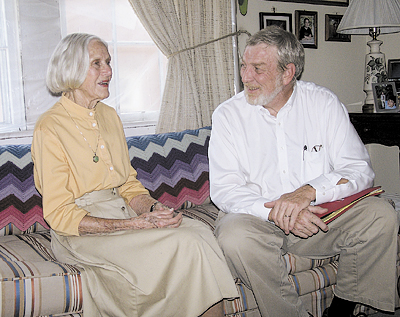 Bateman and church member Vivian Morris discuss health issues during his visit to her home.
When she did not show up for several Sundays, Paul contacted her to see if anything was wrong. When he discovered that she had been sick with no one to care for her, Paul became frustrated. “I said to myself, ‘This has to stop. This is not acceptable for a church community.'”
Paul had been an emergency trauma nurse for 27 years before quitting the nursing profession to work for an in-home healthcare company. Because of his medical background, Paul suggested that his church become involved in a ministry known as Parish Nursing, also referred to as Faith Community Nursing.
Like Paul, many concerned health workers in churches across the nation have established Parish Nursing ministries within their church congregations.
Parish Nursing is not just a “good samaritan program,” but is a nursing practice sanctioned under the American Nurses Association. Records of all calls and assessments must be maintained, and just as any other healthcare practice, confidentiality must be maintained.
The FCN handbook says, “The faith community nurse is knowledgeable in two areas: professional nursing and spiritual care.”
While this is a healthcare practice, parish nursing is not an invasive practice. “If there was a diabetic who couldn’t give himself his shots everyday, I could not give him a shot,” Paul explained. “However, I could assess his condition and give him advice on in-home medical assistance.”
FCN is based on the spiritual aspect, focusing on wellness, rather than diagnosis.
Paul believes that “people need four kinds of upkeep: physical, psychological, social, and emotional.” All four areas must be maintained. If only one of those (say, the physical) is addressed or if only one is not addressed (say the spiritual), then wellness is not being promoted.
“The good thing about this program is that these nurses are able to pray with as well as care for their congregations.”
Perhaps one of the biggest obstacles the nurses in FCN face is actually finding people to help. It is imperative to convince the congregation that the Parish Nursing program is not just a volunteer group, but a professional practice. On average, Paul receives three calls a month from his congregation.
The next obstacle is finding people to help with the program. When asked how many people are involved in the Parish Nursing program at Earle Street Baptist, Paul laughed, “Me.”
However, the more healthcare officials involved, the better, since they are each able to contribute their individual expertise to better serve their congregations.
Parish nurses’ responsibilities range from simply being available for those in their congregations who are suffering, to researching for insurance companies, educating and advising their congregations as well as explaining the medical field.
Paul has realized over the years that “the problem with modern medical assistance is that there is so much out there that lay people drown in the amount. They may suffer for years with a disease or disability because they have no idea how to receive help with it.” Faith community nurses help their congregation find the correct healthcare assistance that they need.
Though the congregation is first on their list of people to serve, the Parish Nursing program can also offer their service to the surrounding communities. Parish Nursing can be used as a broad evangelistic tool. Some Baptist churches in South Carolina use their health program to reach out to the community.
B.J. Burns, the health ministry advisor of Holly Ridge Baptist Church, Simpsonville plans to conduct a health fair for the community, offering free blood pressure screenings. She also stocks the back of the church with magazines promoting health among the congregation.
Martha Bridges, the director of the health ministry at Simpsonville First Baptist, sets up a blood pressure station in one of the back Sunday school rooms for any one who is interested. She has also helped to compile a directory of the healthcare professionals in their church to hand out to interested people.
Other churches stock health closets filled with items such as wheelchairs, crutches, and other helpful items that people have donated.
At the June Parish Nursing meeting for the Greenville area, the topics of discussion were senior companionship outreach, as well as the possibility of purchasing automated external defibrillators for their churches. Within the Parish Nursing program, there are always new possibilities for ways to promote wellness among the people they serve.
In the end, Paul Bateman and all other parish nurses are simply servants taking time from their busy lives to advance the wellness that Christ himself promoted.
If your church would like more information on how to begin its own Parish Nursing ministry, look on parishnurses.org or seek the assistance of a church in your community who already has a Parish Nursing program established.