
About a year and a half after Hurricane Katrina, in March of this year, I was enjoying my morning pre-work ritual of drinking coffee while reading the newspaper at the kitchen table with my husband. I read an article about the forgotten in neighborhoods around New Orleans that still were not rebuilt or cleared. I began to cry right there at the table.
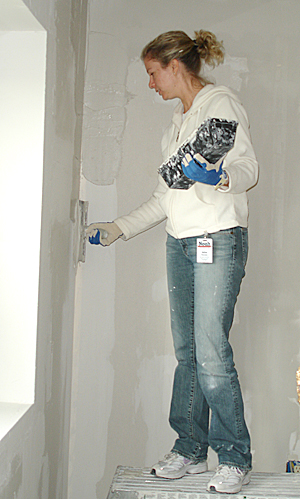 As a participant in Operation Noah Rebuild, Allie Osman does mudding in a New Orleans house.
Wiping my eyes, I thought, “Who am I to be upset and angry when I’m not doing anything to help?” God’s clear and certain voice entered my thoughts and said, “Well, do something instead of just feeling something.”
I made a commitment to God that I would try to take action and obey his command, and I asked him to show me how because I didn’t have any connections or resources in New Orleans.
That morning at work, I chatted with a co-worker and found out that her husband Michael was in New Orleans on a mission trip with a group from Summerville Baptist Church. They were helping to rebuild homes as part of Operation Noah Rebuild, a project in partnership with the North American Mission Board.
My jaw dropped, literally, and I just stared at her for a few seconds before I regained my composure. I was surprised by how quickly God had responded to my request. I researched Noah, found out that Michael’s group planned to do a return trip in October, and signed up to go with them.
I prayed for God to prepare me for the trip, to give me the emotional, mental, physical and spiritual strength to do his work. I knew that God was going to use this trip to teach me, to shape me, to help me become more like he wants me to be. I anxiously anticipated his hands at work.
As we approached New Orleans on Interstate 10, the first thing I noticed was the dead, barren, broken stalks that used to be trees lining the highway on either side. Nature is so resilient, it shocked me to see this fatality more than two years after Katrina. What must it have looked like immediately after the storm?
After checking into the converted church where we would be sleeping, I went for a walk with the two other ladies in our group. We explored the neighborhood called Violet that is adjacent to the church. It is still difficult to wrap my mind around the living conditions. Most of the small brick homes are deserted. You can tell because the windows are broken open and all that can be seen inside is darkness. They have been gutted to remove the rot from the flood. A few homes are in various stages of reconstruction, but they are flanked by houses one has to assume will never be lived in again. Some families live in small trailers parked in their driveways.
We met a lady who appeared to be in her late 60s. She sat in her driveway on a hard-back chair, next to the trailer she’d been living in for years, her damaged house as her backdrop. The lady exuded resilience and endurance. She smiled as we spoke about lighthearted topics. She slapped her knee, threw her head back and laughed out loud, telling us about Fats Domino and where his house was located.
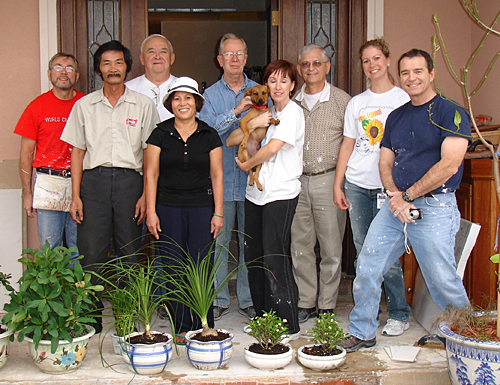 This team, which was about half of the Summerville group, is pictured with the owners of the home that was rebuilt during the Operation Noah Rebuild project.
The next morning, we set out for our worksite for a full day’s work. I was surprised to see groups of children standing on the street corners. Amid all this devastation, they waited for the school bus as if their surroundings were normal and their lives were usual.
The couple whose house we worked on came to America from Vietnam 30 years ago. The husband works for Mrs. Smith’s and the wife raises plants to sell. I grew to know the wife, Tanya, more as the week went on. She kept house in the trailer and ventured out to tend to her plants and her yard, and to tend to us. I got the impression that because she had lost her worldly possessions to a disaster that was out of her control, and she was not in control of the time line for when she could move back into her house with her family and reestablish a sense of normalcy in her life, she maintained a sense of control and appreciation of life through meticulously caring for her hundreds of plants. Her appreciation for the work we were doing at her house was tangible. Each and every day, she brought us delicious Vietnamese food for lunch. She saw us serving her and wanted to serve us back. She saw the gift of time, energy and some household items we were giving to her, and she wanted to give to us. At the end of the week, she gave us plants from her collection as gifts of thanks. Her generosity was so much a part of her character that she wanted to bless us by sharing with us the only things she could: her food and her plants that were prepared and raised with love.
The last thing that our team did at the house was to prayerwalk through each room, praying for each of the family members and their guests who would spend time there. This act was the perfect culmination to the work that we had finished in the house that is on its way back to being a home.
I find myself recalling a verse that I saw written on a piece of paper and tacked to a wooden beam at the Noah supply warehouse. Matthew 25:40 says, “The King will reply, ‘I tell you the truth, whatever you did for one of the least of these brothers of mine, you did for me.’ ” We are all connected, no matter how far apart we live or how different we may seem at first glance. We need to concentrate on our similarities, not our differences. We need to show each other love and serve one another, for we are all in need of love and service from others.
Osman is director of university relations at Charleston Southern University.