
There’s a non-glitzy side to Miami you’ll never see depicted on “CSI: Miami.” Sure, there’s the flaunted wealth, the big beachfront homes, the flashy cars, the fast boats, and glamorous life in the fast lane for the celebrities and superstar athletes who live there.
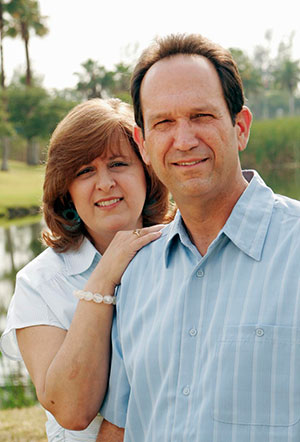 Husband-wife team Al and Noemi Fernandez
But Miami is a city of paradoxical extremes. While the city has been ranked the third richest in the United States, it also has more citizens – about a third of the population – below the federal poverty line than any other U.S. city, except Detroit and El Paso, Tex. Miami is the seventh largest metro area in the U.S., with more than 5.4 million people.
The son of Cuban immigrants, Southern Baptist missionary Al Fernandez, 50, loves Miami as only a man born and raised there could. As a native, he witnessed the start of the influx of Cubans, Latinos and other Hispanics into Miami in the early 1960s.
Fernandez’s parents were already planting churches in the Miami area when Cubans began flooding into Miami to escape the Marxist dictatorship of Fidel Castro. Fernandez accepted Christ when he was 6, and felt called to the ministry at 15.
“But it took me 15 more years to let go and allow God to work in my life,” he said. “I’ve been here all my life, grew up Southern Baptist, and I feel this is the place where God has called me to be.”
Fernandez is married to Noemi, a Cuban by birth. They have two sons and a daughter. As director of the Florida Baptist Convention’s “Urban Impact Ministries” in Miami, Fernandez is one of some 5,500 missionaries in the United States, Canada and their territories supported by the Annie Armstrong Easter Offering for North American Missions.
“Urban Impact was established three years ago,” Fernandez says. “We felt there was a need to establish a stronger Southern Baptist presence in South Florida. We want to impact Miami with the gospel of Jesus Christ.”
Fernandez has three distinct areas of responsibility: urban church planting, urban leadership development, and urban evangelism.
Bilingual, Fernandez believes God has uniquely equipped him to minister in South Florida. “I grew up in Spanish-speaking churches so I understand the context. I’ve also pastored in English-speaking churches. It’s like God has allowed me to be a bridge across the different cultures and nationalities in Miami.”
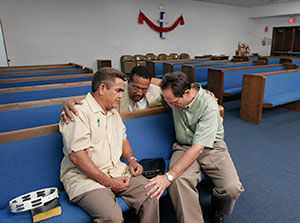 Fernandez, right, prays with fellow Miami-area Southern Baptist pastors Obed Matos, left, and Tommy Milton at Glendale Baptist Church, Miami.
Miami has the largest Spanish-speaking population in the Western Hemisphere outside Latin America. One might think that would make Fernandez’s job easier, but language doesn’t tell the whole story.
“The number one challenge is Miami’s diversity and multiculturalism,” he said, stressing that not all Hispanics are alike because they come to Miami from different nations – Cuba, Mexico, Puerto Rico, Venezuela, etc. “Hispanics from different countries may all speak Spanish but still have different customs, traditions and cultures.
“We need a sense of unity and cooperation within our churches and associations,” he said. And we need each other, because it doesn’t matter how large a church is in Miami, no one church can reach all the people in this environment. We have to work together.”
Another reason for Miami-area churches to come together – especially in today’s gloomy economic recession – is money and resources, according to Fernandez.
“Miami is a city of ‘haves’ and ‘have-nots.’ You see the entertainers and the athletes who live here, yet you’ve got average people who have to work hard every day in their jobs just to survive. These dynamics make it hard to minister here,” he said.
Fernandez believes that Miami’s continued growth in Hispanic population and culture foreshadows the way the United States will look in the future.
“What you see in Miami today is what you’re going to see in the rest of this nation in the next 20 years. I think as Southern Baptists, we need to change our strategies and understand that in the future, we need to know how to minister and be effective in these large urban settings.
“The reality of these ministries is that they cost money. And one size ministry does not fit all. We need a lot of resources to do the work of the Lord in South Florida.”