
The guy in the flashy boat whips his arm forward, casting the sun-glistened lure through the spring air with a whistling sound. The lure splashes among the cattails lining the shallow banks of the lake. As the line is reeled in slowly, there’s the unmistakable jerk and a seven-pound bass explodes out of the water, ready for battle.
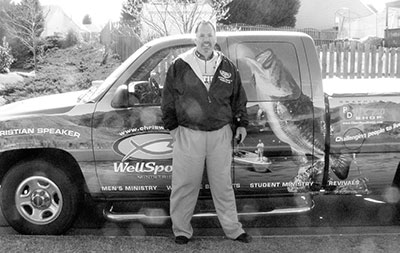 Chris Wells, a North American Mission Board Mission Service Corps missionary, serves as chaplain for the Bassmaster Elite Series, traveling to tournaments in his colorful pickup.
A seemingly idyllic life on the surface, the professional bass fisherman’s life is rife with pressure and temptation.
For every big-name pro like Kevin VanDam, Bill Dance or Roland Martin, plenty of guys finish out of the money or barely make enough to squeak by. Addictions, issues with families and lonely lives also are common for an angler on the road.
Chris Wells sees it all.
Wells, 42, grew up in Summerton, near the Santee Cooper Reservoir, about an hour from Columbia. With a dad and brother who loved fishing, he had a bait-casting reel at age 6. His boyhood heroes were bass pros, not pro baseball or football players. Young Chris fine-tuned his fishing skills reading Bassmaster magazine and watching the Saturday fishing shows on TV.
As a student at Francis Marion College in Florence, Wells gave his life to Christ one night under a pecan tree. Today, he is a popular speaker, evangelist and chaplain on the Bassmaster Elite Series tournament trail for the Fellowship of Christian Anglers Society.
“I’ve never fished professionally and don’t now,” Wells said. “Bassmaster wanted a chaplain who knew competitive fishing but was not a competitor. The Bassmaster tour guys didn’t think the pros would open up to another competitor.”
Being a Bassmaster chaplain is just like pastoring a church, said Wells, who has studied toward an M.Div. degree first at Southwestern Baptist Theological Seminary and now at Liberty University in Virginia.
“They come to me with some tough problems. At a recent tournament at Lake Amistad in Del Rio, Tex., one of the pros got a call that his dad had just died. He didn’t know what to do. If he chose to go home right then, he wouldn’t get any points for the tournament and wouldn’t make any money for his family. It was a tough call.”
And just like the pastor of a church, Wells has to minister to all kinds of guys – some wildly successful, rich and famous, others not so much. Some anglers need counseling for addictions to alcohol or pornography or for a struggling marriage.
“Some of the guys are millionaires,” Wells said. “When you go into Walmart, you see their faces on packages of fishing lures – Then you have the guys who are eating peanut butter, sleeping in tents in campgrounds, trying to earn enough just to cover expenses and get to the next event.”
Professional anglers earn everything they get and laugh when they hear of the pressures on pros in other sports, such as NASCAR or golf, Wells said.
“Pressure is when there are only 10 minutes left in the tournament and you have to catch a five-pounder to earn enough money to get back home. The last-place golfer still gets a $25,000 check. The last-place pro fisherman goes home with nothing.”
Wells said the Bassmaster “season” normally includes 13 tournaments, but because of the down economy, there will be only eight tournaments in 2009. Practice days are Mondays through Wednesdays, with 101 pros opening each tournament on a Thursday. That field is cut back to 50 and then to only a dozen the last day.
“Only the top 50 get paid,” Wells said. “This year, there will be only eight chances to win. While the winner of a Bassmaster tournament wins $100,000 and the next top 49 fishermen in a tournament win from $10,000-$25,000, 51 guys go home with nothing.” All Bassmaster contestants must pay a $5,000 entry fee per tournament and cover expenses related to their boat, lodging and travel.
“A lot of people think bass fishing is all about luck,” Wells said. “It’s all about giftedness, not just luck. I could practice my golf swing 14 hours a day but would never be a Tiger Woods.”
As a self-funded Mission Service Corps missionary with the North American Mission Board, Wells (www.chriswells.org) raises his own support for Wellspoken Ministries, a ministry he founded in 2004.
“I try to catch the guys in casual situations when they’re going out on the lake or coming off,” Wells said. “I do servant evangelism and try to build relationships with them.”
Wells also leads Bible studies the Wednesday night before a bass tournament begins. At the first 2009 tournament at Lake Amistad in March, he spoke to both pros and tournament marshals. Nine prayed to receive Christ, he said.
“I always tell stories to get the guys hooked. Faith comes by hearing. I just don’t preach to them,” he said, adding that he typically works in the sinner’s prayer.
This summer, the North American Mission Board has signed Wells to speak at four World Changers events and one Power Plant event. Aimed at students, Power Plant is a church-planting initiative for young people, while World Changer participants gather in cities to repair and renovate housing in low-income neighborhoods.
Reflecting his hectic schedule, Wells recently left a Tuesday night preaching commitment in South Carolina, climbed into his colorful, bass-and-logo “wrapped” GMC pickup truck and began the 14-hour journey to yet another pro bass tournament – this one at Lake Dardanelle in Arkansas.
Wells and Pam, his wife of 14 years, live in Greer with their sons, Stephen, 10, and Wesley, 6. They are members of Brushy Creek Baptist Church, Taylors, where Wells has served as a student pastor and minister of evangelism.
Noah is a writer for the North American Mission Board.