
Q: “Simply adjust” became one of your mottos in India. What meaning does that have for you now?
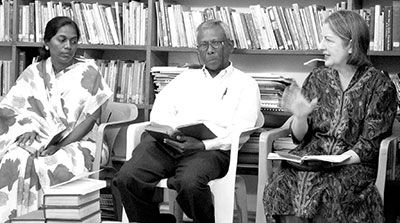 Anthony Jacob, a pastor in India, and Sagaya Mary, a cook at the Indian Baptist Society, listen as Rebekah Naylor speaks at a Bible study in Bangalore, India. The former South Carolinian retired in February after 35 years as a missionary physician with the Southern Baptist International Mission Board.
NAYLOR: I believe “simply adjust” will stay applicable forever. When I cannot do the things I want to do or had planned – such as my recent trip to India that was cancelled – I need to simply adjust. I am still very bicultural and do things that are more Indian than American. So in that, also I must simply adjust. Changes go on around us – political, IMB, life situations, stages of life. Simply adjust.
Q: What is God doing at Bangalore Baptist Hospital and in south Asia now that is fresh and new in your mind?
NAYLOR: Two or three things stand out. Most exciting is the great response to the gospel that we are seeing in south Asia. I never dreamed that I would get to see this, and I feel so privileged. Second, I am encouraged by the number of workers engaging the peoples of south Asia. And I am so thrilled and gratified when I see strong national leadership carrying on the ministries in a great way.
Q: Think back to your first day in India in 1974. What sticks with you still about that day?
NAYLOR: I was stuck for two days alone in Madras, which is now called Chennai. I guess the best word to summarize the feelings was fear. That and feeling so alone and out of touch was quite an introduction. It took more than four hours just to call Bangalore. There was no way to communicate. The trains were on strike. The tiny puddle-jumper planes that left twice a day were full. Welcome to India.
Q: For a few years, you were the only Foreign Mission Board missionary serving in a country approaching 1 billion people. What was that like, and how is it different now in your eyes?
NAYLOR: You miss being with people of your own culture. An example is that Indians do not touch and they do not hug like we do. I missed physical touch. I focused on my work and the individuals whom I helped physically and spiritually to be whole. If I thought about all of India and me being one person, it would have been overwhelming. I also claimed God’s promise that his resources are enough. He has a plan for a way that all the peoples of India could hear about Jesus.
Q: You are a breast cancer survivor. How is your health and how has this impacted your life, ministry and approach to medicine?
NAYLOR: My disease was at a very early stage, and I was fortunate. Nonetheless, the “cancer” word really gets your attention. Though cure is expected, there is that small percent that might not be – even with early-stage disease. So I suppose that somewhere in my mind will be that question and a little apprehension before each checkup.
Certainly I learned much about being a patient, and this makes me more caring and sensitive as a doctor. I also was reminded about the need for good stewardship in every aspect of my life. And I have been able to help several friends and colleagues facing similar problems, not as their doctor but as a friend who has walked that way before.
Q: Your biography lists the myriad successes and accomplishments you have had, but also many of the trials. You were burned in effigy over labor union disputes. You went to court over those allegations and were cleared. India denied your medical license. Visa problems stretched out for years. There were frequent power, water, furniture, rodent, snake and relational issues. You had many days where many might have considered quitting. How did you keep from jumping on a plane and washing your hands of this place during those times?
NAYLOR: The answer to this lies entirely in the call, in God’s clear direction, about what I was to do. Absolutely there were times that I not only wanted to quit, but I actually thought maybe God was directing me to do so. But as I trusted him completely with my life and future, he always gave direction.
Back in 1991, with no license for many weeks and unsure what work I was to do, I actually came home on vacation and went for a job interview at UT Southwestern. In the middle of the interview, it was so clear to me that I was supposed to be in India. I told the man in the middle of it that I was no longer interested in a job.
I also learned that I was accountable for each day – for the opportunities and responsibilities and work of that day. I did not know what the future was, how long I would be in India, or what was going to happen to my parents in America. I learned just to leave all that with God and remember my daily accountability for what he placed there for me to do. Staying grounded in Bible study and prayer was surely an essential part of this.