
At a church cleanup day, a member of the property team approached Berkeley Baptist Church pastor Henry Simmons with a problem: The church had several crape myrtles that were a nuisance because it was difficult for mowers to navigate around.
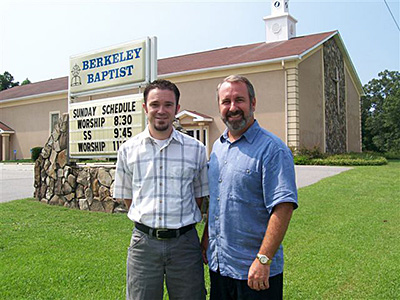 Berkeley Baptist Church youth pastor Matt DesAutels (left) and pastor Henry Simmons.
“They asked me if it would be okay to move the crape myrtles,” Simmons said. “I told them most of their team was on site working and they should get with the chairman and make a decision. They came back and said the team was in agreement to move the trees.
“It didn’t involve three committees or a church vote. It was effective and efficient.”
It’s a simple story that casts a light on the disciple-making and empowerment ministry occurring at the church, located in Moncks Corner, Screven Baptist Association. Since 2000, the church has changed its methods, empowering people to do what God has called them to do. It’s a shift from recruiting volunteers for a buffet of ministry programs.
“I am a process guy much like a minister of education,” said Simmons. “At the start of my ministry, I was sold on Southern Baptist church structure and the way our programs are supposed to work. We did okay with that here, but in smaller membership churches the programs can be overwhelming. Smaller membership churches just don’t have the manpower to do everything and to do everything well. It was on my heart to change our methodology and to try different ways of doing things.”
Berkeley joined with First Baptist Church, Moncks Corner, and took its key leaders through the two-to-three-year T-Net process. T-Net is a Colorado-based ministry that, for more than decade, has guided churches in developing their own definition of a disciple.
Out of the T-Net experience, Simmons led Berkeley to try some new things. “In 2000, we decided to have no set structure or way to do anything,” he said. “We just kept trying new things.”
The church changed its method for ministry. A “disciple team” replaced the former church council. Members of the disciple team, appointed by Simmons and approved by the deacons, didn’t represent programs, but instead represented biblical mandates to worship, witness, teach and minister. Representatives from preschool, children, and youth ministries were added to the team, as was the deacon chairman. Simmons served as team leader.
“Instead of a Sunday school director,” Simmons said, “we now had a teaching leader. It started to free us from some of the programs and methods and gave us a lot more flexibility. We weren’t free from biblical mandates, but we were free from particular programs.”
The disciple team, and its teams of work, like the one for buildings and grounds, was given authority to make decisions without a church vote. “We have church votes on major strategy and purchases, but day-to-day decisions are made by the team, and we trust them,” Simmons said, pointing out that every church leader is accountable to someone. (Simmons is accountable to the deacons.)
“We tested this method in 2000 with four other changes, including using Wednesday as a night to reach out to others,” he said. “At the end of the year, the church voted overwhelmingly to accept the changes.”
Simmons said the church is closely aligned with the “Baptist Faith & Message,” but “has stepped out of the box” with organization and structure. “We set aside ministries where no one has stepped up to serve, and we lift up ministries where people are called by God to serve.”
The structure has been fruitful. “The fruit has been more about quality than quantity,” Simmons said, “but the quality of our ministry has been sky high. Before, our key leaders were weary. Now leaders are in positions where they are sincere, excited about their call. I just try not to get in God’s way.”
Bobby Bailey, director of missions for Screven Association, said there are key elements to the success of Berkeley Baptist Church. “First, there is the element of strong pastoral leadership,” he said, noting that Simmons has served as pastor of Berkeley for 19 years and has earned the trust of the church.
“Second, the high quality of ministry was determined by putting new leaders in places of service based upon their spiritual gifts,” he said. “They were not serving out of obligation to the church, but out of a sense of calling and empowerment by God.
“Third, there is a sense of accountability,” Bailey said. “Each leader is expected to do the work of ministry to which they have been called and empowered.”
“The results are an excitement among leaders as they impact their community,” Bailey said. “Effective friendship evangelism is taking place as the membership is reaching outside into their community with the gospel.” – SCBC