
Audrey Butkus remembers being intimidated the first time she met Roy Larsen. Under the circumstances, her feelings were justified.
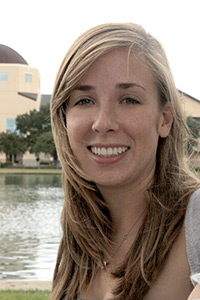 Audrey Butkus
Butkus was a high school freshman in Glen Ellyn, Ill., a “small, Christian, Pleasantville kind of town,” when she joined her high school Key Club. The decision was purely social. Her experience took a left turn at the club’s first Kiwanis meeting, a required part of the service.
Butkus entered a dimly lit old restaurant and looked across the dining room. “It was all these World War II veterans in their Kiwanis hats singing patriotic songs with their wives,” she said. High school freshmen and WWII vets in the same room – not cool, thought the members of teenage Key Club group, who quietly tucked themselves into the corner of the room.
The loudest veteran spotted the teenagers and zipped his electric wheelchair between tables and chairs toward them. It was Roy Larsen. A 60-something WWII veteran, wheelchair-bound by a series of strokes, was elbow-to-elbow with the Key Club.
“He was so enthusiastic,” said Butkus. “All the other men were rolling their eyes because he was singing so loud to all the songs. He was singing with such vigor and passion. That was the first time I met Roy.”
Until that chance meeting, Butkus thought she would study law or architecture in college. Over the next three years, Larsen led by example, living out a life of service, making the journey across town regularly to Key Club meetings.
“He had reverence and personality,” said Butkus. “He was so enthusiastic about helping people – always. He never once complained. He’d literally ride his electric wheelchair down the streets in the snow, up a hill to our high school just to get to the meeting. It really put things in perspective for me.”
It was a turning point in her life.
Today, almost a decade after that first experience with Larsen, Butkus serves as the community service coordinator at Charleston Southern University. The position is part of the AmeriCorps Campus Compact program. It’s a new challenge for the University of Illinois-Champaign graduate who didn’t even know a program like AmeriCorps existed until her senior year of college.
AmeriCorps and CSU launched a three-year service partnership this fall, and Butkus has been contracted to build and develop the program from the ground up.
“I chose a campus that has not had a program before because I wanted that challenge,” she said. “Every campus is unique. Here, community service is not a problem. My job is to get people focused. A lot of clubs and organizations do community projects on their own, but as far as doing one big campuswide event, it doesn’t really exist.”
The first campuswide effort is Sleep-Out for the Homeless on Nov. 13. The campus project requires students to sleep outside in cardboard boxes. The event will be held on the disc golf field. Individual students, or teams of students, will be commissioned to raise money for the homeless during the night.
“I’m from Chicago, and a lot of churches in my hometown would do sleep-outs in February,” said Butkus. “That kind of sleep-out is definitely more of a poverty simulation exercise to understand what the homeless go through everyday.”
The project also requires creativity. Teams will be asked to design the box they will sleep in. According to Butkus, students are already at work on concepts including the White House, pirate ships and castles. Judges will then determine the winner of the most creative box. In addition, students and teams will also be required to serve meals and provide counseling and other services at Lowcountry homeless shelters.
Roy Larsen passed away doing what he loved – serving others. “He was helping another woman get her groceries home,” said Butkus. “So, truly, in his final moments he was helping someone else. It was so inspirational.”
By then, Butkus was a high school senior and president of her Key Club. Larsen didn’t see her graduate from high school or college with a degree in urban planning and development. Larsen wasn’t there when she packed her bags for Charleston after accepting an offer as a community service coordinator.
Larsen wasn’t physically there, but his spirit and influence are alive and well. “I always keep him in my mind,” said Butkus. “When I am frustrated with a project, or tired, or uninspired, I think of Roy. He kept going, never complained once, and he had a much harder life than I’ve ever had. He’s my spark, and he keeps feeding the fire.”
She carries his message and delivers it to college students at CSU. “Don’t complain if you’re doing what you’re passionate about,” she said. “Don’t ever give up. Don’t become discouraged.” – CSU