
A child should not go to bed hungry, sick and unsafe, but in Kibera, Kenya, it is the daily norm. Small children roam the dirt alleys with diseases and empty stomachs, facing the real danger of attacks and being raped by thugs and gangs. They are left to forage for scraps of garbage to eat.
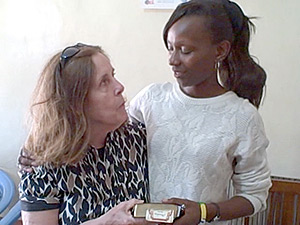 Baxley shares a Bible with Linda Nabongo.
If they have a roof over their heads at night, it is usually a one-room, 10-by-10-foot shack, with an entire family or an assortment of non-related people sharing the space. Most of the places have no electricity or running water. Toilets, in most situations, are wherever a child squats and uses a piece of ground when the need arises.
At one time, Kibera, located in Nairobi, was the largest garbage dump site in Africa. It may no longer be a government dump site, but it is a large landfill where more than a million people live. They search for food, firewood or anything salvageable. I photographed small children digging in mud and raw sewage to get scraps of mud and debris to mix with charcoal to make it go further so they could sell it on the streets.
In the midst of this despair and heartbreak, there is a place of refuge for a small number of children who have been rescued and given an opportunity for an education and a meager meal each day. It is the Soweta Academy and Revival Medical Clinic, founded by pastor Chris Okumu and his wife Joan. He graduated from Nairobi seminary and could have taken a nice church, but God led him to the largest slum in Africa.
They took a swampy, sewage-infested area by a rocky hillside and turned it into hope for thousands of children. They used rocks to build a school and small medical clinic. They started the academy in 1988 with three students. Many of the early students went on to get degrees and came back to teach and help the children of Kibera.
Nobody in Kenya thought the students would do well, but they had 18 students take national exams in 1999, and all passed and went on to get advanced educations. Each year the number has increased, and now all of Kenya knows that the students are excelling. They have blackboards and posters on the walls from which to learn. Pencils, papers and books are in short supply. Memorizing is their best way to learn.
The kitchen will accommodate only a few at a time, so they sit on the ground outside to eat a sandwich or bowl of rice. A large bag of rice costs around $37 and will feed a few hundred children one meal. There are about 1,500 students on the three campuses.
Seventy-five percent of the people of Kibera are estimated to have AIDS. Educating the girls is crucial to changing the mindset and ending the spread of the disease. Medicines are badly needed at the clinic. Babies are delivered at the clinic, but many die from disease and lack of sanitation. Dr. Gilbert Makokha was grateful for the medical supplies we delivered, but so much more is needed.
I will return to Kenya soon. Together we can make a difference in our neighborhoods, and for me that includes my neighbors here and around the world.
– Baxley, a member of Rose Hill Baptist Church in Georgetown, is a Red Cross volunteer and a public information officer volunteer with the South Carolina Baptist Disaster Relief medical team. She can be contacted at mjgkb@aol.com.