
A 10-member South Carolina Disaster Relief (SCDR) medical team will travel to Haiti Feb. 3 to assist earthquake victims, and South Carolina is preparing for a possible influx of injured or orphaned Haitians.
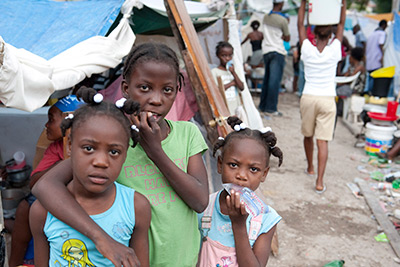 Relief officials estimate perhaps 1 million children lost at least one parent in the Jan. 12 Haiti earthquake.
The South Carolina medical team will join groups from Mississippi, Kentucky and Florida in the first wave of an on-the-ground response from Southern Baptists.
The SCDR team will consist of three doctors, four nurses, a pharmacist and two support persons, including team leader Eddie Pettit, the FEMA-designated incident commander for SCDR and manager for the South Carolina Baptist Convention’s McCall RA Camp.
Pettit and his team will fly into the Dominican Republic on Feb. 3 and travel overland into Haiti the following day. The airport in the capital city of Port-au-Prince remains closed, preventing most direct flights to the island.
“We expect to see lots of infections, broken limbs, disease and dehydration,” Pettit said. He said he doesn’t know if his team will be setting up operations in a building or under a tent – or “under a shade tree.”
The SCDR medical team was formed three years ago as an expansion of the ministry of South Carolina Disaster Relief. This will be the team’s first deployment outside the country, Pettit said. The South Carolina team will return Feb. 11, but Pettit said it will be the first of many SCDR teams that will travel to the ravaged Caribbean island in the months to come.
Pettit said his and future SCDR teams will work with the 842 churches in Haiti that partner with the Florida Baptist Convention, which has been heavily involved in missions work in Haiti for the last two decades.
As the critically injured and orphaned overwhelm resources in Haiti, victims are being transported to the United States. Cliff Satterwhite, director of the SCBC disaster relief group, said SCDR is partnering with government agencies and will be on call to stage triage units at airports in Greenville, Columbia and Charleston if the need arises. “Florida has taken all the people they can take,” he said.
“We’re talking about the severely ill who cannot recover because there is no hospital space in Haiti,” Satterwhite said. “We’re talking about orphans coming, as well.” As the U.S. and Haitian governments relax adoption regulations, Satterwhite said there are Baptist churches in South Carolina “already set up to help” in the event of an influx of orphaned Haitian children.
Satterwhite said South Carolina Baptists can respond to Haiti immediately in the following ways:
? Visit the Baptist Global Response Web site at http://www.baptistglobalresponse.com/new/, where a bulletin insert can be downloaded from the home page.
? Follow Disaster Relief updates through the SCBC Web site and include Haiti in regular church prayer ministry.
? Register for SCDR training, Friday-Saturday, March 5-6, Anderson University. Those interested in Haiti volunteerism can attend a special, embedded training event on Saturday, March 6, as part of the Disaster Relief training. Online registration is available through the SCBC Web site. Interested volunteers may also call the disaster relief group at 800-723-7242 or 803-765-0030.
? Donations may be mailed to South Carolina Baptist Convention, Disaster Relief Fund, 190 Stoneridge Drive, Columbia, S.C., 29210. Donations may be designated for Haiti, and 100 percent of funds will be used in Haiti relief.