
Don Matthews pointed to a white physician’s coat and an old-fashioned medical bag as he began talking about the South Carolina Baptist Convention’s Church Health Assessment and Mobilization Planning Strategy (CHAMPS).
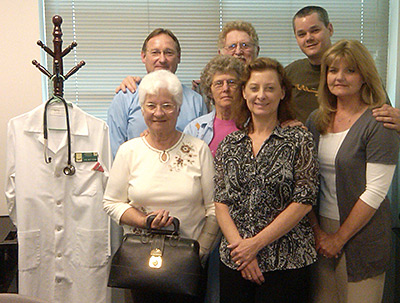 Members of Plum Branch Baptist Church, Abbeville – spiritual internists, of a sort – get acquainted with the basics of assessing their church’s health. Front row, from left: Margaret Dorn, Jean Wells, Karen Willis and Cheryln Pennington. Back: John Noblin (pastor), Bubba Wells and Stan Hyde.
Matthews, director of the SCBC’s church health and revitalization office, said, “When a church contacts our office for assistance, we want that to be like the church is going to the doctor. Sometimes we go to the doctor because there’s an obvious problem, sometimes things just don’t feel right, and sometimes we just want to make sure that everything is okay. The doctor and patient relationship becomes a partnership for good health. That’s what our CHAMPS process is – the state convention and churches serving as partners.”
From a definition at the SCBC website, CHAMPS is an “initiative to assist the local church in its task of fulfilling the Great Commission by focusing on the attributes of a biblical, healthy church.” A healthy church is one that is actively pursuing excellence in the six functions of the church as described in Acts 2:42-47. They are: worship, evangelism, discipleship, prayer, ministry, and fellowship.
The CHAMPS process is designed to help the local church identify the current level of health in each of the six functions. The process is based on providing customized consulting in the areas of prayer (corporate and personal), encouragement (relevant and practical), resources (customized and reproducible), and coaching (mentoring, training, tracking, and the multiplying of leaders).
“The process includes a consultant-led process to determine the attitude, perceptions, and beliefs of the average church member as it relates to the six functions of the church. The church health consultant will work with the pastor, staff, and a church-appointed church health task force to initiate, implement, evaluate, and recommend a church health strategy to assist the church to move to the next level.”
Matthews said CHAMPS is normally a two-month process, but “if a church needs six months or longer to complete it, we want this to be about working with the church’s calendar.” Since it was begun in January 2009, 40 SCBC congregations have completed the process, and 140 are currently engaged.
“Our goal is to improve the long-term health of a church,” Matthews said. “There are, however, many short-term and immediate applications that can affect the growth of the church.”
Northbridge Church, Charleston, began the CHAMPS process in August 2009, and within nine months saw the benefits. “Across the board, our church scored pretty well in the different functions, but within the functions there were some questions that we didn’t answer so well,” said pastor Louis Venable Jr.
“In November we began Friday night discussion sessions. From those conversations, we’ve looked at the different functions and have created 10 goals for each,” he said. “So far we’ve created goals for worship, discipleship and fellowship.”
On a Friday night, as the church discussed its discipleship, Venable said there was a roadblock to getting good turnout on Sunday or Wednesday nights. “Someone suggested that we replace our spring revival with a spring discipleship week,” he said. “It was a great idea. We prayed over the week just like we would for a revival. The first week of May, we brought our people together for eight consecutive nights, and we averaged 158 per night taking seven different courses. I taught a course on ‘How to Study the Bible’ and had 74 attend each night.”
“That’s what this process does for the church – it gets people talking together about specific goals and actions in the church,” Venable said.
Johnny Rumbough, director of missions, Lexington Association, is a consultant in the CHAMPS process and likes that it works toward long-term goals while accomplishing short-term goals along the way.
“For 30 years, I’ve been involved with a lot of planning processes, and this one is the best at leading churches to their future,” Rumbough said. “From day one, it gets the pastor involved and has a high respect for pastoral leadership. That’s important because the pastor needs to be connected to the process for now and the future. Because of the relationship, I believe pastors are more comfortable stepping into it. The pastor knows he’s not going to be surprised.”
“I also like that it doesn’t over-focus on strengths and weaknesses, but just presents both as information,” Rumbough said. “The process doesn’t leave a church with an identification of need; the church is left with ideas for moving forward.”
Is it for every church? “It’s only for the church that is praying about its future and what God wants it to do,” Rumbough said.
Matthews, a certified church consultant, said South Carolina churches receive the benefit of CHAMPS because of the Cooperative Program. “A process like this, working with an independent consultant, could cost a church as much as $10,000. For South Carolina Baptists, this process is provided at no charge because of the Cooperative Program.” – SCBC