
Now is not the time for young pastors to walk away from denominations, but it is the time to ask if denominations are being good stewards of ministry support systems.
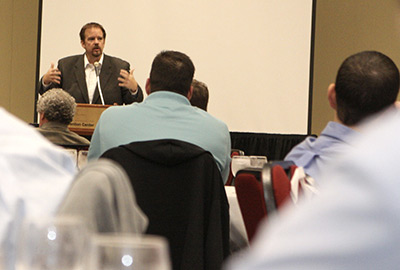 Stetzer delivered the SCBC convention sermon before meeting with a smaller group of young leaders over dinner.
Speaking to about 100 young leaders during a dinner at the South Carolina Baptist Convention, Ed Stetzer, president of LifeWay Research, said, “Don’t be afraid to ask the tough questions, but don’t demonize those with different opinions. Biblically faithful people of all ages and opinions can work together.”
Using a yo-yo as a metaphor, Stetzer referred to the rotating motion of the spool as the forward-moving ministry necessary to advance the Great Commission. He also referred to the yo-yo string as the cooperative denominational system necessary to keep the ball moving.
“It’s okay to talk about the string, but don’t demonize the string,” he said. “You would not do that in your churches. Don’t do it within your denominational family.”
Stetzer affirmed the value of denominations “when they are the tool and not the goal. Denominations are necessary. Jesus gave the Great Commission to the church, but the church can’t do the job it’s been assigned. Your church alone does not have the capacity to complete the mission Jesus told it to do.
“It is not necessary to be in a denomination to be a Christian,” Stetzer said, “but denominations are helpful to Christians. You can’t build a case for denominations in Scripture, but you make a case that cooperation is found in Scripture. I’m a believer in networks, but the heavy lifting is primarily done by denominations. They are our preferred way of partnership, but there is a cost associated with them. And the question is then asked, ‘Are we being good stewards within our denominations?’ “
Stetzer said the answer to the question is no. “We are not being poor stewards, but we are not being the best we can be,” he said. “And seasons like this help us make sure we are being the best we can be. Sure, there is going to be waste, but I don’t know many denominational leaders who are stupid or intentionally wasteful. There are those who have forgotten that they serve churches.”
While exhorting young leaders to stay true to denominations, Stetzer also had a word for older leaders.
“Sadly, we have preached a generation of pastors out of our convention,” he said. “When the contemporary movement began about 20 years ago, pastors began preaching against it. They were preaching against pastors who sat on stools during worship, and they were preaching against pastors who preached in Hawaiian shirts. As a contemporary church planter at that time, I saw what I was doing being attacked from the pulpit by people I was supporting.”
“I want a denomination where old and young are in cooperation together,” Stetzer said. “I stayed in the denomination, but many did not. I just believe we can do more together than we can do alone.”
In today’s church culture, pastors should not over-generalize about the emerging church, nor see the emerging church as inherently liberal in theology, Stetzer said. He also warned about developing caricatures of people, especially surrounding opinions on Calvinism.
“In Southern Baptist life, we tend to caricature people rather than communicate with them,” he said. “If you are so strident in your beliefs, then you should probably go join another team.”
To all leaders he said, “Don’t demean one another. Don’t demean younger pastors, don’t demean older pastors. Our older pastors have sacrificed much and there’s so much we can learn from them.” – SCBC