
Day after day, missionary Clarence Griffin shared the gospel with his Indonesian driver, without success. See what would happen decades later in a showcase of missionary legacy:
“For 25 years, our driver said, ‘No, I cannot, I am Muslim, I cannot do this to my family.’ We retired, we left, our son went back, and the driver came to work for him, and our son led him to the Lord,” says Griffin. “Now that driver wants me to baptize him.”
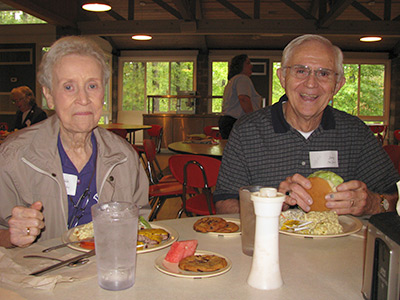 Retired missionaries Erkle and Jerry St. John enjoy lunch at Missionary Day at Camp La Vida on Sept. 22.
Retired North American missionary Jerry St. John, speaking on a different topic altogether, said, “We evaluate too quickly. We need to give things some time.”
Such are the stories – and such is the legacy of missionary zeal – evident at Missionary Day, an informal day of fellowship sponsored by South Carolina Woman’s Missionary Union and held annually at Camp La Vida near Winnsboro. This year’s event was held on a rainy Thursday in late September and attended by more than two dozen retired South Carolina missionaries. They represented more than 500 combined years of service.
The Griffins – Clarence, Ruth and their four sons – spent 36 years in Indonesia. While they officially retired 14 years ago from the International Mission Board, they have returned to Indonesia eight times and to Thailand once, where another of their sons is serving. Recently, Clarence preached at two Indonesian churches in the Atlanta area – ostensibly “to keep up the language skills.”
Jerry and Erkle St. John served for 34 years with the North American Mission Board. In Mississippi, where they worked 11 years, they were first assigned as field workers for ministry to the deaf, which quickly expanded to include ministries to the blind, others with special needs, literacy, and general language ministry.
In South Carolina, Jerry served with the state convention primarily in the area of ethnic new work. The St. Johns are as busy as ever, though Jerry officially retired in 1998. He continues to teach at the Tri-State School of Theology for the Deaf, which he was instrumental in forming in the mid-1990s.
“I teach Old Testament, biblical backgrounds, the writings of John,” he said – out of habit, using his hands to speak. “I just love it.”
Jim Murphy can’t quit, either. After 21 years with NAMB in Anderson, and after seven years with South Carolina WMU, he finally caved in to the continued requests of the Greenwood food bank to serve as their volunteer director. Two moves, one grant, and less than three years later, the food bank has grown exponentially, and is now open five days a week serving countless individuals and food pantries in the area. His wife Irene continues to work part-time with South Carolina WMU in its ministry to youth in the state Department of Juvenile Justice.
In the early 1960s, Richard Kinney was an IRS auditor. The words of Jesus to “render to Caesar what is Caesar’s, and to God what is God’s” kept compelling him, and so he and his wife Daisy applied with the Foreign Mission Board and were assigned to a Bible center in Switzerland. It wasn’t long, however, before Richard returned to auditing – this time for the mission board. Traveling weeks at a time from one mission region to another, the Kinneys served for 21 years, the last three of them in Vienna, Austria.
“This event is really special to us,” said Daisy. “Other states don’t offer such a fellowship. We come every year and feel so embraced and appreciated.”
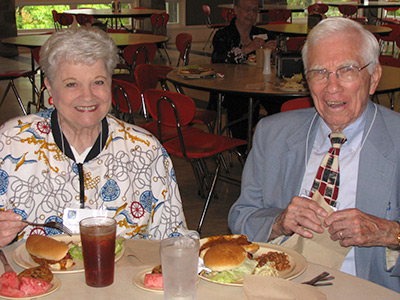 Retired missionaries Kathy and Allen Smith enjoy lunch at Missionary Day at Camp La Vida on Sept. 22.
Kathy and Allen Smith served a combined 35 years on the international mission field – but not exactly together. Kathy and her husband, Dick Henderson, were in Ghana (West Africa) and the Philippines for 10 years. While in the Pacific, they ministered alongside Allen Smith and his wife, who were in the Philippines for 20 years, and in Africa for five years.
Kathy and Dick returned to the States, where Dick passed away. She remarried; her second husband passed away. Kathy moved to Wichita, Kan., to be near her adult daughter. When word reached her that Allen’s wife was critically ill, she sent them an encouraging note. Less than two weeks later, Allen’s wife died, and this time Kathy sent condolences. Thus began a correspondence that ended six months later with a wedding ceremony – Kathy’s third, at nearly 80 years old, and Allen’s second, at 83 years old. She beams when she shares the story of their romance.
After being deployed to the Korean War in the 1950s while serving in the Army, Franklin Harkins swore he’d never go back to that peninsula.
“But God called me exactly there anyway, and I went,” he says, as if the turnaround were as natural as changing clothes. He and his wife Janie, plus five children, moved to what was then still a very pioneer mission field; they had one more child while overseas. The Harkins served in Korea for 31 years.
“I could tell you many stories you wouldn’t believe,” he says. “For instance, there was an island with about 17 churches I was working with, and a lot of people in the community were upset with the Christians because they said we all prayed too early and too loud. A huge fire storm came through, wiping out land and buildings left and right. But when that wall of fire got to the wall of one of our churches, it just plain stopped. Right there. We got a lot more positive attention after that.”
Some of the missionaries attending Missionary Day are natives of South Carolina; some have only retired here. They have two characteristics in common: a love for missions and a near-complete inability to stop serving, wherever they land. – SCBC