
Laurie Register, executive director-treasurer of the South Carolina Woman’s Missionary Union, summed up the general feeling following a Human Exploitation Symposium held in Columbia on Oct. 27:
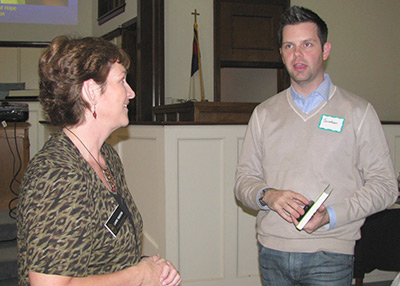 Laurie Register, executive director-treasurer for South Carolina WMU, talks with Jonathan Merritt, founder of the Southern Baptist Climate Initiative, at a symposium held Oct. 27 at Eau Claire Baptist Church in Columbia.
“It’s really beginning to dawn on me just how big this is, how much effort it will take,” she said.
By “it” she was referring specifically to the issue of “natural resources exploitation,” or, put positively, stewardship of the environment. But judging by the comments of other participants, her assessment was representative.
Said Vickie Wilkes, from Woodside Baptist Church in Greenville, “You ask yourself, ‘As a Christian, have we been this blinded?’ We probably push things outside and just don’t deal with them.”
Marcie Malone, from First Baptist Church, Mauldin, echoed her friend. “Our generation doesn’t talk about unpleasant things like this. But we need to.”
The “unpleasant things” were at the forefront of the one-day conference as participants learned about five distinct but highly interconnected aspects of the umbrella term “human exploitation”: human trafficking, natural resources exploitation, pornography, bullying and media exploitation.
The conference was part of a WMU initiative called Project HELP in which national WMU leaders identify a social and moral issue, seek to raise the level of awareness about it, and provide practical approaches for churches and individuals to address the issue. Through August 2014, the focus is on human exploitation, which they define as “the unethical, selfish use of human beings for the satisfaction of personal desires and/or profitable advantage.”
In breakout sessions, WMU and other community leaders from across South Carolina heard one sobering statistic after another:
? Human trafficking (i.e., slavery) is the number two crime in the United States.
? Eighty percent of the people trafficked in the U.S. are women and children.
? More than 50 percent of child pornography websites originate in the U.S.
? Nearly 50 percent of Christians state that pornography is a major problem in the house.
? More than 50 percent of teenage girls who sent or posted sexually suggestive content did so as a “sexy present” for their boyfriend.
? On average, children will witness 40,000 murders on television by the time they are 18.
They also, however, heard stories of hope and counsel on how to be part of a solution.
Jonathan Merritt, founder of the Southern Baptist Climate Initiative, said, “People often ask me, ‘What one thing should I do?’ and my answer is, ‘Read your Bible.’ When you really look at the Scriptures, it will blow you away how the issue of creation care is there from beginning to end.”
Dianne Daniels, ministry consultant with the national WMU, held up a passage from 1 Thessalonians as her overarching counsel in filtering the messages promulgated through multiple forms of media in culture, from movies to magazines to toys.
“Pray for direction and discernment and study the Scripture related to each issue,” she said.
In her session on bullying, Allyson Bowen, founder of Girl Made and Turning Point Counseling in West Columbia, alerted conference goers to the prevalence of “sexting” (texting sexually explicit material, especially photos) among children as young as 4th and 5th grade.
“I was once asked to talk at an elementary school assembly about bullying and cyber-bullying, but the administrators specifically asked me not to talk about sexting,” she said. “They said it was too explicit a topic, and besides, their kids were too young to be facing that issue. Well, during my talk one 4th grade girl raised her hand and asked, ‘Are you going to talk about sexting?’ It was eye-opening for these administrators. We in the church cannot be ignorant about what our children face, and we cannot afford to pretend these issues aren’t real and pressing.”
To that end, Deanna Deaton, South Carolina WMU student associate, closed the conference with a challenge for each person to verbally make one “achievable” commitment to action.
“There is something every one of us can do,” she said. – SCBC