
Paula Hemphill’s job was to look at cells through a microscope and help diagnose cancer. She never imagined she would one day be on the other side of the microscope as a patient.
She and her husband, Ken, former president of Southwestern Seminary in Fort Worth, Texas, were enjoying busy careers when their lives were turned upside down in 2006 – Paula began experiencing a painful mass in her right breast.
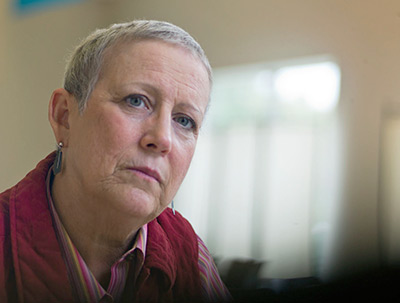 “Having a thankful heart is key to staying victorious in any journey like this,” said Paula Hemphill, a two-time breast cancer survivor who “pays it forward” by ministering to other cancer patients. Don’t go through the battle alone, she says. Build a network of people who will offer love and support.
“After all those years working in cancer diagnosis, and just being aware as a woman of breast cancer, I honestly didn’t anticipate my issue being breast cancer because it hurt so bad,” she said. “I didn’t have any history in my family, no high-risk factors.”
Her gynecologist prescribed an antibiotic and ordered a mammogram and ultrasound test – both came back negative – so he recommended a wait-and-see approach. But after 10 days, Paula insisted on seeing a surgeon, who diagnosed her with breast cancer. Because of her medical training, she was allowed to view her own cancer cells under a microscope.
“If I’d waited three months like my [gynecologist] told me to and then come back, my prognosis could have been a lot different. But because I insisted on seeing a surgeon … within six days, I had a mastectomy.”
Her children were stunned when Paula told them she had cancer, “but she seemed so confident in the Lord and so full of faith that her outlook very much shaped the way that we responded to the news,” said Kristina, one of her three daughters.
Paula’s chemo regimen left her exhausted and radiation caused uncomfortable burns. She lost her hair, including her eyebrows and eyelashes.
Julie Pierce, a breast cancer survivor and co-worker at IMB, where Paula had begun a new career as women’s missional strategist in 2004, offered advice on dealing with chemo and radiation. While Paula was going through treatment, Julie called periodically to check on her.
“The Bible says comfort others with the comfort you have received. And Julie did that for me,” Paula recalled tearfully. “She told me what to expect with the chemo – she told me some things to do that would make the treatments easier.”
Julie told Paula, then 56, to make sure the medical staff gave her a Popsicle or put ice in her mouth to prevent mouth sores from the chemotherapy. She also advised Paula to wear socks and gloves during radiation, which is administered in cold rooms.
Paula’s treatments ended in June 2010, and her oncologist spoke the words every cancer patient hopes to hear: “You will never have this cancer again.”
Thinking she was out of the woods, she went for her yearly mammogram that November and received startling news. She was diagnosed with breast cancer again – this time with a different cell type.
The second diagnosis was even more shocking than the first, Ken said, because Paula had opted for such aggressive treatment with the first cancer.
“Breast cancer and other cancers don’t have any rhyme or reason,” said Paula, noting that one in eight women in the U.S. will be diagnosed with breast cancer during her lifetime. “You can’t ask the ‘why’ question. It’s not a productive question. You have to ask ‘what now.'”
Since both her cancers were fast-growing, Paula decided to have another mastectomy. “I’ve had two breast cancers,” she told her surgeon, “I don’t want to risk a third.”
Before she had surgery, Paula visited Pakistan, where it is estimated that 89 percent of women with breast cancer do not survive. She talked with doctors there about breast cancer awareness and shared the techniques Julie had suggested. This was one of many opportunities she has had to tell her story.
“From the beginning,” Kristina said, “Mom saw the experience of having cancer as another way that she could connect with women and reach out to them with an understanding of their pain.”
“She spent a lot of time dealing with her issues on Facebook and talking with and encouraging our daughters in the midst of [her battle],” said Ken.
While many women struggle with body issues following mastectomies, Paula credits Ken with helping her through any insecurities.
“There’s a huge step I think you have to take in dealing with your self-image in the same way as someone who may be disfigured in a fire or in an accident. … My husband is a wonderful support and he has been, in large part, responsible for our success in dealing with this as a married couple.”
For his part, Ken said, he learned the most important thing he could do was listen. “It’s her body and she’s dealing with it in her own way,” he said. “Just let your spouse express her fears, concerns, hopes.” And share how you feel, he added. Now, more than ever, a woman needs reassurance that she is loved and still beautiful.
Following her second surgery, Paula prepared herself for the toll cancer treatments take, both physically and emotionally.
“I’ve had two times during all these treatments where I literally felt like I could die from the nausea and the fever. … when you are literally so weak you can’t stand. My husband would have to pick me up and put me in the bed or take me to the bathroom. I could not walk. That’s a miserable feeling,” she said.
Keeping a sense of humor helps, Paula said. Her grandson was amazed one Sunday morning that his Nana’s hair had miraculously grown in a matter of minutes.
“He had never seen my wig because it was so hot I didn’t wear it around the house,” she laughed. When they returned from church, Paula took off the wig and gave it to him to wear – much to his delight.
And who says God doesn’t have a sense of humor? The place the Hemphills moved to from Nashville – Travelers Rest, S.C. (In August, her husband was named director of the Center for Church Planting and Revitalization at North Greenville University.)
“Isn’t that a hoot? With all the traveling we do,” Paula said, “when we come home, we live in Travelers Rest.” She and Ken are members of First Baptist Church in Hendersonville, N.C.
One of the biggest challenges for female cancer patients, Paula said, is taking the time to rest, something she has struggled with herself. She and her husband have been busy in ministry work for 42 years, so she had never thought much about Sabbath rest. She’s been forced now to reflect about what rest does to heal, restore and revitalize.
“We live in a culture that expects us to be connected 24/7,” she said. “I’m learning how to turn [my Blackberry] off, go to bed and not feel guilty.”
She advises cancer patients to surround themselves with a network of people who can support them and offer unconditional love.
“One of the hardest things for me in this journey is, ‘How do people perceive me?’?” said Paula, now 62. “I am forever a breast cancer survivor.”
“It’s a natural entree to talk about the Lord – he’s been my healer and my shepherd.”
– Carrington is a writer for IMB.