

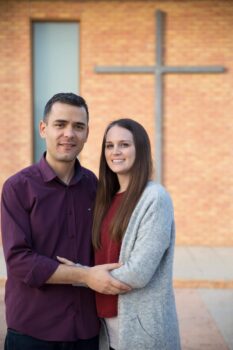
Hagar Ministries founders George and Allison Karkanis
It’s often hard to see the ways that God uses catastrophes to draw you closer to Him.
But not for George and Allison.
Before the COVID-19 pandemic erupted, George and Allison Karkanis had already spent roughly eight years involved with counter-trafficking work. But in 2018, they sensed God’s call to full-time work supporting survivors and other exploited persons. However, it wasn’t until 2020 that they established the nonprofit that would become Hagar Ministries. Though the decision to some seemed abrupt, God had been preparing their hearts for a decade leading up to this point.
George, Allison, and their small team of two volunteers host gatherings that include prayer, Scripture reading, and times of fellowship. They also conduct street outreach, which involves addressing food and drink needs based on the season. Recently, they initiated a strip club outreach, becoming the first ministry in Athens to do so.
The couple also has other employment-related goals for their beneficiaries. Allison said, “Right now, we collaborate with two ‘freedom businesses’ in Athens. People establish these businesses to hire individuals coming out of trafficking. … In the future, we, too, plan to establish a freedom business — a café in Athens to employ trafficking victims for at least two years so they can practice skills and transition to a new life.”
They also host a meal at the end of each month, inviting people who are exploited to join them. Since initial street conversations often last only five to 10 minutes, this provides them with a safer time to build relationships. Eventually, they’d like to increase the capacity of their space so these individuals can visit during the week for a safe place, rest, refreshments, bathroom access, and opportunities for relationship-building.
George and Allison were pleased to share that they’ve felt encouraged by the increasing attendance at their monthly meetings. Allison described how “the monthly meals started as just one [person], then two, then one again.” Currently, they serve around eight individuals at each monthly meal. Sometimes they make food, wondering whether any beneficiaries will show up, but someone always does.
“It may not always be eight, but they show up,” she said.
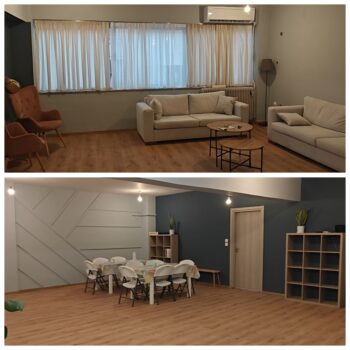
The indoor seating area (top) and a table for serving meals (bottom) serve as a gathering place at Hagar Ministries.
They started doing these meals because Allison encountered a verse about waiting during her quiet time. This verse evoked an idea similar to Christ’s words in Matthew 9:37–38, which reads, “The harvest is abundant, but the workers are few. Therefore, pray to the Lord of the harvest to send out workers into his harvest.”
Allison said God brought to mind a picture of a large, wooden table filled with food. And though there was plenty of food and plenty of seats, nobody was at the table beside her. And in that moment, she felt God speak to her, “I have invited others to come, but you need to bring them.”
How Did Hagar Ministries Get Started?
Allison said she first felt God prompting her to support counter-trafficking efforts when she attended a NewSpring Church service in 2010. A woman from the A21 Campaign, an anti-trafficking global awareness initiative, shared a message that remains ingrained in Allison’s mind to this day. The severity of trafficking struck Allison first as shock, then as passion to enact change.
When she and her husband, George, moved to Athens, Greece, to be closer to his family, the opportunity for counter-trafficking efforts presented itself. Shortly after the move, Allison contacted an organization that supports Nigerian trafficking victims, a group often targeted due to Nigeria’s domestic economic hardship and limited opportunities. She continued volunteering, eventually increasing her commitment to the cause. Finally, in the midst of a pandemic, after much prayer and deliberation, George and Allison surrendered their comfort, income, and potentially their safety by accepting the call to full-time ministry.
The pandemic gave them more time at home, which they spent thinking and praying. They decided to drop their “normal jobs” and, thanks to encouragement from several trusted friends — many of whom are now on the board of Hagar — the couple sensed the call to support this demographic full-time, eventually establishing Hagar Ministries.
Fortunately, the happy couple eventually received support from their mission partner, the Commission to Every Nation (CTEN). In addition to financial backing, this sending organization also provided them with pastoral support to fuel their ministry.
They decided to name the organization “Hagar Ministries,” and their mission statement became: “Hagar Ministries exists to reach individuals in exploitation and to empower them through restoration and employment in order for them to live a healthy, liberated life.” In other words, they work to provide skills for individuals caught in exploitation to move forward in their lives, even providing psychological support and, if they come to Christ, spiritual support.
The name comes from Hagar’s story in Genesis — a woman who encountered God in the wilderness after being exploited. Hagar is seen and called by name by the angel of the Lord, declaring that she is seen by the One who sees all. The name “Ishmael” (Hagar’s son) means “God hears.” Allison explained that Hagar Ministries uses that testimony to tell those who are trapped that they are seen and heard by God.
She said, “When people ask what Hagar means, we get to share that story, and it powerfully connects to the people we serve.”
Why Does the Work Matter?
Sexual exploitation in Athens happens on a scale unknown to most people in the West. Since Greece serves as a significant entry point for migrants entering Europe, and since sex work and the operation of brothels are legal activities, trafficking organizers target the country as a location where exploitation enterprises can flourish. Additionally, Greece does not offer many resources for trafficking victims, making outreach especially tough. Access to free or low-cost counseling is minimal, and educational barriers are also common; many victims have only a middle-school education and cannot read.
Tragically, the scarcity of these resources is compounded by the obstacles that prevent women from even attempting to use these services. To be formally registered as a trafficking victim, they must testify to police against their trafficker. Most women are terrified to do this, so they rarely see justice. These difficulties underscore the importance of the work Hagar Ministries is doing by redirecting people toward Christ, who is the ultimate source of knowledge, peace, rest, opportunity, and, perhaps most importantly, hope.
What most people fail to realize, she explained, is that most individuals in exploitation have not been abducted. Though situations comparable to depictions in films like “Sound of Freedom” and “Taken” do happen, most exploitation does not result from forced kidnapping.
According to Allison, “The majority of exploitation happens because someone the victim knows, perhaps a friend or family member, offers what looks like an opportunity for a job in Europe as a hairdresser, for example. People are often driven by poverty, family need, or lack of options, so trafficking frequently begins with false promises rather than abduction.” In this sense, trafficking resembles coercion more than abduction, making the practice more difficult to condemn from a judicial perspective.
“Despite these challenges, we trust Christ to make a way. Even if healing takes years, all things are possible through Him,” said Allison.
Partnering for Hope
Allison stated that her journey reminds her of how God often works in mysterious ways. God most likely did not tell the representative from the A21 Campaign who spoke at NewSpring in 2010 that He would use her message to start a counter-trafficking ministry in Athens, Greece. However, her willingness to respond to God in obedience and speak before that crowd, within just two years, prompted George and Allison to reach out to victims across the Atlantic.
Allison lamented that “we cannot do everything; the need is too large.” George and Allison would love for more people in the United States to pray, seek where the Lord may be leading them to serve, and consider partnering with Hagar Ministries through opportunities like their Monthly Freedom Partnership or Freedom Prayer Partnership (www.hagar.gr).
Additionally, she said that a couple of nonprofit organizations in the Upstate could greatly benefit from community support, such as Jasmine Road and Switch. Jasmine Road operates a home and a café-style business that provides employment opportunities. Switch works in prevention, intervention, and long-term restoration.
Who knows? Perhaps God is calling you, too, to use your gifts to bring hope where it is most needed.
“And I heard the voice of the Lord saying, ‘Whom shall I send, and who will go for us?’ Then I said, ‘Here I am! Send me.'” (Isaiah 6:8)
— Chandler McCraw is a senior Christian studies major at North Greenville University. He serves as a ministry assistant at Christ Fellowship Cherrydale, Greenville.