
Most churchgoers place a high value on the Bible, but only about a third commit to reading it every day.
The Lifeway Research State of Discipleship study found Bible engagement to be one among eight signposts measuring distinct characteristics for believers progressing in their spiritual maturity. On a scale of 0 to 100, the average churchgoer scores 69.8 on Bible engagement, placing it fifth among the signposts.
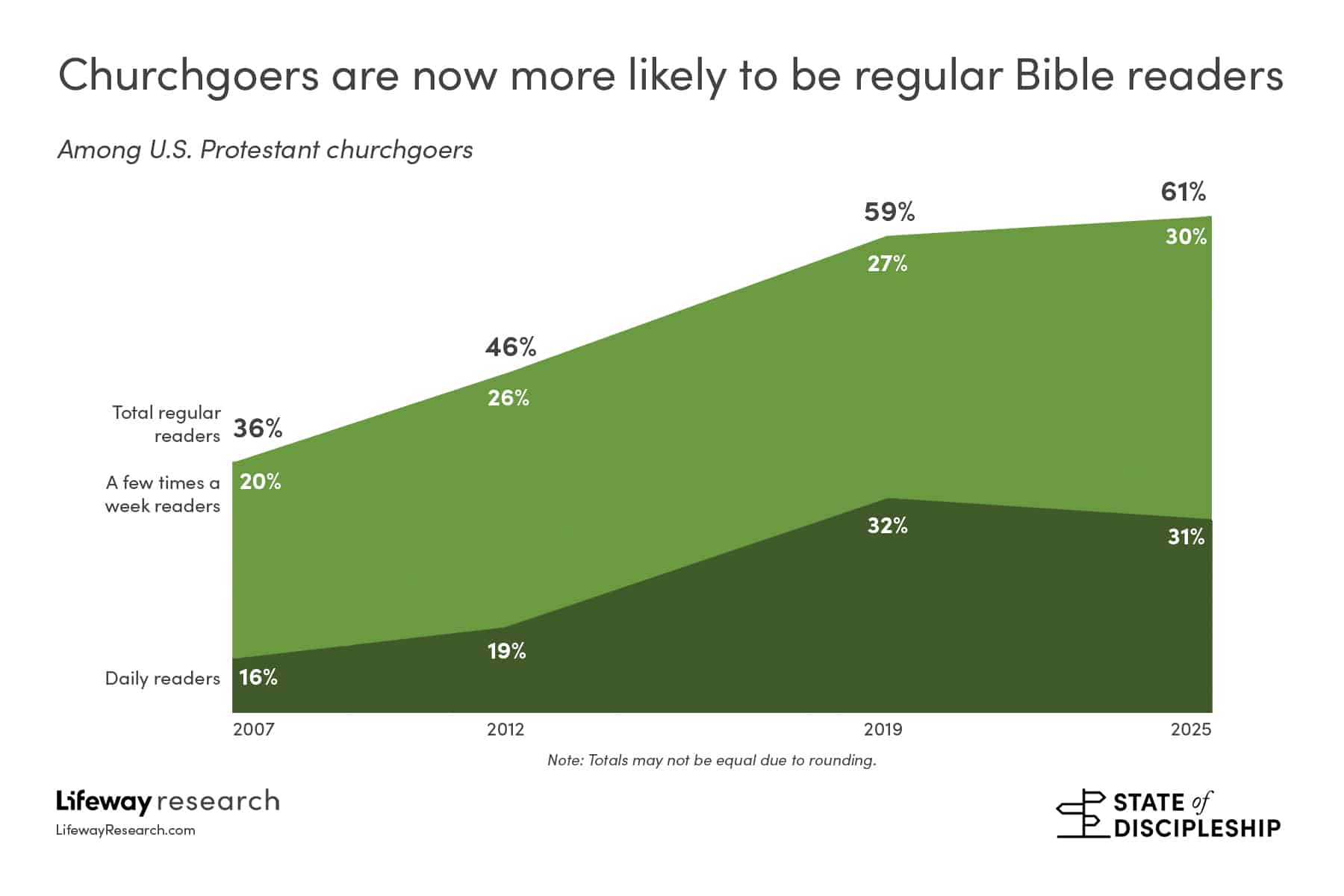
Among U.S. Protestant churchgoers, most say they read Scripture regularly, but just 31 percent say Bible reading is a daily habit.
“Protestant churchgoers overall report they are engaging the Bible, but on any specific question, as many as 1 in 5 say they are not following Jesus Christ in that way,” said Scott McConnell, executive director of Lifeway Research. “This reflects an overall pattern in assessments of churchgoers where the direction is often good but far from the standard seen in Scripture.”
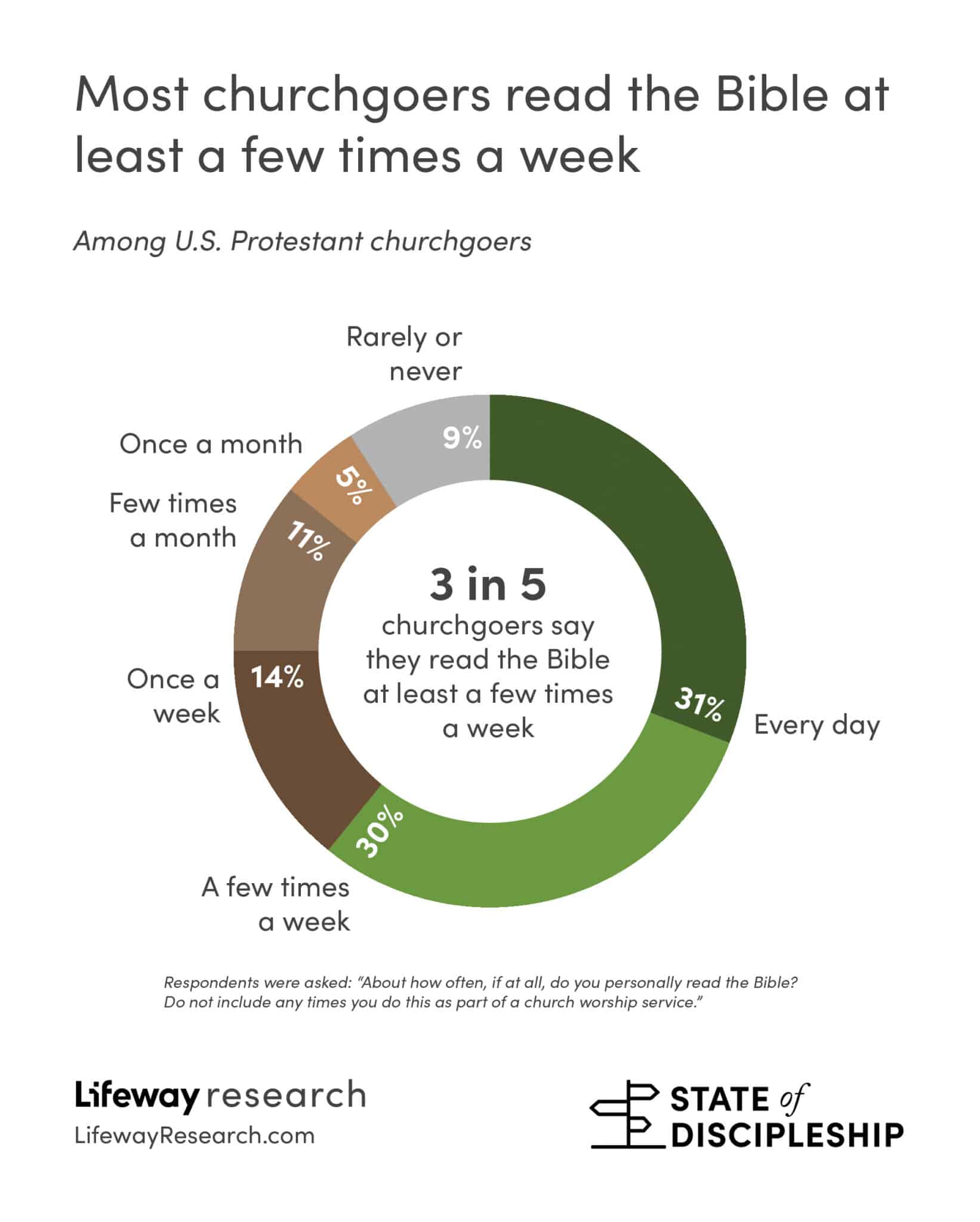
According to the State of Discipleship study, around 3 in 5 Americans who attend religious services at least once a month (61 percent) regularly read the Bible, including 31 percent who read every day and 30 percent who do so a few times a week. Some engage once a week (14 percent) or a few times a month (11 percent). Few say they read Scripture only once a month (5 percent), while 1 in 10 (9 percent) do so rarely or never.
Reading frequencies have remained mostly steady since 2019, when Lifeway Research found 59 percent were regular Bible readers. Personal Bible engagement has increased, however, since previous studies. In 2012, 46 percent regularly read the Bible, including 19 percent who did so every day. Five years earlier, in 2007, only 36 percent of churchgoers were regular Bible readers, with just 16 percent who read daily.
“The portion of churchgoers reading the Bible a few times a week or more on their own has leveled off recently after rising dramatically since 2007, but the churchgoer population was also changing during this period,” said McConnell, “A lower percentage of Americans attend a Protestant church once a month today than when this series of studies began. Clearly, the remnant of Americans attending church each month are more willing to regularly read the Bible on their own than when churches were more populated.”
A recent Lifeway Research study found 9 in 10 Americans have read at least some of the Bible, but just 22 percent have finished the book at least once. Churchgoers were more likely than others to have read larger percentages of the Bible. Even among those who attend church services more than once a week, around 3 in 5 (59 percent) say they’ve read the entire Bible at least once.
While the State of Discipleship found Bible engagement to be a positive factor for adults’ spiritual growth, previous Lifeway Research studies have shown the importance of Bible reading for the next generation. The biggest predictor of whether a child becomes a faithful believer as a young adult is whether or not they regularly read the Bible growing up.
Additionally, while 66 percent of churchgoing teenagers stop attending when they become young adults, those who spend time regularly reading the Bible are 1.23 times less likely to drop out compared to those who do not spend personal time in Scripture.
 Skipping Scripture
When U.S. Protestant churchgoers miss time in their Bible, many say it has a negative impact, but not everyone feels the absence in the same way.
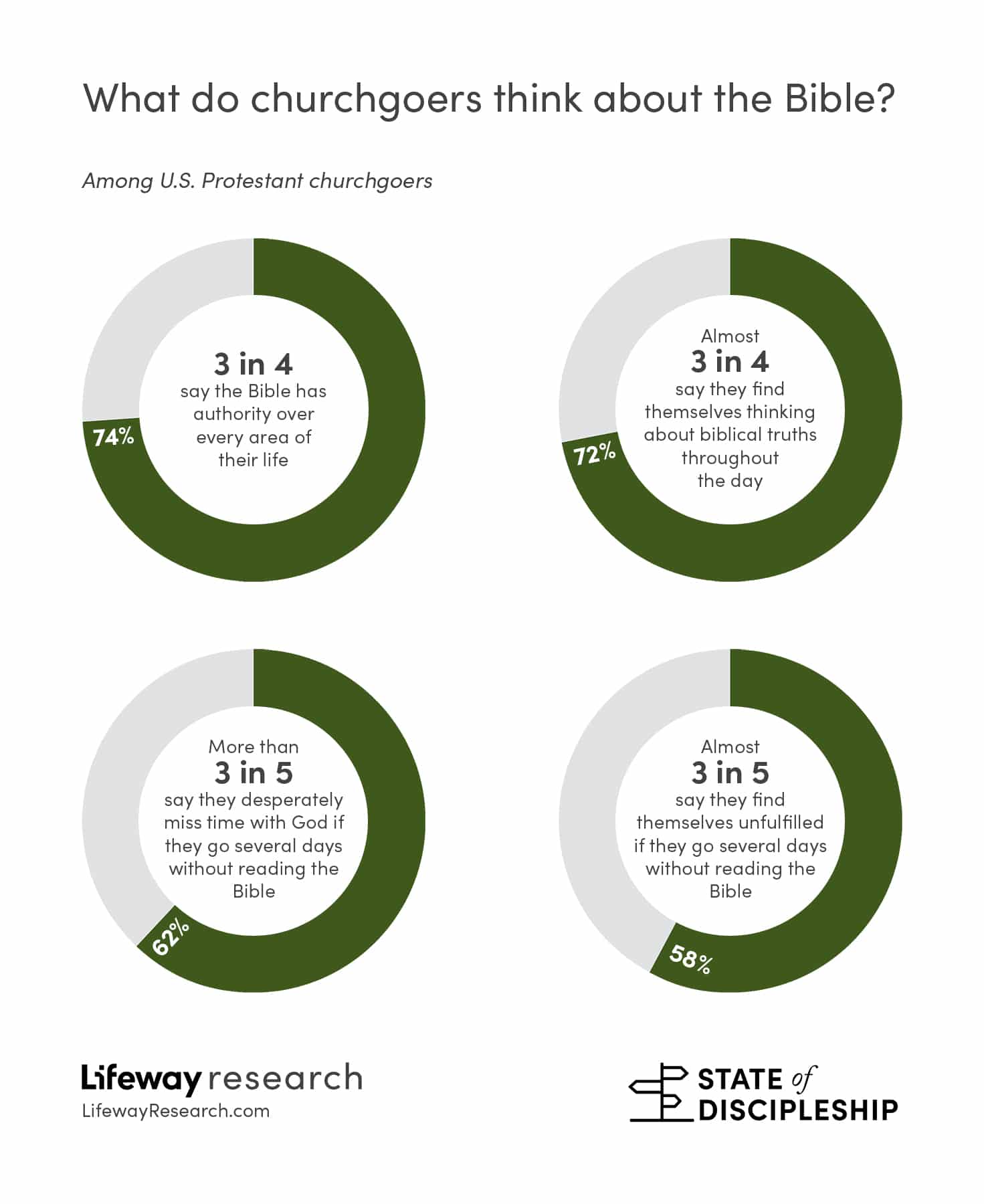
Three in 5 (62 percent) say they desperately miss the time with God if they go several days without reading the Bible, while 21 percent are unsure and 17 percent disagree. Similarly, 3 in 5 (58 percent) say they find themselves unfulfilled if they go several days without reading their Bible, while 21 percent aren’t sure and 21 percent disagree.
Yet even among those who say they notice when they aren’t engaged with the Bible, that sentiment isn’t always strong. Three in 10 (30 percent) strongly agree they desperately miss personal time with God when they go several days without reading the Bible, and 26 percent strongly agree they find themselves unfulfilled in that situation.
“Most of those engaging the Bible regularly are doing so because they enjoy what the practice brings to their lives,” said McConnell. “Movement toward more Bible engagement requires intentionality, but movement away from this devotion can start out as a slow drift. However, a moment of reflection among those who have experienced the value of engaging the Bible reminds them of what they are missing.”
Compared to 2019, churchgoers have similar overall attitudes. Seven years ago, almost 3 in 5 (58 percent) said they desperately missed the time with God when they went several days without reading the Bible, while 22 percent weren’t sure and 20 percent disagreed. At that time, however, 33 percent strongly agreed and 25 percent somewhat agreed.
 Attitudes toward the Bible
As expected, U.S. Protestant churchgoers hold Scripture in high regard, but not always in the highest regard.
Around 3 in 4 (74 percent) say the Bible has authority over every area of their lives, with 15 percent unsure and 11 percent disagreeing. However, only 40 percent strongly agree, leaving 3 in 5 with at least some doubts about the authority of Scripture.
Similarly, more than 7 in 10 (72 percent) find themselves thinking about biblical truths throughout the day, while 19 percent aren’t sure and 10 percent disagree. Yet just 31 percent strongly agree that’s regularly the case for them. Those percentages are similar to 2019, when 69 percent agreed, 20 percent weren’t sure and 12 percent disagreed.
“The Bible can’t have full authority in someone’s life if they don’t know what it says or aren’t considering what it says about the specific things they are facing in life,” said McConnell. “The Bible makes the appeal, ‘Be transformed by the renewing of your mind, so that you may discern what is the good, pleasing, and perfect will of God’ (Romans 12:2b, CSB).”
For more information, view the complete report and visit LifewayResearch.com/Discipleship.
— Aaron Earls is the senior writer for Lifeway Research.