

Around a quarter of Americans don’t identify with any religion, but many still hold some religious perspectives.
Lifeway Research surveyed more than 2,000 U.S. adults who are atheist, agnostic or have no stated religious preference to discover their perspective on meaning, morals and what’s missing from society.
“The secularization trend in America saw a growing percentage of Americans cease to identify with a religion,” said Scott McConnell, executive director of Lifeway Research. “We desired to understand the thinking of these ‘nones’ on many aspects of life and religion.”
For the past 50 years, one of the primary religious demographic stories in the U.S. has been the rise of the nones, those who select “none of the above” when asked their religious preference. The percentage of Americans in this group has climbed from the single digits in the 1970s to more than 1 in 5 American adults today.
Recent research has shown their growth has plateaued after decades of uninterrupted growth, but the nones still comprise a significant portion of the U.S. religious landscape. And much like their religious counterparts, the religiously unaffiliated are not monolithic in their viewpoints.
Religious beliefs among the nonreligious
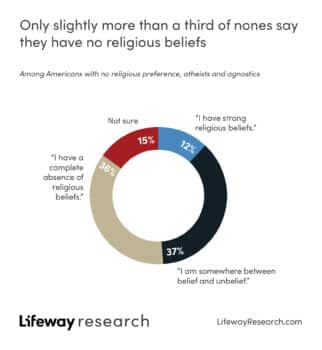
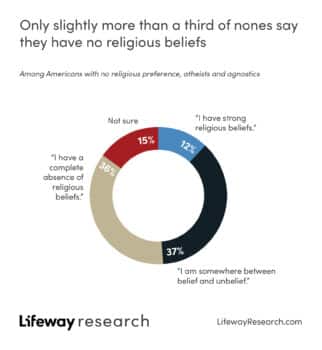
Only slightly more than a third of nones (36 percent) say they have a complete absence of religious beliefs. A similar share (37 percent) say they are somewhere between belief and unbelief, while 12 percent have strong religious beliefs. Another 15 percent aren’t sure.
Still, few religiously unaffiliated (23 percent) see religion as important in their lives. More than 2 in 3 (68 percent) disagree. Similarly, few (29 percent) describe themselves as a person of faith, while most (53 percent) reject that label.
 Almost half (47 percent), however, consider themselves spiritual. When asked what is included for them in being spiritual, almost 2 in 3 (65 percent) say being in tune with their inner self. More than 3 in 5 say it includes a belief in spiritual forces, karma and/or energy (63 percent) or being in tune with nature (62 percent).
“When people in our culture say ‘secular,’ they imply a forgone conclusion that religion is absent or obsolete,” McConnell said. “Yet, only half who do not claim a religion for themselves actually have such secular views. So, if we want to call American society secular, we have to define it differently.”
Most nones who think of themselves as spiritual say, for them, being spiritual involves belief in a higher power (56 percent) or connecting with other people (53 percent). Fewer say it includes belief in spirits, angels and/or demons (40 percent) or a belief in God (39 percent).
As far as their specific religious beliefs, the religiously unaffiliated have a variety of perspectives on God. Almost a quarter (23 percent) aren’t sure if God exists. One in 5 (20 percent) say they believe God does not exist. Fewer say they believe in God and seek to know God relationally (18 percent), believe there is a God but don’t think God can be known (15 percent) or believe there are multiple gods or deities (11 percent). Around 1 in 8 (12 percent) aren’t sure.
Most (55 percent) believe the existence of supernatural entities is very likely, including 25 percent who strongly agree. Three in 10 (30 percent) disagree, and 15 percent aren’t sure.
“The nones’ beliefs that the supernatural exists and that there is something deeper, fuller and transcendent defy the secular narrative that people are fleeing all that is religious and spiritual,” McConnell said.
When it comes to life after death, almost half (48 percent) of nones say no one really knows what will happen. Almost 1 in 5 (18 percent) say they will cease to exist anywhere.
Three in 10 have some type of afterlife belief. Almost 1 in 10 say they will return here in another life form (9 percent), while 1 percent believe they will go to hell.
Around 1 in 5 believe they will go to heaven, either because they have tried their best to be a good person and live a good life (9 percent), because they have confessed their sins and accepted Jesus Christ as their Savior (7 percent), or because God loves all people and will not let any of them perish (4 percent).
Thoughts on religion
Nones often see religion as an imposition that society will inevitably leave behind.
Almost 2 in 3 religiously unaffiliated Americans (63 percent) feel like religion has been imposed on them rather than offered as a choice. Most (54 percent) say society’s move away from religion is inevitable. Half (51 percent) say religion does not belong in public life.
 They are more split, however, on whether religion could be a force for good. Nones are equally divided over whether they can imagine any religion motivating positive human action — 42 percent believe it is possible and 42 percent disagree.
Many religiously unaffiliated say their opinions on religions come from personal experience. When asked which religions they have explored enough to feel they know what they like and don’t like about them, most (55 percent) say they have done so with Christianity.
Fewer say they have a depth of personal experience with Islam (13 percent), Buddhism (13 percent), Jehovah’s Witnesses (13 percent), Judaism (12 percent), Latter-day Saints (11 percent) and Hinduism (7 percent). Around 2 in 5 (41 percent), however, say they haven’t explored any of these religions enough to make that judgment.
“Christians who want their neighbors who are nones to join them in following Christ need to be willing to listen to the reasons nones have concluded they don’t like Christianity,” said McConnell. “America’s religious communities should also take note that 2 in 5 nones have not done much religious exploring at all. Clearly, they haven’t been given a compelling reason to do so.”
Meaning in life
When asked about goals for their lives, most nones (55 percent) say they want to help the lives of their loved ones flourish. More than 2 in 5 (44 percent) want to maximize their own flourishing. Slightly fewer (37 percent) want to help the lives of all people flourish, while more than a quarter (28 percent) want to find meaning in something or someone transcendent or beyond the physical human experience.
As they look for meaning in life, 81 percent say humans have to create that meaning themselves. Still, less than half (43 percent) say there is nothing in life beyond human flourishing, and 38 percent often feel their goals and achievements lack meaning.
“Many governments and companies have tried to add goals related to human flourishing, acknowledging that financial metrics alone do not reflect our aspirations,” said McConnell. “Most nones resonate with life goals around flourishing, but they are divided on who should benefit. If society follows the lead of nones, it may not lead to a united future since so many focus only on benefiting themselves or their loved ones.”
Morality
The nonreligious often find their sense of morals and authority from within as opposed to any external source.
More than 2 in 3 (68 percent) say the source of authority they should submit to is their own decision-making. Around 2 in 5 (39 percent) point to science and things that can be proven. More than 1 in 5 say their parents or other family leaders (22 percent) or God (22 percent).
 Fewer say a source of authority over their lives that they feel they should submit to is the government (13 percent); mentors, counselors or teachers (13 percent); their boss (11 percent); or their friends’ standards or expectations (10 percent).
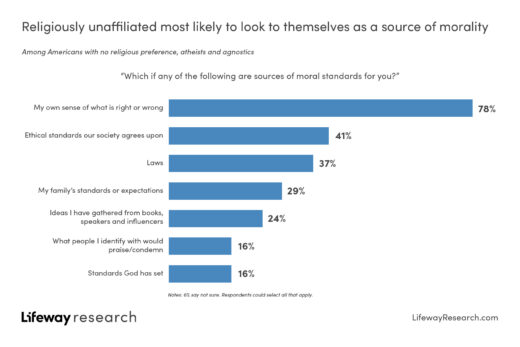
Similarly, most nones are looking inside themselves first for their morality. More than 3 in 4 (78 percent) say a source of moral standard for them is their own sense of what is right or wrong. Around 2 in 5 point to ethical standards our society agrees upon (41 percent) or laws (37 percent).
Around a quarter say their source of moral standards is their family’s standards or expectations (29 percent) or ideas they’ve gathered from books, speakers and influencers (24 percent). Fewer say their source of moral standards comes from what people they identify with would praise or condemn (16 percent) or what God has set (16 percent).
Almost 4 in 5 (79 percent) say they are intentional about living from a clear set of values. Still, 43 percent regret their failure to live up to their own set of values, while 49 percent disagree.
Disappointment and regret are not confined to some individuals. Almost 9 in 10 nones (88 percent) say much in society is broken.
“While social media and public shaming may impact some people’s behaviors, it is rare for nones to anchor any of their moral principles upon peers or social groups. They believe they have an innate moral code to follow, though many admit they don’t always live up to it,” McConnell said.
Looking for more
As the religiously unaffiliated see brokenness in society, many also hope for more, personally and societally.
Most (55 percent) believe there is an ultimate purpose and plan for every person’s life. And almost 3 in 5 (58 percent) say finding that deeper purpose for themselves is a major priority in their lives.
Two in 3 (65 percent) believe there is a fullness to life that can transcend the ordinary. Slightly more say there is a source of wholeness in life that they want to find (68 percent) and that there must be something more to life than what they’ve found so far (69 percent).
Looking beyond themselves, 69 percent believe we need a better source of wisdom for life’s problems, while 56 percent are holding out hope that someone can redeem our culture.
“People often try to define nones by what they are not. Yet their aspirations for wholeness, purpose and wisdom are not dissimilar to religious Americans,” McConnell said. “Those with no religious preference largely prioritize individual choice, live by clear values, lament the state of our society and are looking for the source of wholeness they desire in life.”
For more information, view the complete report and visit LifewayResearch.com/Nones.
— Aaron Earls is the senior writer for Lifeway Research.