
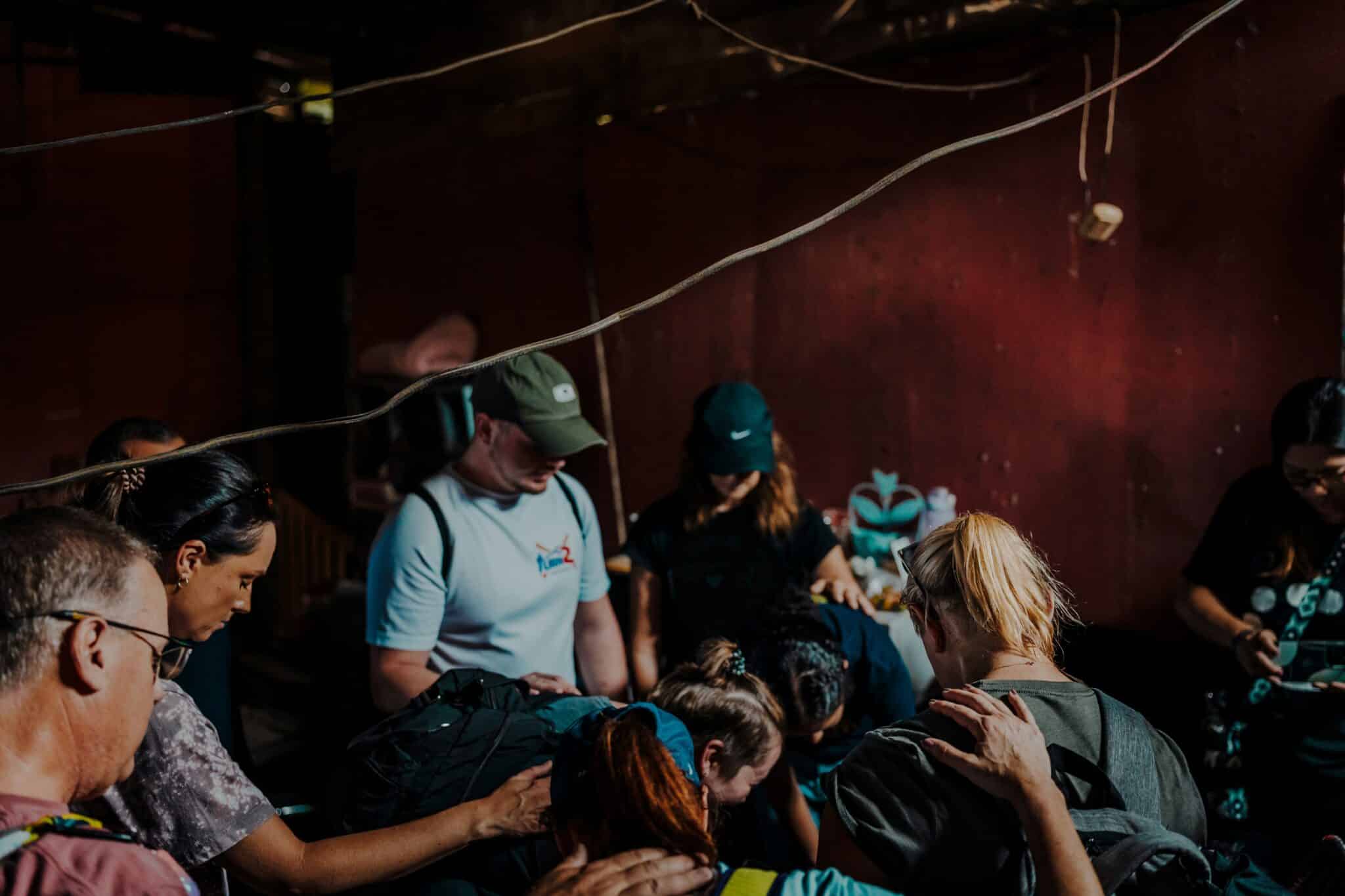

We’ve heard the commandment—go and make disciples of all nations. We know the gospel, but we’re too scared to share it. We sense the Holy Spirit’s prompting but rationalize disobedience by promising ourselves that “we’ll share next time.” So what do we do about this fear? How do we grow in boldness?
Boldness Defined
I appreciate Got Questions’ definition of boldness from their article, “What Does the Bible Say About Boldness,?”“Boldness is the courage to act or speak fearlessly, despite real or imagined dangers. When a person acts boldly, he or she takes action regardless of risks.”
The article also helps clarify what boldness is not: “Boldness is not to be confused with rashness or aggressiveness.”
Parrēsia is the word used in the New Testament for our translation of boldness. Paul prays for it in Eph. 6:19-20 and the disciples pray for it in Acts 4:29. We see in Acts 4:13 that boldness is not dependent on one’s intellect or education.
Interestingly, Parrēsia is also translated in English as “openly” or “plainly” depending on the context. For example, it’s used in John 16:29, “His disciples said, “Ah, now you are speaking plainly and not using figurative speech!” And Parrēsia is also used in John 11:54, “Jesus therefore no longer walked openly among the Jews..”
Blue Letter Bible defines the term as “freedom of speech, unreservedness of utterance.”
Therefore it seems boldness is speaking the truth plainly and with courage. Culture may equate boldness with being pushy, insensitive, exclusive, or judgmental—but Christians equate boldness to lovingly and openly speaking the truth in the power and name of Christ.
So how do we become bold?
1. Prayer
Paul, the apostle, asked the saints to pray that he’d proclaim the gospel boldly. He said in Ephesians 6:19-20,
“and also for me, that words may be given to me in opening my mouth boldly to proclaim the mystery of the gospel, for which I am an ambassador in chains, that I may declare it boldly, as I ought to speak.”
The disciples also prayed for continued boldness in Acts 4:29.
If we want boldness; we must pray for it. Boldness comes more naturally with some personality types—but boldness in reference to gospel proclamation—is not simply a personality trait. God can empower any believer through the Holy Spirit—no matter how shy or introverted they are.
2. Presence
God commands courage and fearlessness countless times throughout the Bible and the reason He gives is His presence.
In the book of Exodus when God is calling Moses to deliver His people, Moses gives God excuses for his lack of eloquence. But God responds to Moses by telling him that He’d be with Moses’ mouth (Ex. 4:10-12). When Joshua was told to be strong and courageous, the reason given was that God would be with him wherever he went (Josh. 1:9). And in Matthew 28:18-20, God commands that we make disciples and then leaves us with a precious promise: “And behold, I am with you always, to the end of the age.”
In addition, God told the disciples to stay in Jerusalem until they received the promised Holy Spirit (Lk. 24:47-49, Acts 1:4). Therefore, God’s presence is crucial for obedience to the Great Commission. Boldness comes outside of yourself—it rests on Christ. It’s about His power being made perfect in our weakness! (2 Cor. 12:9).
Boldness comes primarily from God’s presence, not our personality.
3. Power
A common hindrance to gospel proclamation is fear of saying the wrong thing. What if I push that person farther away from God? What if I don’t have the answers to their questions?
The problem with these doubts is the root of the fear often lies in our own inadequacy. The power for salvation is not in your cleverness; it’s in the power of God through the message of the gospel.
I love what Paul says in 1 Corinthians 2:1-5,
“And I, when I came to you, brothers, did not come proclaiming to you the testimony of God with lofty speech or wisdom. For I decided to know nothing among you except Jesus Christ and him crucified. And I was with you in weakness and in fear and much trembling, and my speech and my message were not in plausible words of wisdom, but in demonstration of the Spirit and of power, so that your faith might not rest in the wisdom of men but in the power of God.”
Paul wants their faith to rest in the power of God, not the wisdom of men!
We see again how the gospel carries God’s power in Romans 1:16 which says,
“For I am not ashamed of the gospel, for it is the power of God for salvation to everyone who believes, to the Jew first and also to the Greek.”
Donald Whitney, in Spiritual Disciplines for the Christian Life said that the gospel itself holds power. It’s the message more than your mannerisms that carry the power.
The apostles were not special in and of themselves. The only reason they were able to witness with such boldness in the face of persecution was because they were clothed with power from on high. Jesus told his disciples to wait in Jerusalem until they received His power.
“and that repentance for the forgiveness of sins should be proclaimed in his name to all nations, beginning from Jerusalem. You are witnesses of these things. And behold, I am sending the promise of my Father upon you. But stay in the city until you are clothed with power from on high” (Lk. 24: 47-49).
Whether you’re sharing the gospel with Muslims, Hindus, or Catholics: one key message doesn’t change—the gospel. Share the gospel. Don’t worry about all the other things. Keep Christ and the gospel central. That’s how faith comes—through the Word of Christ (Rom. 10:17).
Evangelism is not about having every question answered. Faith is given by God. The power is in Christ and in the message of the gospel—not in your cleverness.
4. Preparation
Though God does provide us His power for gospel proclamation—that doesn’t mean that we don’t have to prepare.
1 Peter 3:15 says,
“but in your hearts honor Christ the Lord as holy, always being prepared to make a defense to anyone who asks you for a reason for the hope that is in you; yet do it with gentleness and respect,”
Though the primary cure to the “fear of saying the wrong thing” is faith in God’s power and presence, there’s also a measure of responsibility we carry to be prepared for the hard questions. God has given us His Word which is sufficient (2 Tim. 3:16-17). Do we know it? Have we read the difficult parts of the Bible that may leave an unbeliever questioning?
As Christians, we must come to a point where we no longer just increase in wisdom, knowledge, and maturity for our own benefit, but for the benefit of others. When is the last time you read a Christian book for the sake of helping somebody else? When’s the last time you attended a Bible study in order to better equip yourself for ministering to others?
Hebrews 5:12-14 says,
“For though by this time you ought to be teachers, you need someone to teach you again the basic principles of the oracles of God. You need milk, not solid food, for everyone who lives on milk is unskilled in the word of righteousness, since he is a child. But solid food is for the mature, for those who have their powers of discernment trained by constant practice to distinguish good from evil.”
We’ll touch on the last four ingredients for bold evangelism in part two.