

Matt Rogers’ time at Southeastern Baptist Theological Seminary was about to conclude. But a new season was beginning. His wife, Sarah, was pregnant with their first child, Corrie, and parenting would soon begin. But raising a little girl (and later four more kids) wasn’t the only form of parenting that he participated in. A church plant would soon be born.
“Starting a new congregation is very much like having a child, and the maturation process of a church is very much like raising children,” said Matt.
But before a new church was born, a planter had to be produced.
Matt grew up in a Christian home in Rock Hill, S.C., and went to North Carolina State University not knowing what he wanted to do — perhaps he’d become a teacher or lawyer, he thought. But during the summer after his freshman year of college, he worked at a summer camp and was surrounded by peers who knew God, read the Word, and fought sin. Though he would have called himself a Christian before then, God changed Matt’s trajectory that summer. He transferred to Furman University to start a new way of life and served at a church in student ministry during his last three years of college. After college, he served several years on staff at another local church in Greenville. Many affirmed a pastoral calling on his life, so he and his wife moved to seminary to work through his aspiration.
While at seminary, he and Sarah attended North Wake Church, and Matt did a residency there. He learned what meaningful membership, expositional preaching, and mission-mindedness looked like. It was there that some pastors asked him to consider church planting.
During his last semester of seminary, he took a preaching class alongside Jon Chasteen, Jeremy Chasteen’s brother, a founding pastor of Crosspoint Church in Clemson. Jon told his brother Jeremy, who was living in Clemson, S.C., that he needed to reach out to Matt about a staff opening at Crosspoint.
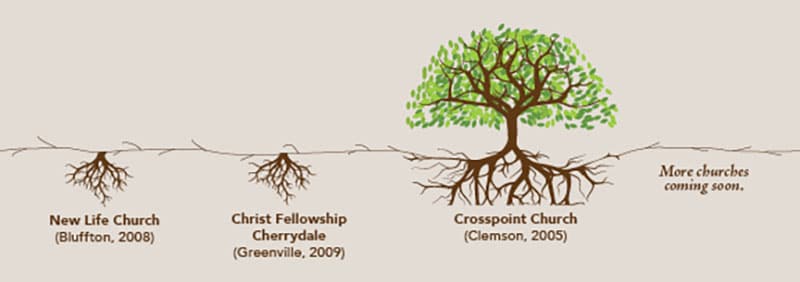
At the time, Crosspoint Church needed a family and youth leader. And Matt could fill the spot. So he and Sarah left SEBTS after graduation, moved to Clemson, and he joined the staff at Crosspoint Church. Two years later, the church sent them to plant Renewal Church in Greenville.
Matt and Sarah, along with two other couples, formed the core group that met for a Bible study through Ephesians. Other unbelievers and locals also joined the study. After roughly nine months of informally meeting at Rocky Creek Baptist Church, the group transitioned to the conference room at a local hotel and covenanted together as a new church.
Matt likened the beginning of the church planting process to raising an infant.
“You’re moving through a lot of the same stages with a church that you’re moving through with a little human,” said Matt.
Matt said the infancy stage of church planting isn’t glamorous; it’s a grind. He was 30 years old when he planted Renewal Church, now Christ Fellowship Cherrydale, and said he was inexperienced and felt inadequate as he learned to care for a marriage, young kids, and a baby church in the same season. He said being a young pastor is like having a baby in your mid-20s — you still feel like a kid yourself even though you have adult responsibilities.
“I’m learning to be a leader and a pastor, and doing that while pastoring is an interesting coming-of-age experience because your church is coming of age at the same time,” he said.
But the infant — that was Renewal Church — grew and entered the toddler stage, which he said consists of setting values and creating a biblical culture and healthy ecclesiology. He said this stage also includes all the regular aspects of shepherding — discipling, church discipline, pastoral counseling, and care.
Matt said, “Much like raising a toddler, it’s perhaps the messiest stage in church planting, but super formative.”
Now, 17 years later the church has entered adolescence.
Matt said their values haven’t changed — things like expositional preaching, meaningful membership, church planting, and missions. But he has changed, and their flock has changed.
“I don’t know that I recognize myself 10 years ago,” Matt said. “I feel healthier fighting sin, fear of man, people pleasing, being secure in my own identity. Those things certainly grow over time.”
Matt said God grows and changes you by His Spirit.
“I’m definitely a healthier leader than I was in the first decade,” he said.
The flock has also changed, in that there are no longer just 30 members to care for, said Matt. The congregation has grown — and along with it has come more diversity, more needs, and more necessary organizational structure. Matt said it’s hard to stay committed to the simple work of a pastor as organizational needs get more complicated.
“As the needs of the congregation grow, it becomes more tempting to live in more of that business space than in the pastoring space,” said Rogers.
Matt and Sarah have since raised their first child, Corrie. In fact, Corrie is now a freshman at Anderson University. And similar to raising a kid and sending her off, Matt hopes to do the same with his church members. He said he wants to look back on decades of ministry and see dots on a map of members they’ve discipled and sent to the nations.
He hopes his local church family will look back and say, “That was such a formative stage in my life — in who God is, how to love Jesus, [and] why I should care about His church.”
One of those children in the faith was Trevor Hoffman, who would plant The Church at Greer Station, now Ridgewood Church in Greer. But that’s a story for next month.
This article is the third story in an ongoing series of church planting stories. Read the first story here and the second story here.