
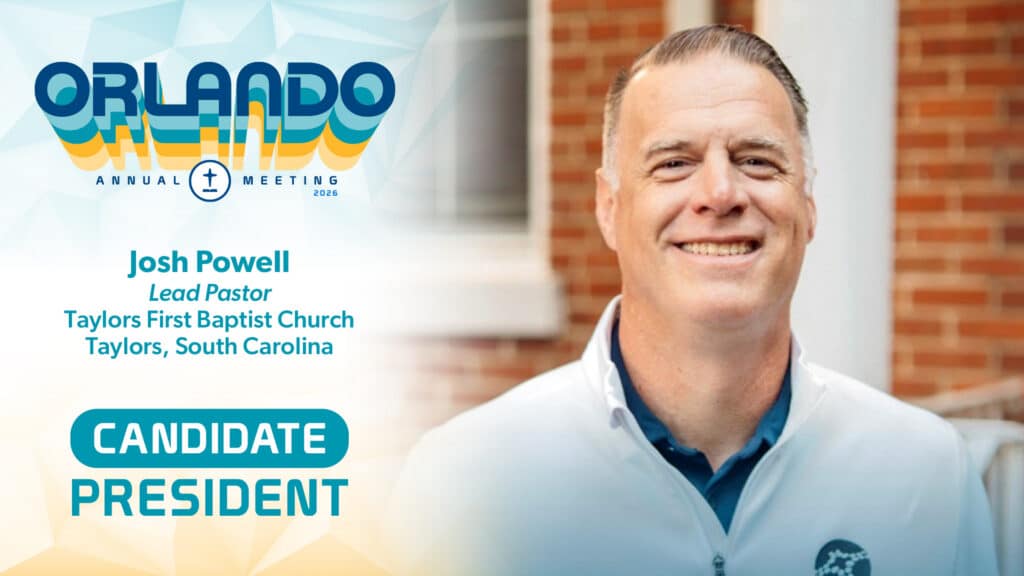

Each year, Southern Baptists gather for our annual meeting as stewards. We come as messengers from our churches, entrusted with a responsibility that stretches back nearly two centuries: cooperating together for the sake of the Great Commission.
That cooperation is remarkable. Thousands of churches — large and small, rural and urban — voluntarily work together to send missionaries, train pastors, plant churches, and proclaim the gospel across the world.

Josh Powell, pastor of Taylors First Baptist Church, preaches on the worker who is approved by God during the Monday morning session of the 2025 SBC Pastors’ Conference.
I love the Southern Baptist Convention. I come from a long line of Southern Baptists. I grew up in SBC churches. I spent my life serving in SBC churches and institutions. Although the SBC has always had challenges it needed to address, I am deeply grateful for what God has done through this convention. Because of that love and gratitude — and because I believe deeply that this cooperative effort must be strengthened for the sake of the lost and for future generations — I have agreed to be nominated for president of the Southern Baptist Convention.
I am running because I believe Southern Baptists have an opportunity in this moment not simply to debate our challenges, but to strengthen the foundations that have always made our work possible.
My burden can be summarized in three commitments: Strengthening confidence in our confession, rebuilding trust in our cooperation, and renewing our focus on the Great Commission.
Strengthening Confidence in Our Confession
Southern Baptists have always been a confessional people. Our shared beliefs are clearly expressed in the Baptist Faith and Message (2000), which establishes the doctrinal boundaries that allow thousands of autonomous churches to cooperate in good faith.
In recent years, some conversations within the convention have suggested uncertainty about matters our confession already addresses. I believe Southern Baptists should have confidence both in the clarity of our confession and in the wisdom of the messenger body to apply it.
One example involves how the convention determines whether churches are in friendly cooperation. In 2019, the convention created a standing Credentials Committee to address such matters between annual meetings. While that effort was well-intentioned, experience has shown the process has not served the convention as well as hoped. In practice, it has shifted decisions that historically belonged to the messenger body into a smaller process removed from the floor of the convention.
In 2024, a diverse group of Southern Baptist leaders studied this issue for a year and concluded that the authority to seat or unseat messengers should belong to the messengers themselves. The convention overwhelmingly affirmed that recommendation, and I believe we should follow through on that decision.
Southern Baptists have already demonstrated that they are capable of addressing difficult questions from the floor of the convention. In recent years, messengers have clearly spoken regarding churches whose practices fall outside our confessional consensus.
Our confession is clear, and our messengers are capable. Returning these decisions to the messenger body would restore our historic model of confessional accountability.
Rebuilding Trust in Our Cooperation
Southern Baptist work depends on trust. When churches give through the Cooperative Program, send students to our seminaries, and support our missionaries, they do so because they trust that the gospel we confess is being faithfully proclaimed and carried to the ends of the earth.
That cooperation remains one of the great strengths of the Southern Baptist Convention. But like any partnership, it requires constant attention and care.
One reality we must address honestly is the long-term decline in Cooperative Program giving. The CP remains one of the most effective missions funding models in the world, but many churches do not fully understand how it works or why it matters.
Some churches have also expressed concerns about how decisions are being made within our institutions and whether their voices are being heard. Whether those concerns are always warranted or not, the perception matters. Healthy cooperation depends on confidence.
If elected president, I would encourage renewed conversation across the convention about how we tell the story of the Cooperative Program and why it remains vital to our shared mission. That includes listening carefully to pastors who want to support the CP but have questions about how it functions today.
Having served as chairman of the board at Southern Seminary, I have seen firsthand how seriously trustees take their responsibility to serve the churches. Continuing to strengthen trustee accountability and leadership training will help ensure that churches remain confident in the cooperative work they support.
Renewing Our Focus on the Great Commission
Ultimately, Southern Baptists do not cooperate simply to maintain institutions. We cooperate to fulfill the Great Commission. The International Mission Board and the North American Mission Board are sending missionaries and planting churches in some of the hardest places on earth. Our seminaries are training pastors and missionaries who will serve churches for decades to come. State conventions and local associations are strengthening churches in their regions.
But every conversation about structure, funding, or governance must point back to the mission.
The world is changing rapidly, and the opportunities for gospel witness are enormous. Southern Baptists should be the most outward-focused people in the evangelical world. Our best days will not come from endless internal debates, but from renewed commitment to reaching people with the gospel.
A Hopeful Path Forward
Like every generation of Southern Baptists, we face challenges. We must guard our doctrine, strengthen our cooperation, and refine our strategies for the mission entrusted to us. Yet I remain profoundly hopeful about the future of the Southern Baptist Convention.
I see that hope in pastors faithfully preaching the gospel each week, in missionaries carrying the gospel to the nations, and in young leaders preparing for ministry who believe the SBC still has an important role to play in the work of the Great Commission.
The presidency of the Southern Baptist Convention is not a platform for personal ambition. It is a role of stewardship. If elected, my goal would be simple: to serve the convention in a way that strengthens confidence in our confession, rebuilds trust in our cooperation, and renews our focus on the Great Commission.
Southern Baptists have accomplished extraordinary things when we work together. I believe the best way forward is renewed confidence in the cooperative mission that has defined us for generations.
That is why I am running.
— Josh Powell is pastor of First Baptist Church in Taylors, S.C.