
An increase in personal Bible use in the U.S. in 2025 was short-lived, the American Bible Society said in its latest State of the Bible release, with newest engagement numbers receding to 2024 levels. But ABS isn’t ready to call it a loss.
Instead, “it’s complicated,” ABS researchers said in summarizing the data from Chapter 1 of the 2026 report.
“People who newly opened the Bible last year may have since closed it. But they themselves remain open,” researchers wrote. “How can we help them navigate a complex book so that they can experience the simple and life-transforming message within? Let’s not miss this discipleship opportunity in America.”
The difficulty of establishing new habits could partly account for the backslide, ABS said.
“When we see millions of Americans pick up the Bible and then put it back down, it’s easy to view that as a step backward,” researchers said. “But anyone who has tried to build a new habit knows that the first few attempts and failures are necessary steps of the journey.”
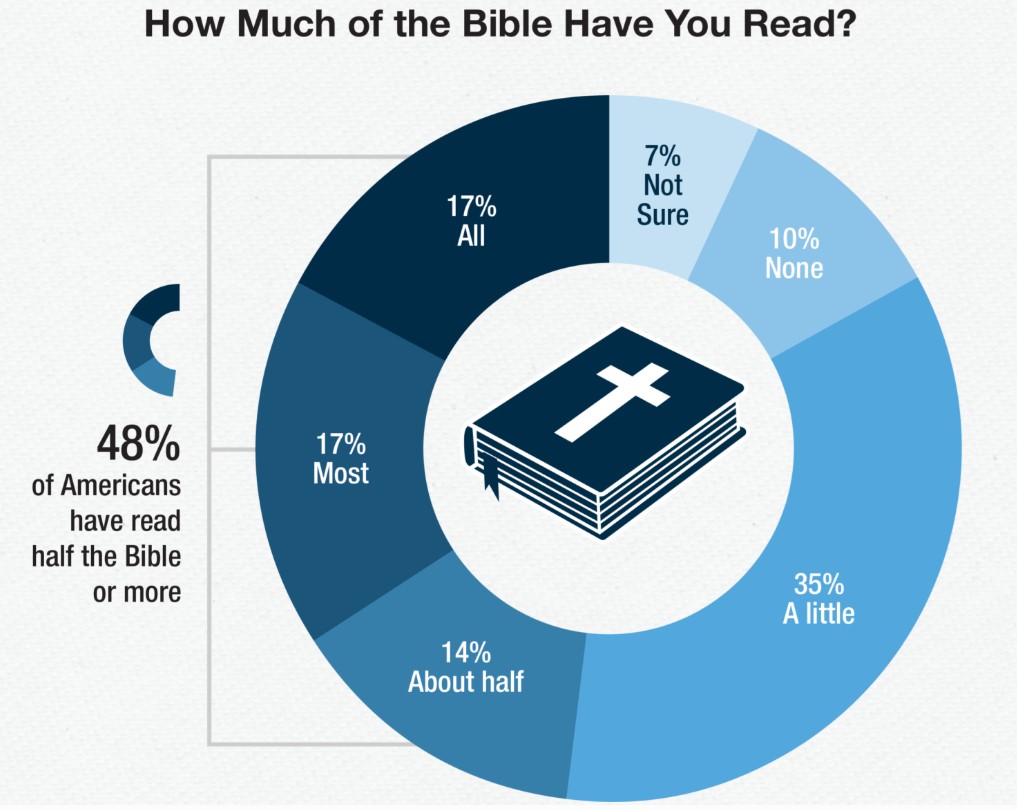
What’s solid is the percentage of the Bible Americans estimate they’ve read, with about half of those surveyed estimating they’ve read at least half of the Bible over their lifetime. Equal portions, 17 percent each, of American adults estimated they’ve read most or all of the Bible, with 14 percent saying they’ve read about half of the Bible, for a total of 48 percent.
Conversely, 35 percent said they’ve read a little Scripture, 10 percent said they’ve read none, and 7 percent said they’re not sure, with a total of 52 percent saying they have read less than half of the Bible.
“Nearly half, 46 percent, of weekly church attenders aren’t regularly engaging with Scripture on their own. When we asked why, the answers were simple: not enough time, and not knowing where to start,” researchers wrote. “So what’s our best advice? Make Bible habits a regular emphasis. Once a year isn’t enough. Think quarterly or even monthly. Recommend a specific plan. Start a group. Preach it. Model it. Repeat it until it sticks.”
Active Bible users are those who read Scripture once weekly to daily, occasional users are those who do so three or four times a year to monthly, and non-users are those who read Scripture less than once a year or never, by ABS definitions. ABS considers adults Scripture-engaged when they read Scripture frequently, consider it central to their lives and seek to live by its tenets.
Key Findings
- Evangelical Protestants continue to decrease as a percentage of the population, comprising 24 percent, 22 percent and 21 percent, respectively, in 2024, 2025 and 2026. Men have driven the loss, falling from 23 percent of evangelical Protestants in 2024, to 19 percent in 2025 and 18 percent this year — while women remained steady at 24 percent since 2024.
- The 17 percent of Americans who are Scripture-engaged, 47 million adults, is about the same as the 18 percent who were Scripture-engaged in 2024. The one-year increase in 2025 put Scripture engagement at 20 percent, or 52 million adults.
- A quarter of Americans, 25 percent, are considered active Bible users, 13 percent are considered occasional Bible users, and 62 percent don’t read Scripture.
- Women have long outpaced men in Scripture engagement — at 20 percent compared to 15 percent in 2026 — but men have narrowed the gap with slight increases in use. In the latest findings, 24 percent of men were active Bible users, up from 22 percent in 2024 — while, concurrently, a few women slipped from active use to occasional use, researchers said.
- Blacks outpace whites and Hispanics in Scripture engagement, with 29 percent of blacks making the mark, 16 percent of whites, and 15 percent of Hispanics.
The findings are based on ABS research conducted Jan. 8–27 in collaboration with NORC at the University of Chicago, which generated 2,649 responses from a representative sample of U.S. adults. Respondents were chosen based on NORC’s AmeriSpeak Panel.
— Diana Chandler is Baptist Press’ senior writer.