
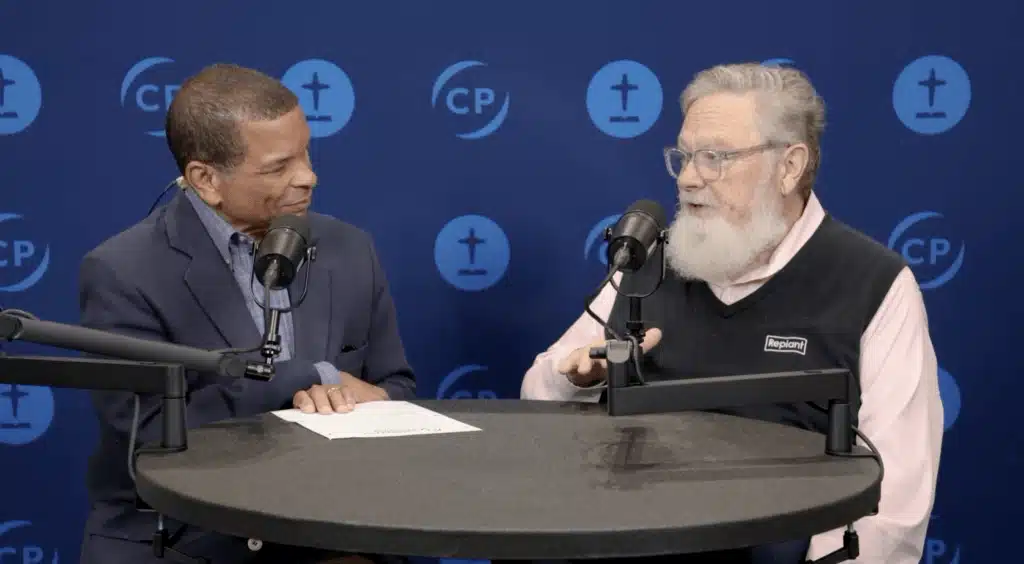
If you want to get Mark Clifton talking, ask him about a church’s impact on its community and beyond. Want to see him find another gear? Call those churches “small.”
“About 13,000 [Southern Baptist] churches last Sunday morning had less than 50 in worship,” Clifton said recently. “Every one of them is important, and every one of them matters. Only eternity is going to reveal the true results of their labor. … We’ve way underestimated what God can do among 42,000 Southern Baptist churches that average less than 150 in every neighborhood, in every village, in every crossroad. It’s a tremendous resource. To say that unless you get to 200 or 300 [in attendance and] are not on the varsity team is really offending to me.
“There are no small churches, because we don’t serve a small God.”
Clifton, executive director of Replant, Revitalization and Rural Strategies for the North American Mission Board, shared those thoughts in Orlando with host Lawrence Smith while recording the Better Together series, which tells about the impact of the Cooperative Program.
The normative-sized Southern Baptist church faces challenges unique to its setting — namely isolation, resources and feeling like it doesn’t measure up to the large church across town, Clifton explained. However, those same churches also tend to underestimate their global footprint through CP.
Clifton has had a personal stake in many replant efforts.
“I’ve replanted a number of churches. In Linwood, Kansas, we had two remaining members,” he said. “I couldn’t have replanted that if the Lord hadn’t brought other Southern Baptist churches alongside us to help, the Cooperative Program … [and] some grants for community development. … We have a great family of churches that want to help and are willing to do it.”
Those churches also have an inherent advantage over those with larger crowds. Younger generations are favoring small mom-and-pop stores or coffee shops over franchises. There’s something to becoming a familiar face, and that’s tougher in a larger crowd.
“They have the feel of the local culture,” said Clifton, who hosts the Revitalize and Replant podcast. “That’s what small churches have. That’s what people today want.”
It’s true, for all their devotion to and familiarity with screens, Gen Z acknowledges the superiority of face-to-face interactions. An Impact 360 study from earlier this year noted that more than half (54 percent) strongly agreed that in-person relationships should be more valued than those online. That figure jumped to 70 percent for practicing Christians.
Believing is one thing, of course. Putting it into practice is another. The average-sized Southern Baptist church is an excellent place for the latter.
“What they want is something real and authentic and meaningful and relational,” Clifton said. “And that’s what small churches can do really well. … We see a light go on when guys realize ‘I don’t have to be a small copy of a big church. I can be what God wants us to be in this neighborhood.’”
Rural churches must also recognize that the population in those areas has increased each year since 2020. That growth has come from both domestic migration and international migration.
“We have a tremendous need to plant rural churches, especially outside of the South,” said Clifton. “If you live in rural America outside of the South, it’s just as unchurched as the Northeast. It’s an incredible mission field.”
Those churches — the ones currently active and those to come — are a significant part of an expansive effort.
“[Through] the Cooperative Program, a normative-sized church [can] celebrate something every time you get together. … Every week you can get up on that platform and you can celebrate something God is doing around this globe through Southern Baptists.”
— Scott Barkley is chief national correspondent for Baptist Press.