
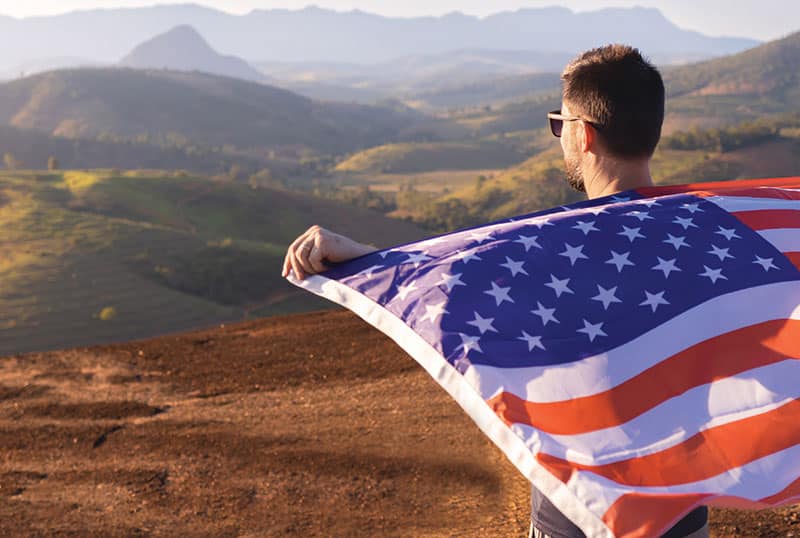
I have been excited all year about the upcoming 250th birthday of the United States. Why? I suspect that for a person my age, it has to do with memories of the bicentennial celebrations of 1976. The 200th anniversary of our country was a dominant social fact that year. It was everywhere. We felt so proud to be Americans and so blessed to live in what we believed was the greatest nation in the world.
Today, I find people somewhat less enthusiastic. “It was easier to celebrate in 1976,” they say. “Things were better then.” Not so fast. The United States had, by any reasonable estimate, lost the Vietnam War. President Nixon had been forced to resign. His successor, Gerald Ford, went through a wrenching process in which he decided to pardon Nixon to spare the country any further trauma after Watergate.
~ 1976, Where Did You Go?
The year 1976 was hardly a golden age, but we celebrated heartily. In those days, patriotism was a more widely agreed-upon virtue. Today, we’re far less certain. It doesn’t help that civics education is a much lower priority now than it was in the past. I grew up in an America that wanted me to know why my country was a great one and why it should be preserved and protected. We live in an age of constant criticism and deconstructionism with what often seems like an endless campaign designed to debilitate us as Americans.
At the recent Southern Baptist Convention in Orlando, I was part of the Committee on Resolutions. As we discussed what we might do, I was eager to talk about doing something for America 250. When it was suggested something like that might be pro forma, such as a thank you to the host city, I urged the committee to treat an America 250 resolution as something very serious and substantive.
We received a couple of very strong submissions that we were able to turn into a strong statement. When you celebrate the Declaration of Independence, especially as a Christian, it is important to recognize the failures we have had in recognizing the promise of the idea that all men are created equal. We put such an acknowledgment in our resolution, but I was determined to add something else that I don’t think is talked about enough.
Yes, we have had some major failures, but we have also had huge, important successes. The committee supported adding a line about the critical role the United States played in defending freedom around the world against totalitarianism of the Nazi and Soviet varieties in the 20th century.
Recently, it has been popular to talk about a Project 1619 having to do with slavery. I would ask that we also consider a Project 1989 for the fall of the Berlin Wall and the liberation of much of Europe. We might add that South Korea remains free today in part because of American efforts.
~ Justified Patriotism and the Baptist Contribution
American patriotism, then, is justified. We have increasingly realized our original promise. The United States has made important philosophical and pragmatic contributions that have affected the course of world events for the better. In addition, it has provided a safe place for hundreds of millions of us to live, thrive, raise our families, and, critically, to worship God freely without our consciences being constrained by some Caesar. That last thing was something else we dwelt upon in our resolution. The United States was a pioneer in religious liberty. And that trailblazing regarding religious liberty was partly done by Baptists. Baptists have been significant contributors to the American constitutional order.
My special hope is that we will remember how important religious liberty is. I wrote a short book for Courier Publishing — Postliberal Protestants — about the need to maintain our commitment to religious liberty and the free church tradition over against the old established church model from Europe. One thing I pointed out is that those nations that hung onto establishment are now the most secular places in the world, while American churches have maintained their vitality and influence.
But there’s another point to make beyond the historical and social science kind of case to which I’ve alluded. When the church gets tied up with the state in an official relationship, the impact on the church is bad. First, making the church legally powerful attracts ambitious figures who crave the church’s influence without its holiness. Second, when government gets control of faith, it tends not to want to relinquish it. Instead, the church ends up as a kind of “department of God,” as I explained in another book, The End of Secularism (Crossway, 2009).
~ Let’s Cherish Religious Liberty
Now that we have reached our special 250th anniversary as a nation, I hope we will regain an appreciation for the religious liberty that has helped keep us both free and actively seeking God’s guidance. I pray also, even as I express great gratitude for all that our nation has to offer, that we will keep Christ first in our hearts and always keep politics in a secondary position.
— Hunter Baker, J.D., Ph.D. serves as senior fellow for civics and religious liberty at the Center for Religion, Culture, and Democracy. He formerly served as provost at North Greenville University.