
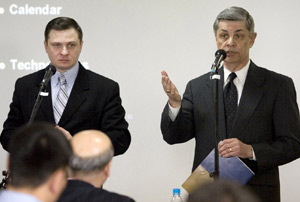
 Carlisle Driggers, right, executive director-treasurer of the South Carolina Baptist Convention, is assisted by a translator in teaching a workshop during the Euro-Asiatic Baptist Federation’s annual meeting.
In a land marked by political and cultural transition, churches can grow stronger and reach future generations with the gospel if they “turn their heart’s affection” toward the kingdom of God, Ken Hemphill advised Baptist leaders from the countries of the former Soviet Union.
“God is seeking a people who will embody his name, embrace his mission and obey his word,” declared Hemphill, national strategist for the Southern Baptist Convention’s Empowering Kingdom Growth emphasis.
He spoke to more than 100 Baptist union leaders who convened outside Moscow to learn how the EKG initiative could make a spiritual impact upon the region’s numerous people groups. EKG blends a spiritual focus on the kingdom of God with planning tools to help congregations discover their vision, mission and values.
“An effort like this helps lay a spiritual foundation for understanding what God is doing in the world and how churches can take part in it,” Hemphill said. “We’re not emphasizing a specific model for the church, but a passion for God’s kingdom that can be customized for the cultural setting.”
Representatives of the International Mission Board partner with two dozen Baptist unions across the sprawling land mass of eastern and central Europe – home to 400 million people who comprise 425-plus language and cultural groups spread across 12 time zones.
The EKG conference – held as part of the 51st meeting of the Euro-Asiatic Federation of Evangelical Christians-Baptist – was funded by the IMB, the SBC Executive Committee and the South Carolina Baptist Convention.
Fifteen years ago, Baptists in the region were part of one union. In the post-Soviet era, churches formed separate national unions and are now grappling with how to cooperate in ministry amid newfound freedoms. Some of the countries where the leaders serve are taking economic strides forward, while others remain burdened by political and religious pressures as they continue to emerge from communism’s shadow.
Baptist work in some of the countries dates back more than a century. Union leaders wonder whether changing some of the old traditions – in order to reach new generations – could generate conflicts among union-affiliated churches.
“The biggest challenge in the short term is the strong reliance on tradition and doing ministry the way it’s always been done,” said Fiodor Baraniuk, director of the Sunday school department for the Russian Union of Evangelical Christians-Baptist. “EKG is helping people to refuse doing church in just the traditional way.”
Even with struggles ahead, Baraniuk has high hopes for the EKG process and future partnerships with Southern Baptists working in Russia and the former Soviet countries.
“EKG has helped our churches have a clear sense of determining where we should go,” he said. “We are trying to filter everything we do through the eyes of the kingdom of God.”
Hemphill hopes EKG will help the churches transcend generational and cultural divides as they adjust to new cultural and political realities.
“It’s really humbling to see these leaders embrace the biblical understanding of the kingdom of God,” Hemphill continued. “While we’re certainly in a different cultural setting, the biblical basis for EKG is cross-cultural. It is not a program, but it must become a passion bathed in prayer and based on God’s power.”
The IMB’s representative in Russia attributed the warm reception EKG received from the Baptist union leaders to its strong biblical content.
“EKG, from beginning to end, presents a biblically based, conservative Christ-centered process for helping churches look at ways to not just grow the unions but at ways to help all evangelical believers,” Ed Tarleton said. “Pastors and leaders in these countries share incredibly strong concerns for being biblically based in what they do. EKG is a great combination for strengthening existing churches and providing the DNA for new churches to be planted.”
Southern Baptist leaders and IMB representatives first introduced EKG to Russian Baptists’ key leaders three years ago. They accepted the initiative as a national ministry focus after a prolonged session of reading scripture and praying about its use among the union’s approximately 1,400 churches. EKG materials have been translated into Russian and Ukrainian, with additional translations under development.
EKG started in the South Carolina Baptist Convention to help churches engage more aggressively in God’s mission for the world.
“A church that isn’t moving forward doesn’t have a heart for the world,” declared Carlisle Driggers, executive director of the South Carolina convention and EKG’s primary originator. “Jesus was preoccupied with calling people to his kingdom here on earth. A kingdom-focused church sees the world through the eyes of Jesus.”
A “kingdom mindset” has long-term value, Driggers added. “This is not a program, it’s not a fad, it’s not something that’s here today and gone tomorrow. It’s being obedient to Jesus when he calls people to the kingdom. And that call is to last until he establishes his ultimate kingdom.”
Calling EKG a “spiritual vision,” Driggers underscored the importance of starting right.
“The whole process begins with spiritual preparation,” he said. “If we’re going to lead the churches, then we have to do it spiritually. The goal of spiritual preparation is for the people of God to be captured by the heart of God through Jesus.”
The Baptist union leaders expressed enthusiasm about their part in the effort.
“Our desire is to live according to God’s will – doing what he asks us in our time,” said Peter Mitskevich, senior vice president for the Russian Union of Evangelical Christians-Baptist. “We would like God to bring revival, and we just want to be his instruments. It is our dream to see the expansion of God’s kingdom in our time.”