
“God has a heartbeat to bring revival to our nation,” Ken Hemphill told participants at an Encouraging Kingdom Leaders Minister’s Conference in Louisiana. “But it will not occur until we have a revival in our giving.”
Hemphill, national strategist for the Southern Baptist Convention’s Empowering Kingdom Growth emphasis, was the featured speaker at the inaugural joint venture of the Louisiana Baptist Convention and host Louisiana College.
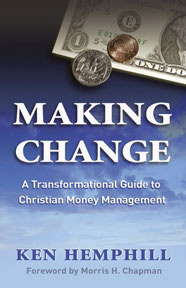
Hemphill, who spoke five times during the three-day conference, debuted material from “Making Change: A Transformational Guide to Christian Money Management,” a new book scheduled for release at the SBC’s June 13-14 annual meeting in Greensboro, N.C.
Hemphill described “Making Change” as “the component of EKG that enables a church to complete the Acts 1:8 task.”
The goal of EKG, he noted, is to re-establish a vision for kingdom growth in the local church.
“EKG is not a program but a passion,” Hemphill emphasized. “At its heart, it is a desire for revival that is based on prayer and dependence on God’s power.” EKG represents God’s heartbeat and is designed to inform and transform the hearts of people, he said.
Hemphill earlier wrote “Empowering Kingdom Growth: The Heartbeat of God,” as the foundation for the EKG emphasis. Meanwhile, “The Acts 1:8 Challenge” by Nate Adams, is an EKG-related resource for a church seeking to reach its “Jerusalem, Judea, Samaria and the uttermost parts of the world,” he said.
The need for revival in the United States is acute, Hemphill said. At least 10,000 SBC churches did not report a single baptism last year, and 51 percent baptized five or fewer. Hemphill also noted that 80 percent of SBC churches are plateaued or declining and that baptisms have been stagnant since the mid-1960s.
“By almost any statistic you examine,” Hemphill said, “the church growth movement is not working.” He also indicated that, for the most part, mega-church growth has occurred as a result of transfer growth rather than reaching the unchurched.
While the state of evangelism indicates a need for spiritual transformation, the financial reality in America is equally revealing, Hemphill said.
During the Depression, 3.2 percent of Protestant income was given through a local church, Hemphill said. In 2001, the figure had dropped to 2.7 percent and currently stands at 2.5 percent.
Statistics reveal that only 4 percent of church members tithe and just 25 percent give systematically.
Additionally, Hemphill related that in 1982, the average level of giving by SBC churches through the Cooperative Program was 10 percent of their offerings. In 2000, it had dropped to 7 percent.
“One reason we are struggling with finances in our churches is because we have cut back on missions giving, and the people have followed the example,” Hemphill said.
Making Change, to be published by Broadman & Holman, focuses on finances from the standpoint of God’s kingdom, Hemphill said.
“The church growth movement emphasized marketing and created three unmentionables,” Hemphill said. “Churches stopped talking about the blood of Jesus, the sin of man and money.”
Making Change provides comprehensive money management for Christians, he said, and it presents a vision to the church and individuals of how financial resources can and should be used to advance God’s kingdom.
Underscoring the blessing of contentment rather than the curse of greed, Hemphill shared practical information on debt reduction, earning, saving and spending.
Hemphill also addressed the biblical laws of giving and emphasized the concept of “whole-life stewardship.”
“Is God pleased with the way we are allocating our finances?” is a question Hemphill said Christians and churches must constantly ask.