
“It’s good to be odd for God.”
That’s what Jim Burton, director of volunteer mobilization at the North American Mission Board, told yellow-shirted disaster relief leaders at the annual Disaster Relief Roundtable, April 25-27, in Arlington, Tex.
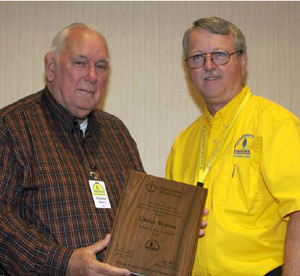 South Carolina Baptist Choice Watson, left, receives the Southern Baptist Disaster Relief Robert Dixon Award from Terry Henderson, the North American Mission Board’s national disaster relief director. Presented during the 2006 Disaster Relief Roundtable, the award recognizes a lifetime of achievement by Watson. About 350 disaster relief leaders attended a SBC-wide Disaster Relief Roundtable, April 25-27, at Fielder Road Baptist Church in Arlington, Tex. In South Carolina, the highest Disaster Relief Award is called The Watson Award.
Burton quoted 1 Peter 2:9, which describes Christians as “a peculiar people” set apart to do God’s will. Disaster relief volunteers exhibit abnormal behavior as they travel hundreds of miles in crowded vehicles – often with strangers – to volunteer, he said.
“It’s not normal to choose to sleep on a floor or shower in a trailer that has wheels on it. It’s not normal to get up at 4 o’clock in the morning – if you even get to sleep at all – to cook thousands of meals, often in high heat and high humidity,” Burton said.
Carrying chainsaws to other states to remove debris from the houses of strangers, packing up materials to care for children they’ve not yet met, and risking health by shoveling mud and muck out of flooded homes are other indicators that Southern Baptist volunteers don’t lead normal lives.
“Folks, you’re peculiar, you’re different because God has done something in your lives,” Burton said. While sitting at home viewing a disaster on television might be easier, he noted, “Our norm is defined by our calling, however peculiar that might be to the rest of the world.”
Burton cited examples from among the 51,782 trained Southern Baptist volunteers – half of them new to disaster relief during 2005.
Sarah Trimble, an assistant state feeding coordinator from Florida, led feeding units in Hattiesburg, Miss., and Lake Charles, La., and later served as a liaison to FEMA for Hurricane Dennis and to the American Red Cross during Hurricane Wilma.
Looking across the audience to Trimble, Burton said, “Sarah, you’re not tired and you’d do it again. That’s odd and I’m glad,” prompting cheers in the crowd.
Jean and Jim Dunn, a California couple who retired to Tennessee, immediately volunteered to provide relief for Hurricanes Katrina, Rita and Wilma. Burton praised the African-American couple’s faithfulness, while urging the predominantly white audience “to continue to open the gate to invite all of God’s volunteers to work with us.”
Among the volunteers Burton met in New Orleans was a multi-generational team that traveled from the state of Washington, taking advantage of a spring break to include college students along with retirees.
“It was a beautiful moment seeing a senior adult and some 20-somethings telling this pregnant woman with a shell-shocked look, ‘We want to take your hand and pray with you right here.'”
Even the Cooperative Program’s role in funding disaster relief is outside the norm, Burton explained. “Our choice is to cooperate – it’s our strength.” In less than 20 years, God has taken Southern Baptist disaster relief “from buddy burners to mobile units that can produce tens of thousands of meals,” Burton said. “He’s chosen you for this task. You are set apart. You are his treasure, his possession, and that’s worth celebrating.”
During the 2005 hurricane season, 500 Southern Baptist disaster relief units representing 41 state conventions operated for 184 days, utilizing 21,000 volunteers whose time amounted to 165,748 volunteer days. That accounted for more than 14.5 million of the 17,124,738 meals prepared by Southern Baptist crews all year.
In the aftermath of the hurricanes, disaster relief volunteers purified 21,595 gallons of water – nearly a third of the 68,846 gallons offered in 2005; facilitated 103,556 of the 155,967 showers made available; completed 25,826 of the 28,253 loads of laundry; relayed 3,107 ham radio messages; and cared for 7,817 children of displaced families.
Activity throughout the year expanded to a total of 166 responses to disasters and included the removal of 13,986 cubic yards of debris and the repair of 7,246 buildings – far more than the 2,683 reported for 2004, which was double the prior year’s number. NAMB reported 187 new units placed into service last year, including those focused on chainsaw recovery, mud-out and rebuilding equipment, kitchens, command and communication lines, as well as childcare, shower, laundry and water purification facilities.
Additional opportunities for volunteer service will come through several new ministries being piloted by NAMB, Burton said, including four-day “Families on Mission” trips and on-site adult training in church-planting principles and evangelism skills tentatively called “The Grove.” Volunteer mobilization also is partnering with the Louisiana Baptist Convention and New Orleans-area churches in a two-year effort to provide as many as 50,000 volunteers through “Operation Noah Rebuild.” Information is available by calling 1-877-934-0808.