
In 1991, Romania’s constitution established it as a republic with a multiparty system. It also declared individual rights such as free speech, religion and private ownership. However, government corruption, unemployment, extreme poverty and distrust of the police – not to mention hundreds of orphaned children – make many Romanians desire a return to their days as a communist-bloc nation.
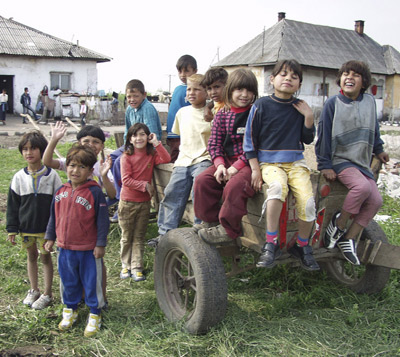 An extended gypsy family of more than 100 people resides on an abandoned military base near Campia Turzii, Romania. Lacking electricity, gas and running water, the family makes do with the remnants of three former warehouses, along with the rubble of two buildings that were demolished. Winter temperatures are known to dip to minus-30 in the area. Next year, the government plans to reclaim the property, making the family homeless.
That’s the scenario Holland natives Fred and Madeleine Van Klingeren found back in 2000 when they settled into the small Romanian town of Dej about 100 miles from the former Russian border (now the Ukraine). Not much has changed since that time among the older generations, but through daily diligence and hard work, the Van Klingerens are seeing a glimmer of hope in the eyes of some of the nation’s youth.
Much of it has to do with a South Carolina-based organization they spearhead – Building Hope Together Ministries Inc. – that was founded by Tucapau Baptist Church of Startex in 2001 as an independent, non-profit organization.
“We believe God created each person and he loves each of us the same way,” said Fred, who can speak several languages but still struggles with the Romanian dialect. “Each of us is created in His image. Some make good decisions. Others make wrong decisions. We can’t change people. We can only show them what it means to be a Christian by how we live and by teaching them God’s word.”
With that in mind, the Van Klingerens spend much of their time visiting Baptist and Pentecostal churches within a 100-mile radius of their home to encourage members through testimony and song. They also work with area orphanages, assist the impoverished, minister to the elderly, and secure financial support for promising young students who can’t afford college.
Most recently, the couple has been working with a couple of churches to establish an outreach center for teens in Campia Turzii, which they feel is key to changing the mindset of the people in helping them overcome their dark past.
“The youth in Romania need to know there is hope for them,” said Fred.
According to official sources, approximately 21.7 million people live in Romania, which is about the size of Oregon. With roots dating back to 200 B.C. and the Roman Empire, it’s comprised mostly of Romanians (89 percent), but also features a strong ethnic influence from Hungary and Germany. Of that, 87 percent align themselves with the Eastern Orthodox Church, with Roman Catholics and Protestants each holding a 5 percent share.
Although Romania’s constitution now endorses “freedom of religion,” it’s here that the Van Klingerens, as well as other Protestants, often face the most difficulties. Many government officials are Orthodox, so they fund their multi-million dollar projects, while simultaneously creating roadblocks that thwart the growth of other faiths.
Why would anyone want to cling to their communist past?
Even if Romanians wanted to forget their communistic past, there are too many reminders. One of the most striking images I saw when I first entered Clue was massive concrete walls of bleak-looking, run-down condominiums – some several stories tall and for several city blocks. In fact, the Van Klingerens live in a similar housing complex in Dej, but have renovated the interior to make it more attractive.
During the communist era, farmers had their property seized and converted into government-owned entities, while the families were carted off to the cities to live in government housing – the concrete condos. Each day, buses transported the displaced families and other residents to the farms to work from sunrise until dark, and then returned them to the city. Everyone had a “job.” If they didn’t work, they didn’t eat. Even so, the portions were small.
Obsolete guard towers still dot the countryside. During the communist era, motorists were subject to an inspection of their car and personal belongings. The vandalized towers now feature shattered glass and graffiti, but they still serve as a haunting reminder.
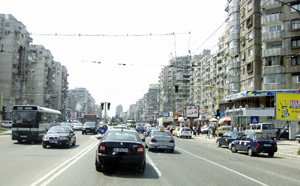 One of the most striking images when entering Cluj and other major Romanian cities is the stretch of concrete walls of bleak, run-down former communist condos, some of which are several stories tall and several blocks long. The government once used the buildings, which are still occupied today, for housing farmers and their families after their land was seized as state-owned property.
Much of Romania’s soil is very fertile, and nearly all families use every inch of their yard to grow food and raise livestock. It’s still the norm – not the exception – to see farmers using an ox or mule to till even massive fields, and numerous Romanians still use horse-drawn carts for transportation.
To the contrary, the unemployment rate is now very high, and numerous homes have been decimated by the departure of husbands and fathers who leave to find work in other countries – never to return. The average Romanian citizen earns $200-$300 per month. That, coupled with parents who can’t afford to support their children, has overwhelmed the government’s ability to adequately provide housing for them in children’s homes or orphanages.
One of the first projects tackled by the Van Klingerens when they arrived in 2000 was restoring two large bathroom facilities that were in deplorable condition at a children’s home in Ilisua. They also supplied clothing, shoes and school supplies.
During my time in Romania, we made two trips to the home. From the moment I stepped out of the vehicle, I was swarmed by children of all ages tugging at me and begging to play football (soccer to them), basketball and other games. Craving affection from outsiders, they clung to me from every angle – five or six at a time – holding both hands and arms, riding my back. It was heartwarming and heartbreaking.
I saw very few caretakers at the Ilisua children’s home, but it’s certain the staff is inadequate to handle the 100-plus children living at the aging facility. What’s more, government funds are drying up and the shelter will close within a year. What happens to the children at that time is unclear, but it’s reportedly a custom that those who turn 18 are forced into the streets with no place to go.
On one occasion, we visited a large extended family of gypsies that was short on food. With us were Curtis Marshall, a retired science teacher from Byrnes High School who now pastors Orrs Baptist Church in Chester; his wife Joan; Ron Poston, an Orrs member; and Daniel Rus, a youth minister from Bethel Pentecostal Church in Campia Turzii who doubled as our interpreter.
Perhaps as many as 100 adults and children of all ages were living at an abandoned Romanian military base. The family lacked gas, electricity and running water. We were advised not to enter their homes because of the risk of disease.
While there, several of the children gathered around me, but a young girl about 8 years old kept tugging at my shirt and speaking in Romanian. After she persisted, I asked Daniel to translate.
“She’s saying ‘I’m clean, I’m clean, you can hug me,'” Daniel explained. Disease or not, I gave the young girl a bear hug and it brought a big smile to her face.
Madeleine and Daniel then began handing out food packages. When all had been distributed, hungry hands still reached out, and we feared a squabble might take place between family members fighting for the remnants.
“I have to remind them I’m a missionary, not a millionaire,” Madeleine said with sadness. “We pray that, just as the Bible says Jesus took five loaves of bread and two fish and multiplied it and fed 5,000, he will take our meager offerings and multiply it for the people of Romania.”
Editor’s Note: Freelance writer Glenn Bridges recently returned from a two-week trip to Romania, where he observed the work of missionary couple Fred and Madeleine Van Klingeren of Building Hope Together Ministries, Inc. BHTMI is an independent charitable organization founded five years ago by Tucapau Baptist Church, Startex.
(Related story: Keeping faith and hope alive.)