
Ed Quattlebaum is a detective whose passion is history. A retired pastor and director of missions, his new career began on Mother’s Day 1998, when called as pastor of Bethabara Church in Cross Hill. Bethabara, founded in 1794, obviously had a long history, he said, but “no one could tell me the story.”
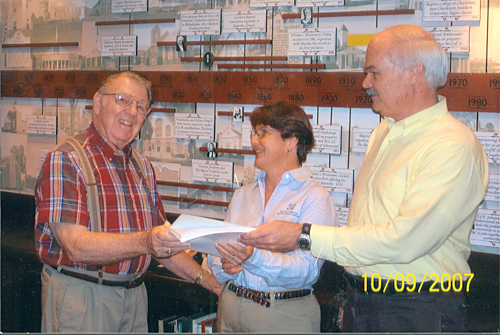 Quattlebaum, left, is pictured with Poster and Mark Jeffcoat, who oversees the convention’s historical collection.
Quattlebaum’s love of history began at Furman University, where he was a history major, and continued during his studies at New Orleans Baptist Seminary. The faculty taught the concept that “trying to go into the future without some concept of the past is like trying to plant cut flowers.” Now in retirement, he rediscovered his love for history and a story that needed to be told. Sarah B. Segars, whose parents had been at Bethabara, wrote a 10-page history in 1956, but Quattlebaum felt additional research was needed to fully preserve the heritage of this early church.
His first stop was Furman University’s Baptist Historical Collection, where Glen Clayton, then curator, helped him find microfilmed records of church minutes. The next stop was the Caroliniana Library at the University of South Carolina in Columbia, where he found the original 1801-1881 minutes and typed transcripts. During the Great Depression, the Works Progress Administration (WPA) typed the handwritten minutes of many churches as part of their work. “The typed minutes are a blessing to researchers, their eyes and their patience,” Quattlebaum said.
The Caroliniana Library is a major source for Baptist records and holds the papers of such notable Baptists as Richard Furman, Oliver Hart and William Bullein Johnson, in addition to church and associational minutes.
Trips to libraries in Laurens, Whitmire, Greenville, Newberry and other places added additional information, and as librarians learned of his project, they started setting aside or copying material related to Bethabara.
Associational minutes were also important. A caution to researchers: “Be sure and check associational records carefully, because as the population of South Carolina increased and more Baptist churches were planted, boundaries changed to meet the needs of the churches.”
Another helpful source of information came from the families of former ministers. “I used the names of the pastors as the skeleton on which to build the history. Each piece of new information added a realistic picture of a person.”
Quattlebaum followed every trail, tracing descendants to Summerville and as far away as Texas. Not only did information come from family genealogical files, but a wonderful discovery was that a descendant of Elder Martin Ball, pastor 1840-1844, is currently studying at Southwestern Baptist Seminary.
“I also used local newspapers and world news to help readers understand the time period,” Quattlebaum said. “One example is five weeks when the church held no services because of the great influenza epidemic of 1918.”
Bethabara’s history is more than a recitation of dates and times. It is illustrated with pictures of 18 of the former 42 pastors. These came from family members, other churches and a variety of sources.
Under the church, he took pictures of the original hand cut timbers that form the foundation. The axe marks are still clearly visible. You can run you hand across them and sense the physical effort that went into building this pioneer church.
Right now, the Bethabara history is in a looseleaf notebook. Quattlebaum plans to have it printed in book form. “The roadblocks and frustrations have all been worth it as I have seen the story come together.
“Church members see the importance of their ministry not only in the community, but also in this country’s Baptist heritage. It lets everyone rejoice that God has used Bethabara, its members and pastors for his glory for more than 210 years.”
Quattlebaum encourages all who would be church historians to “stay with the story, because things open up in ways you can’t expect.”
Protecting church history and records isn’t just the task of historians but of everyone. If your church has a story that needs telling, form a church history committee.
If you need help getting started, contact Mark Jeffcoat at the South Carolina Baptist Convention for additional help. Remember, it’s not just your church’s story; it’s the story of all South Carolina Baptists.
Suggestions for researching your church’s story:
? Check what church minutes are available
? Interview church members
? Check associational minutes
? Contact the Baptist Historical Collection at Furman University
? Contact and visit other area and state libraries
? Contact family members of former pastors
? Read The Baptist Courier on microfilm
? Read area newspapers on microfilm for church references
Jane Poster, formerly Baptist campus minister at the University of South Carolina, is a history consultant for the South Carolina Baptist Convention, assisting churches in finding resources to celebrate and preserve their history. She is the author of “Reckless For Christ,” a story of the early years of Baptist student work in South Carolina. A Greenville native, she is a graduate of Erskine College and Wake Forest University.