
Editor’s note: According to LifeWay Research, the average tenure of a Southern Baptist pastor at one church is seven years. (The median tenure is four years.) Many pastors stay longer, and a very small few serve one church for a lifetime. Over the next few weeks we are presenting a series of articles profiling a remarkable brotherhood of South Carolina pastors who have led their churches for 40 years or more and continue to do so. We know of three such pastors: John Arthur, Boyce Whitman and Richard Alderman. If you know of others, please share their names with us by e-mailing butch@baptistcourier.com or calling 1-888-667-4693.
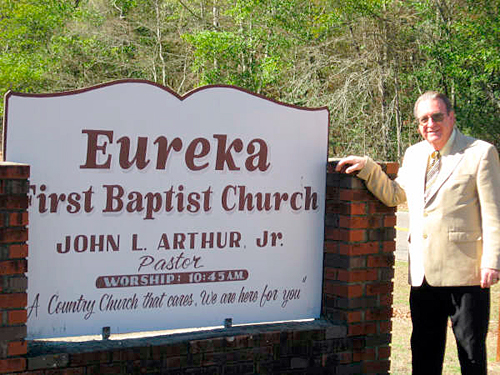 “Even if I had a million dollars, I wouldn’t quit the ministry,” says John Arthur, pastor of Eureka First Baptist Church for 44 years – and counting.
John Arthur, 64, pastor for the last 44 years of Eureka First Baptist Church, a rural community 12 miles southeast of Edgefield, believes pastors who have served one church for periods of time measured not in years, but decades, have a unique perspective to bring to the conversation with today’s up-and-coming church leaders. He thinks a seminar featuring a panel of such long-tenured pastors would be in order.
For one thing, Arthur believes pastors are often too quick to leave their churches at the first sign of trouble. “Like a ship on the sea, sometimes you have to drop anchor and hold your ground,” he said.
Arthur dropped anchor for his ministry at Eureka First Baptist on Jan. 1, 1964, although he began preaching at the white-framed church in August of the previous year. After a few months of preaching on a week-to-week basis, the church asked him to be their interim and soon called him as pastor.
He was a 19-year-old student at North Greenville College, taking classes six days a week and driving home on Saturday afternoons in order to be with his congregation on Sundays. The next few years were “pretty rushed,” as Arthur completed his junior and senior years at the University of South Carolina before heading off to Wake Forest, N.C., to pursue a three-year master of divinity degree at Southeastern Baptist Seminary. Throughout his college and seminary years, he continued to travel home on weekends to attend to his pastoral responsibilities at his church.
Arthur isn’t reluctant to admitting to “ups and downs” at Eureka – a place he affectionately calls “unique” – especially during the early years of his ministry. When he tried to start a multiracial outreach (“don’t put ‘welcome’ on the sign if you don’t mean it”), someone ignited a gasoline bomb underneath his house, causing considerable damage but not resulting in injuries or loss of life. During the same period someone tried to run his car off the road.
He recalls another time when a deacons meeting went sour and he had to jump into his Corvette and speed away with some of the deacons giving chase.
Things have calmed down a bit, he says, laughing, “but I may be out of God’s will – nobody is trying to kill me.”
Looking back, “it’s been interesting,” he said, “both bad things and good things.”
Some of the good things, Arthur said, include seeing children come to the Lord, “seeing a light come on in their eyes.” “Sometimes children are the ones who lead the congregation,” he said.
Another good thing is “helping people grow.” For instance, the church now has a praise team to “help develop some folks musically.” Also, the church has explored a wide spectrum of outreach efforts, from hosting old-fashioned tent revivals to conducting Sunday night worship services in an area nightclub, an event that attracted a bigger crowd than the club draws on a typical Saturday night.
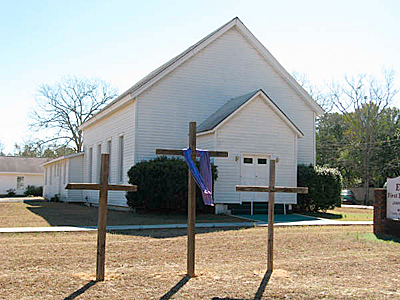 In 1964, Eureka First Baptist Church, located in a rural community 12 miles from Edgefield, called 19-year-old John Arthur as pastor.
Arthur’s desire is that the modest congregation (25-30 people) worshiping on Sunday mornings at Eureka will experience a spirit of celebration. “We get beaten up six days a week,” he said. “When we worship, we want to relax and enjoy ourselves in the Lord. We also learn something; I’ll put some meat on the table and we can all chew on it.”
As a bi-vocational pastor, Arthur has supported himself through a variety of jobs, including teaching school, selling encyclopedias, working in a mill and spinning records as a disc jockey. Currently he is helping conduct survey-based research through the University of South Carolina for a federally funded sexual-abstinence program. “It’s neat that the government is paying to help young people for a change,” he said. Arthur’s current job will play out this fall, but he’s confident he’ll find something else.
He has no plans to retire anytime soon. “My house won’t be paid for until I’m 77,” he said, laughing. “Even if I had a million dollars, I wouldn’t quit the ministry. I’d like to die with my boots on, in the middle of a sermon.”
Looking back over his ministry, Arthur says there are things he might have done differently. He might have stayed in school longer, perhaps have gone for a doctorate. He might have tried to work a little harder. But one thing would remain the same: his guiding scripture, Psalm 78:72: “So he fed them according to the integrity of his heart; and guided them by the skillfulness of his hands.”
“Some pastors are stuck on themselves,” he said. “We all need to realize that it’s not about us; it’s about Jesus and our congregation. We are to help them grow into the likeness of Jesus Christ.”