
Change. The word strikes fear in the hearts of many. But what if the church could embrace change as movement from the Holy Spirit pushing Christians to be more effective in reaching communities?
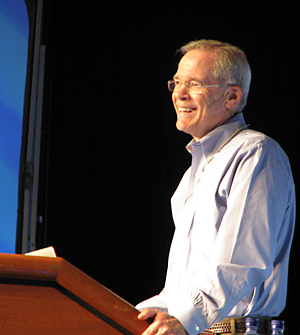 Aubrey Malphurs
The question was posed to a group of pastors, lay people and church staff at the Affecting Change conference May 13 in Columbia. Aubrey Malphurs, professor at Dallas Seminary and ministry consultant, facilitated what he termed “strategic envisioning” as he detailed the challenges, preparation and process of changing ministry paradigms.
“Churches all across America are struggling,” said Malphurs as he gave statistics of church decline. “I know it is not encouraging news, but you can’t work on a problem until you are aware of a problem.”
Malphurs addressed current challenge as the church collides with the realities of culture in the 21st century. He reminded participants that the numbers of church people are declining, while the number of non-Christian groups and other religions are growing exponentially.
“I hope you take that as a challenge,” he said.
Malphurs said the current world climate leans toward the spiritual domain, but people “are just not looking to the church for answers.”
“People are interested in spiritual things because God is doing his job; the problem is, the church is not,” he said.
He also looked at the challenges of ministering to multiple generations in one church, a common question in many congregations.
Yet Malphurs posed the question, “What would happen if we don’t minister to this current generation? Each generation reacts to the generation before.”
He acknowledged that churches must be ready to change before moving forward, and encouraged entire congregations to assess their ministry and evaluate the effectiveness.
“A paradigm shift takes place when your current paradigm doesn’t work any more,” said Malphurs.
He also cautioned against copying another church’s model.
“We have to be very careful about church franchising. What works in Chicago or California may not work in Mesquite, Tex.”
“We have much freedom under the Holy Spirit in how we do church, as long as it doesn’t contradict scripture. The problem is, we are in paradigm paralysis and we just can’t see it.”
Malphurs also walked attendees through the process of developing and evaluating a church mission statement, core values, and vision.
In the end, said Malphurs, the hard work of following the Holy Spirit’s call to assess and evaluate a church’s ministries to a community is well worth it.
“Christianity is all about transformation, is it not?”