
A new medical disaster relief team in South Carolina will have unprecedented access across the world, even in seemingly impenetrable countries.
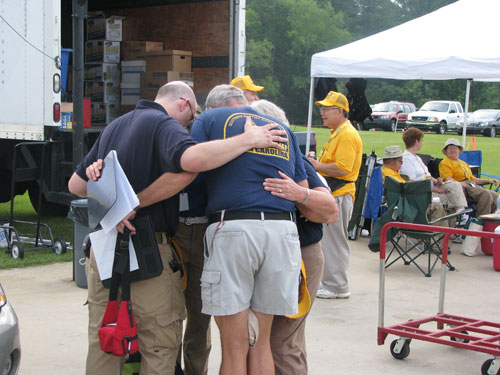 Earlier this summer, the new medical disaster relief unit participated in a field exercise and training in preparation for activation in the event of an emergency. The exercise was staged to emulate a disaster zone, complete with 200 life-size mannequins with various injuries to symbolize mass casualties. Volunteers had to process the patients, interact with victims and medical personnel, and utilize a Medi-Vac helicopter system. The unit also practiced cleaning and packing all equipment.
The new team – consisting largely of medical personnel such as doctors and emergency technicians – is a joint effort between several emergency relief entities, including federal disaster medical assistance teams (DMAT) and the South Carolina Baptist disaster relief ministry.
The unit is fully equipped as an operational, mobile medical emergency center able to accompany other disaster relief teams as medical aid or be sent independently to an area. Lessons learned in previous disasters such as Katrina confirmed to emergency medical personnel that often an infrastructure can be so badly damaged that mobile units are necessary.
All medical team members participate in training classes offered through DMAT. After certification, this unit will be activated as any other South Carolina disaster relief unit.
“Cliff Satterwhite, South Carolina Baptist disaster relief director, thought it would be a good idea to have medical folks around when they sent chain saws off somewhere,” said Ralph Shealy, a Charleston emergency physician and medical team member.
The team is also structured to respond internationally.
“We are preparing all of our equipment so that it is palletized to be loaded onto trucks and aircraft for transport internationally,” said Shealy.
Team member Randy Shell recalls a trip to Sri Lanka after the devastating 2005 tsunami.
“We could not have gotten near the country, but that we had a doctor on the team. The doors opened and we walked right in, and I thought to myself, ‘I bet we can do this anywhere in the world,’?” said Shell, who, shortly after the Sri Lanka trip, formed Southeastern Medical International which is working in concert with the disaster relief team to provide much-needed equipment and medical supplies.
Satterwhite and other disaster relief leadership have also met with the South Carolina Department of Health and Environmental Control to offer the team as a resource in case of a state-concentrated disaster.
Greg Edens, a family doctor in Easley and member of East Pickens Baptist Church, knew early in the process he wanted to be a part of this newly formed team.
“I feel called to do it – to be able to use some of the skills God blessed me with as a platform to share my faith,” he said.
“This is really something God is doing, not something we could have ever come by,” said Eddie Pettit, Camp McCall manager/director and coordinator for the team. “This is something that came about really because there was a need there. We thought we were fine for all those years. We never thought our infrastructure would be damaged. Katrina taught us that we don’t have it covered.”
The new unit is one of two statewide disaster relief units, with the other being a chaplain unit. Other units originate in associations or churches. South Carolina and Oklahoma are currently the only two states with disaster relief medical units.
Pettit says the team still has some major needs, including in-kind donations from hospitals or doctors’ offices.
“There are some things that hospitals really don’t need, but that we do to help us in a major disaster,” he said.
Pettit also points to a need for pharmacists, police officers or security personnel, insurance brokers and attorneys to serve as volunteers on the team.
“We haven’t even scratched the surface of the potential of the people in the state,” said Pettit.
Shealy agrees, recognizing the ability of disaster relief to meet the needs of people all over the world.
“It is the Baptist community that is doing these things. It is where the action is. It is where the work is done.”