
A proposal to study a restructuring of the Southern Baptist Convention is not needed, says Morris Chapman, president of the SBC Executive Committee.
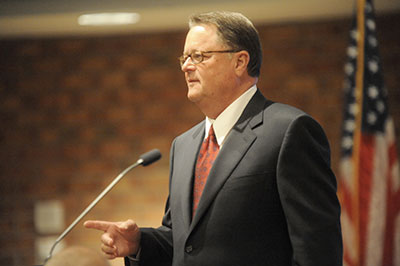 Morris Chapman
Chapman made his feelings known about a proposed Great Commission Resurgence Declaration, which was issued in late April by SBC president Johnny Hunt, in a lengthy Baptist Press column on May 29.
The declaration will be presented at the annual meeting of the Southern Baptist Convention in June. If it is approved, Hunt will appoint a task force to make recommendations on a Great Commission Resurgence and the structure of the convention.
Chapman wrote that as he began reading the 10 articles in the declaration, he “rejoiced in the strong affirmation of our convention’s biblical convictions.” He said, however, that he discovered that article IX and “its commentary stood starkly apart from the other nine articles. It suddenly departed from biblical affirmations in order to address the reorganization of structure and methodology within our denomination.
“The article included several negative characterizations and unsupported judgments of the denomination,” observed Chapman.
Chapman acknowledged the language in article IX was “revised within 48 hours when several leaders in the convention rightly expressed their concern and indicated they could not sign the document as written.” The declaration has now been revised a third time and removes the reference to “restructuring” the denomination, Chapman wrote. The statement in the declaration now reads, “our convention must be examined.” Yet, he said, “changing the language has not made the perceived intent any more acceptable.”
Chapman noted in his column that if article IX remains in the declaration, all attention will remain riveted on it.
Chapman said he is not opposed to effective and efficient organization and noted that periodic changes are necessary. “But revival in our churches and appointing a task force to study convention structures are not two parts of one whole.”
Chapman said that a premise of the declaration is that Southern Baptists must unite around North American church planting, pioneer missions around the globe, and theological education. That has already been done, he asserted. In 1997 the Southern Baptist Convention was restructured so that 95 percent of all Cooperative Program funds received by the Convention were – and still are – directed to the “very three priorities identified by the framers of this declaration: our two mission boards and our six seminaries.”
“At the Southern Baptist Convention level, our structure already has been ‘streamlined for more faithful stewardship of the funds entrusted’ to it.”
Chapman wrote that although he constantly urges state convention executive directors to increase their CP allocations to SBC causes to 50 percent, he “cannot concur that the states are bloated or seeking to retain more and more CP money in the states.
“In fact, just the opposite is true. The slippage in Cooperative Program giving is at the local church level. If our churches still gave the same percentage of CP funds from the churches through the states as they did a decade ago (8.24 percent then; 6.08 percent now), the International Mission Board would have an additional $35 million this year alone – NAMB and our seminary funding formula would each have received approximately $17 million more this year.
“While our annual dollar amount of Cooperative Program [support] has continued to grow, we have reached a historic low in the percentage of CP funds forwarded by the churches, in spite of a restructuring that took place just over a decade ago and was hailed as the dawn of a new day for evangelism and missions. Reallocating our funds will not solve any perceived problems. But a genuine revival might!”
While the document has been signed by some SBC agency leaders, Chapman has not signed it. As of June 2, 3,043 people had signed the declaration, which is posted at www.greatcommissionresurgence.com.
Chapman offered five reasons for not having signed the declaration:
(1) “Though I embrace a call for a Great Commission Resurgence, I cannot sign the declaration as long as article IX remains. Merely reorganizing a national body will not ignite the fires of revival. Why would we believe that reorganizing the convention is the road to revival? Getting bigger is not better. Getting smaller is not better. Only getting better is better.
(2) “I cannot sign the declaration as long as article IX is included because it is likely to be divisive. For 30 days the declaration boldly called for a restructuring of the state and national conventions. Therefore, a study with such an obvious, predetermined bias toward restructuring, whether of the national convention or more broadly, will likely undermine rather than enhance state and national cooperation and unity.
(3) “I cannot sign the declaration if its article IX is interpreted as a need to realign convention priorities. The article IX commentary identifies ‘North American church planting, pioneer missions around the globe, and theological education’ as ‘three priorities around which Southern Baptists will unite.’ But, as noted, Southern Baptists already unite around these.
(4) “I cannot sign the declaration if it includes article IX because we have not been told what is wrong with the convention structures and procedures, and even if we had, the convention does not have the authority to ‘restructure’ the ‘denomination’ at every level as initially urged by the SBC president. Restructuring the convention did not result in revival in 1997.
(5) “I cannot sign the declaration because an undercurrent accompanying the request for structural reorganization is the dissatisfaction that local church missions offerings are not counted as Cooperative Program gifts. I fear this particular dissatisfaction would find its way as a bias into the selection of any study committee or task force. Capitulating to this viewpoint would improve nothing, for if all missions offerings were added to the Cooperative Program totals, there would not be more money for missions, just higher totals reported under the Cooperative Program.”
Chapman said that if SBC messengers adopt the Great Commission Resurgence Declaration and empower the president to appoint a task force or study committee, he will “work diligently with that committee to supply them all the information they may need from the Executive Committee.”
“But for now,” he said, “I am extremely burdened that what may be at stake is our cooperative methodology, our representative trustee system, and our Cooperative Program.”
Wilkey is editor of the (Tennessee) Baptist and Reflector.