
As June signals the onset of hurricane season, Baptist disaster relief responders across South Carolina triple-check their equipment, and Cliff Satterwhite recalls the 1989 category 4 storm that spawned the state’s efficient network of volunteer relief units.
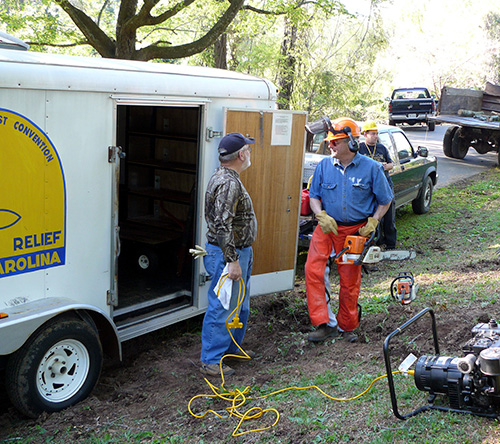 South Carolina Baptist Disaster Relief chain-saw units responded quickly after a tornado hit the Connie Maxwell Children’s Home campus in Greenwood in April.
“Hugo was a wake-up call for us,” said Satterwhite, director of the disaster relief group of the South Carolina Baptist Convention. There were no Baptist-affiliated disaster relief units in South Carolina 20 years ago when Hugo slammed ashore just north of Charleston. Teams from other states poured in to help.
Today there are more than 6,800 South Carolina Baptists certified by state and federal emergency preparedness agencies to respond to situations anywhere in the U.S. The volunteers represent 126 separate units, some of which are owned by churches, others by local Baptist associations. Thirty-eight of South Carolina’s 43 Baptist associations have disaster relief units.
While hurricanes can wreak human misery and property damage on a massive scale, South Carolina’s disaster relief volunteers are prepared to help in other kinds of emergency situations. Chain-saw units were in Laurens County last week helping with clean-up after a tornado. Easter weekend saw twisters in five counties, and South Carolina disaster relief units responded. Food, shower and chaplaincy units established operations near the Myrtle Beach wildfires, and teams from South Carolina spent seven weeks in Kentucky in the aftermath of January’s hundred-year ice storm.
Satterwhite said there are 15 different types of disaster relief units, or “disciplines,” in South Carolina, including a medical response unit with 350 trained health professionals. There is also a unit designed to help children in evacuation settings. The COPE (Christian Opportunities for People Evacuated) unit can mobilize after a Katrina-scale event, and specially-trained adults can provide structured play and instruction for children and “let kids be unstressed,” Satterwhite said.
Beyond the humanitarian assistance disaster relief volunteers provide, Satterwhite said the ministry is brimming with opportunities to share Christ. When volunteers help others, they ask victims to share their accounts of what happened. “When they tell their stories, they almost always then ask, ‘Why did you come?’ That’s when we say that Jesus Christ is our savior and has shown us his love and wants us to share his love with them,” he said. “We have earned the right to tell them why we came.”
As the tropical storm season heats up, Satterwhite hopes South Carolina families will think ahead about being prepared: storing fresh water, food and flashlights, and designating an emergency meeting place in case telephone communications go down. He also encourages churches to think about offering their facilities, particularly family life buildings with kitchen and shower facilities, as evacuation shelters.
Mickey Caison, a disaster relief leader at the North American Mission Board, said preparations for churches could also include creating a communications plan for linking the church with its members during a disaster and, in advance, building strong relationships with community resources such as the Red Cross, the Salvation Army, and city and county emergency management personnel.
Churches can decide in developing a disaster plan if they want to be an SBC disaster relief operations center, a site for a feeding unit or a temporary living shelter for disaster relief volunteers.
“At the same time, their disaster preparedness plan will help them in ways to minister both to their church members and to the community. If they don’t have a plan, the church is just going to react to the situation,” Caison said.
“A lot of times in a disaster, we’ll call a church and ask if we can use their church to set up a feeding unit. But their response is, ‘We’ll have to call a deacons’ meeting or have a business meeting to decide.’ We in disaster relief don’t have time for that so we must go on to another church.”
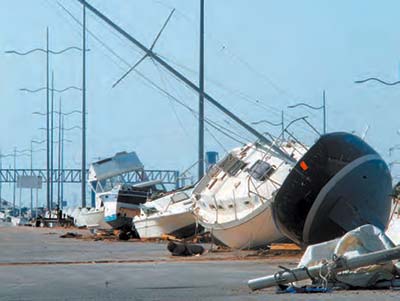 Hurricane Ike wreaked havoc on the gulf coast of Texas, includ-ing these boats in the Galveston area. A disaster relief expert at the North American Mission Board says prepared-ness is the best defense against any disaster.
Caison said unprepared churches without plans lose a golden opportunity to position themselves, their ministries and their facilities in the community.
“In having a strong relationship with community leaders in case of a disaster – before the disaster strikes – the SBC church will have a seat at the planning table,” he said. “Churches will be in on the planning, know what’s going to happen and know how you can be part of the response. Your church then becomes a viable part of the ministry of disaster relief following a disaster.
“The bottom line is that local churches are in a unique position to respond to individual needs in ways that no other organization or group can,” Caison said. “Churches can demonstrate the love of Christ as they meet the needs of disaster victims. Even spontaneous reaction to a disaster in the church’s community can be helpful if it’s coordinated with the efforts of other disaster relief agencies.”
A statewide disaster relief training session will be held Oct. 9-10. Visit scbaptist.org/dr for more information. – With reporting from Baptist Press