
At a press conference minutes after he was elected president of the South Carolina Baptist Convention, Fred Stone spoke emphatically about his desire to see a younger generation of Baptists involved in shaping the future of the denomination.
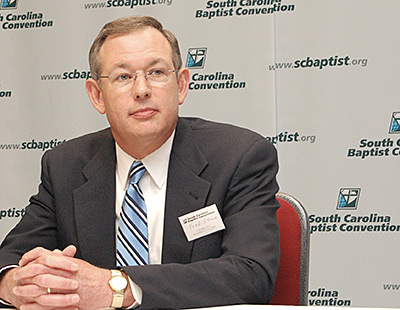 Traditional Southern Baptist denominationalism “is not working anymore,” newly chosen SCBC president Fred Stone told reporters after his election Nov. 11.
“When I come to these meetings,” said the 53-year-old pastor of Pickens First Baptist Church, “I feel young because I look around me and most people are older than I am.” Younger leaders, including pastors and lay people, may “feel like their voices really aren’t being heard, that they aren’t welcome,” he said.
Stone hopes to change that. He said he plans to reach out to younger church leaders at meetings and to listen to them, and he will encourage convention leaders to “listen to how younger pastors are thinking.”
“We have some of the sharpest young minds in our state today as at any time in my involvement in the convention in the past 27 years,” Stone said. “They are theologically sharp, culturally aware and Baptist to the core in their theology. They want to reach people, and they are leading their churches to fulfill the Great Commission.”
Stone said he believes that if younger Baptists are engaged in “helping set the agenda – they will participate – their churches will give, and the Cooperative Program will increase.”
He said he believes the way to bring older and younger generations together is first to identify “what we hold in common,” which he said is the Great Commission, then to “come to the table” to evaluate methodology.
Noting that the SCBC has adopted a budget that is smaller than the previous year and that giving has declined, Stone said most SBC churches, perhaps as many as 89 percent, are either plateaued or declining, and baptisms are down. “Obviously, if you look at what’s going on in the life of our convention right now, it’s not working,” he said.
“Our theology is not going to change,” Stone said. “The Baptist Faith and Message is going to be our doctrinal standard. But we cannot have this idea that this is the only way to do it. What are some other ways we can accomplish our purposes? That’s where younger pastors – need to be given a real hearing because they are as much a part of the South Carolina Baptist Convention as older pastors.
“No one owns this convention. We are the convention. We exist for the glory of God, and I think we need to focus more on that. We need to find ways to best glorify God and fulfill his purpose. And it’s not going to be the way it used to be, because that way is not working.”
Stone said the future of the denomination depends on “looking at ourselves realistically, making changes that need to be made and bringing younger pastors and church members into leadership and active involvement.”
“If we don’t do that, we will be a much weaker convention,” he said. “We will have seen our best days if we do not make a strong, sincere effort to get younger men and women from our churches – not just pastors – actively involved. They are going to have to be participating to help shape our convention into what it’s going to be.”
Stone also talked about the work of the SBC’s Great Commission Resurgence Task Force, which is examining the denomination’s missional focus and structure and is preparing a report for consideration at the annual meeting of the SBC next summer.
Stone said he hopes the task force’s report will not be “divisive,” adding that “it does not have to be so if we keep a kingdom focus.” He said SBC leadership “needs to understand there’s important kingdom work to be done in our state conventions.” Likewise, he said, state conventions “need to understand that our churches need to be doing a lot of things to reach the nations for Christ.”
He said he hopes an end result of the GCRTF report will be “a greater emphasis on giving more” to the International Mission Board and on helping SBC seminaries “to be as strong as they can be.”
He said he hopes for “mutual recognition of – worth and value to the kingdom” among all SBC institutions as the task force examines SBC structure. “We’ve got to guard against these turf wars that could be construed to be developing,” he said.
Stone said widespread support for the Great Commission Resurgence Declaration last year indicates that Baptists don’t want to be about “business as usual” or to be doing “just denominational stuff.”
“We want to be about reaching people, fulfilling the Great Commission, making disciples,” he said.