Editor’s note: The following article was adapted from a story published Dec. 3 in The Christian Index, the state Baptist paper of Georgia. It was written by Joe Westbury, managing editor of the Index.
The U.S. government may have declared that the recession is officially over, but try telling that to Baptists who continue to struggle with paying their mortgages while maintaining their financial commitment to their churches.
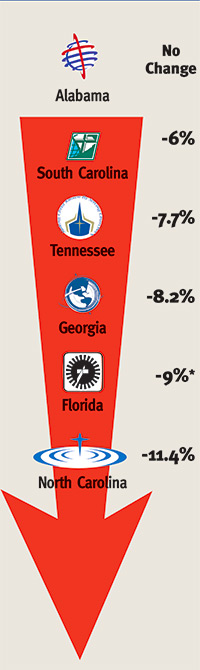
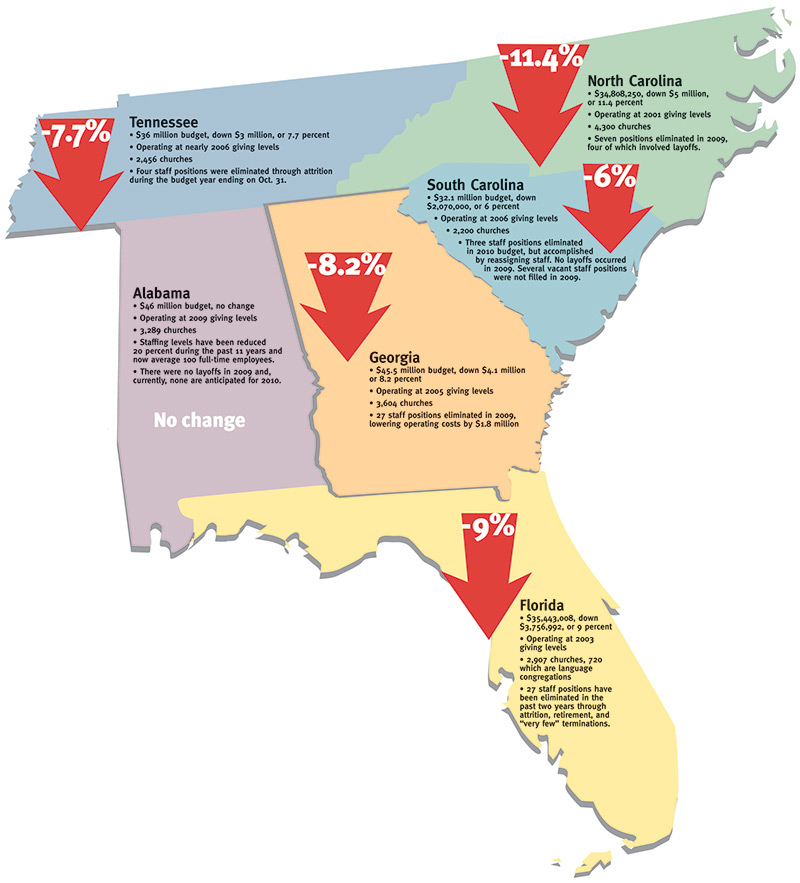
As Cooperative Program giving edges even lower, state conventions in the Southeast are also feeling the pinch and have reduced staffing levels and trimmed budgets to levels not seen in nearly a decade.
In general, state conventions are trimming staff as they trim their budgets, taking funding back to levels not seen in some states since shortly after 9/11. Cooperative Program giving in 2001 simply won’t support the economic growth that occurred in the following decade and fueled expansion in many state conventions.
Few ministries are being eliminated, with conventions preferring to retrench rather than surrender any ground that had been gained in better days. However, staffing levels are being trimmed and employees are being spread thinner to maintain previous service levels.
And as those staffing levels are brought in line with giving levels, convention employees are seeing downward pressure on their salaries. Conventions are becoming more creative in how they reimburse staff for services rendered. If there is no money coming in, it is difficult to share it with staff.
Salary increases are becoming the exception and salary freezes the norm. Some state conventions are reducing benefits but giving small salary increases to help offset the loss. For example, North Carolina is providing a nominal cost-of-living adjustment – 1.5 percent – but increasing the amount the employee pays for health insurance. Tennessee is giving employees the option of accepting a lower annuity funding and taking the amount in a very modest salary increase, or declining the increase and keeping the annuity funding.
In all cases the result may be a net gain, but it is better than a salary reduction, employees say.
Alabama
Alabama appears to be the healthiest of the sister state conventions and is the only one to avoid a budget decrease, operating next year on the same $46 million budget. Cooperative Program receipts will also be divided the same as in 2009, with 57.5 percent for Alabama missions and ministry and 42.5 percent for Southern Baptist national and international causes.
The state convention did not eliminate any staff positions in 2009 but has been on a steady diet when it comes to reducing its employee headcount. That reality was clearly spelled out by messengers in Resolution 1 during its annual convention meeting on Nov. 17.
Titled “On Affirming Great Commission Ministries,” the sixth “whereas” states “The Alabama Baptist State Board of Missions has, through attrition, reduced its staff by 20 percent during the past 11 years.”
The inclusion of the paragraph let its churches know that the state convention is running a lean ship and plans to be a good steward of its resources. Staff salaries were frozen for 2010 to help keep a lid on expenses.
Rick Lance, executive director of the Alabama Baptist State Board of Missions, said he was not discouraged by the fact that the state convention apparently would miss its income goal for 2009 by about 3 percent.
“I really feel as good as I can about where we are in our financial picture,” Lance told the state board during its Nov. 16 meeting prior to the annual meeting. “We are grateful for the stewardship and sacrificial giving of Alabama Baptists.”
The state convention is just now feeling the impact of the economic downturn, he added, and the future is less than rosy.
South Carolina
South Carolina messengers approved a $32.1 million budget, voting to operate on $2,070,000, or 6 percent less, for 2010. The state convention did not make budget cuts during 2009, opting instead in April to implement a spending policy of 95 percent.
James Wright, associate executive director and chief financial officer, told the Index that Cooperative Program allocations will be divided the same as in 2009, with 59.56 percent for South Carolina missions and ministry and 40.44 percent for the SBC.
There were no staff layoffs in 2009, but the convention left several vacant positions unfilled to help with the decrease in CP receipts. Three positions were eliminated through reassigning current staff, Wright said.
The convention has been able to avoid eliminating ministry areas through the downturn, choosing instead “to continue our ministries with fewer staff. We have worked to be even more efficient in our staff time and resources,” the administrator explained.
Jim Austin, SCBC executive director-treasurer, said he is grateful for the “sacrificial giving” of South Carolina Baptists during tough economic times. “South Carolina leads the South in having the highest unemployment rate,” he said, “yet South Carolina Baptists remain faithful to Cooperative Program and Great Commission giving that effectively impacts the world for Christ.”
Tennessee
In the Volunteer State, Tennessee Baptists will operate on a $36 million budget for 2010, down $3 million, or 7.7 percent. That will revert state spending to a level not see for five years, back in the 2005-06 budget year. Tennessee operates on an October-September fiscal year.
State leadership did not wait long to begin adjusting its budget expectations. In November 2008, shortly after messengers approved the $49 million budget for 2008-09, the budget was trimmed by 4 percent. A few months later in March 2009, it was trimmed another 6.5 percent, for a total of 10.5 percent.
Administrative director William Maxwell said the TBC/SBC allocation for 2009-10 will remain “a true 60/40 percent with no preferred items.”
The state convention downsized four positions in the just-ended fiscal year through attrition. Maxwell said no department ministries were eliminated through the cuts; instead, the work was absorbed by other staff and through new processes.
As is becoming common in the general workplace, there were no salary increases in the 2008-09 or 2009-10 budget years. However, “salary and benefits were restructured to give staff more options. Overall compensation for all employees remained level,” Maxwell said.
Georgia
Georgia Baptists approved a $45.5 million budget, down $4.1 million, or 8.2 percent, from the previous year. When that amount is added to the previous year’s 5.16 percent drop, the convention will be operating at a level 13.43 percent below that of two years ago, said Mike Williams, assistant executive director and vice president for operations.
The state convention had been planning for the decreased funding level for much of 2009 and had been trimming costs and overhead for much of the year. Part of that downsizing impacted staffing levels: 13 positions were eliminated in March and another 14 staff were removed from the headcount in November, for a total of 27.
The reorganization was painful but necessary in the current economic climate, Williams said. The cuts lowered operating costs by $1.8 million and reduced payroll obligations by 10.64 percent.
Staff salaries will remain frozen for the second year. Headcount at the Duluth office building is currently 175, down from last year’s 202.
Florida
The Florida Baptist Convention has trimmed 27 staff positions over the past two years but continues to see downward pressure from weak Cooperative Program receipts.
“We have tried to be proactive for the past two years, gradually letting people go through retirement, attrition, and a very few releases and as such we reorganized, eliminated some positions, and chose not to fill others,” explains communications department director Barbara Denman.
“This has been a process across the board – campus ministry, board-elected staff, support staff, and conference center employees. We have tried to do it as painlessly as possible. At a high two years ago, we had 185 employees; now we have 158 in all positions. That figures out to be a decrease between 12 and 13 percent.”
Messengers to the annual meeting in Pensacola approved a $35,443,008 budget, down $4 million, or 9 percent, from the $39.2 million budget approved the previous year. But that $39.2 million budget for 2009 did not have staying power.
State leadership trimmed the budget twice during the year, settling at $35,150,000 to end the year in the black. The 2010 budget represents less than a 1 percent increase over that in-house adjustment but still down 9 percent from the budget approved by messengers a year earlier.
The new budget includes allocations of 53.75 percent designated for Florida Baptist State Convention causes; 40 percent to Southern Baptist Convention causes; 2.75 percent designated for church-planting assistance; and 3.50 percent to the church annuity program. Percentage distributions between the SBC and Florida Baptist missions and ministries remained the same as the prior year.
The cuts have not been without its downside. In the past three years, the state convention has started about 140 new churches a year, many among language groups. That count fell to 118 in the 2008-09 year just ended.
North Carolina
The relative bright spot among the struggling conventions is North Carolina, which posted the greatest decline among the sister conventions but is using the opportunity to reorganize and provide greater support to some ministry areas.
It needs to be noted, however, that in addition to a sluggish economy, Tar Heel Baptists have also been embroiled with internal strife as moderates and conservatives battled for representation. The state convention lost several high-profile churches aligned with the Cooperative Baptist Fellowship in recent years that have caused a drag on giving levels.
However, that turmoil appears to be nearing its end as the state convention abandons a multi-channel funding approach for one unified budget which exclusively supports the Cooperative Program and no longer accepts and channels funds to the CBF.
John Butler, executive leader for business services for North Carolina Baptists, said 2010 would be “the fifth year of the past seven when income has been lower than the previous year.” That meant the convention had to trim $5 million from where it began 2009 in order to offer messengers a balanced budget for 2010 of $34,808,250.
The cuts came at no small cost for many, including reducing staffing levels. Butler told the Index that convention officers closely monitored the downward spiral throughout the year. Then in mid-August as offering receipts continued to drop, seven positions were eliminated – four of which were staffed. That saved the convention $500,000.
Those cuts came on the heels of a salary freeze for employees for 2009. The 2010 budget included a 1.5 percent cost-of-living increase for employees, though the BSC also increased the amount that employees pay for their health insurance.
“The net effect was pretty much break-even for most staff,” Butler told the Index. About 100 employees now work out of the Baptist Building in Cary.
Those cuts come on the heels of deeper cuts in 2003 when 15 employees were downsized and the convention was restructured. Prior to the restructuring, individual consultants enjoyed a nearly 1:1 ratio to administrative support staff; after the downsizing, the ratio shifted to as high as one administrative staff to four consultants.
While the 2003 restructuring affected primarily support staff, the second round of downsizing this year affected primarily higher salary consultants. But the dark cloud that trimmed $5 million from the budget had a silver lining for ministry areas that received significant funding increases:
? Cooperative Program funding to the Southern Baptist Convention continued a five-year trend of one-half percent increases annually. The 2010 division between the BSCNC and SBC is 65.5/34.5. If the new budget is met, the compounded 2.5 percent increase would mean an additional $870,000 to the SBC over 2005 levels – and the same amount less for ministries in the state.
? Significant increases were also budgeted for priority areas, such as $44,000 for church planting; $174,000 for the SBC; $106,680 for Baptist Children’s Homes; and $159,000 for campus ministry.
But those increases had to come from somewhere:
? Convention and Board operations were trimmed the most, with $724,000 savings found in insurance, some cost shifting to employees for health care and annual meeting expenses.
? The congregational services group lost $496,000, or 18.7 percent, of its budget. That is the group whose consultants interact most with existing churches in areas such as marriage and family ministry, senior adults, music, church health, Sunday school, and children’s home ministry.
? The public relations and resource development group was dropped, with most responsibilities and their money shifted to several groups – including $576,541 to church planting and missions development – but total funds for those functions were cut by $240,000.