
Thousands of food-laden “Buckets of Hope” are making their way to Haitian churches, and Chileans are providing meals to 2,000 people each day, thanks to South Carolina Baptists who continue to send aid and encouragement to millions struggling to rebound from devastating earthquakes.
South Carolina Baptists shipped 6,448 five-gallon plastic buckets loaded with food to Haiti, exceeding a state goal of 5,000 buckets. In Chile, local churches are serving up to 2,000 meals a day after receiving equipment and training from two South Carolina Disaster Relief mass-care feeding teams.
Hands-on relief for Haiti
“The Haitian churches will actually distribute the buckets so that people will see the buckets coming from local churches,” said Cliff Satterwhite, director of the disaster relief group, SCBC. “Still, each bucket carries the message, ‘A Gift of Love from Southern Baptists’ in French, Creole and English.”
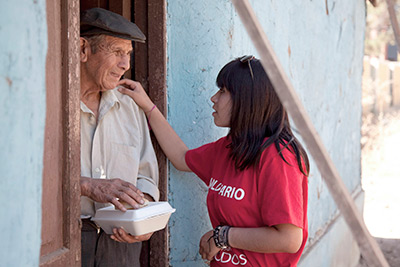 Johanna Cavero Delgado, a National Union of Young Baptists volunteer from Puerto Montt, Chile, delivers a meal to an earthquake survivor in Talca. Working together, Chilean Baptists and South Carolina Baptists prepared the food.
Satterwhite said he believes churches from across the entire Southern Baptist Convention will send more than 100,000 buckets. Each bucket includes rice, cooking oil, dry beans, all-purpose flour, sugar, spaghetti noodles, peanut butter and a storage bag.
“This project allowed many Baptists to participate in something hands-on for Haiti relief,” Satterwhite said. “Most people won’t be able to go to Haiti, but they can have a part in packing a bucket for relief efforts.”
South Carolina’s fifth medical team served in Cap-Haitien, about six hours from Port-Au-Prince. Team leader was Terry Parrish from Mountain View Church in Six Mile.
“There are as many as 500,000 displaced people in Cap-Haitien,” Satterwhite said. “These are people who chose to get out of Port-Au-Prince. Because of the migration, conditions are more difficult than they were in Port-Au-Prince.”
The medical team assessed the needs for future medical teams.
“We do know that future teams will include some rebuilding and crisis-intervention teams. There is a fear factor over building safety in Haiti.”
Training Chilean feeding teams
“Chilean churches adapted quickly to providing mass feeding, and the ministry has really taken off,” said Satterwhite. “Our first team bought equipment and provided training, and our second team has now returned after consulting there with local churches. We have gone from 1,000 to 2,000 meals per day.”
Satterwhite said the meal service and its transition to local churches has been smooth, especially considering that food must be purchased fresh from local markets and then cooked and served soon after purchase.
“The Chilean churches now see themselves as disaster relief workers, and that was our purpose,” he said.
As winter approaches in the Southern Hemisphere, attention turns to the coordination of building teams, working to construct 500 prefabricated housing units for displaced people. A crew of eight volunteers can construct two of the 12-by-18-foot units in a day. Each has a tin roof, door, and windows. The Chilean government has approved the design, which will cost about $1,500 to build.
“We are working alongside other state conventions to send building teams,” Satterwhite said. “South Carolina will send its next building team, April 13-21, and we are putting together a team with many of those who came to our March training event at Anderson University.”
Satterwhite said initial construction will be in the town of Molina, where the goal is to construct 400 houses with help from all state conventions.
South Carolina Disaster Relief is the lead state in Southern Baptist aid to Chile following the 8.8-magnitude earthquake in February. – SCBC