
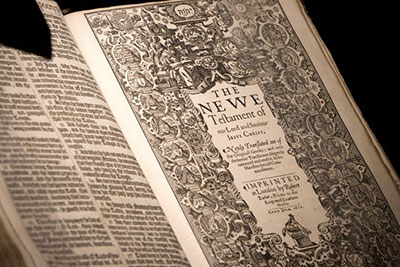
The year 2011 marks the 400th anniversary of the King James Bible.
Alister McGrath, chair of theology, religion, and culture at King’s College, London, notes the great impact of the KJV upon English language and culture: “The King James Bible was a landmark in the history of the English language and an inspiration to poets, dramatists, artists, and politicians. The influence of this work has been incalculable. Without the King James Bible, there would have been no ‘Paradise Lost,’ no ‘Pilgrim’s Progress,’ no Handel’s ‘Messiah,’ no Negro spirituals, and no Gettysburg Address. These, and innumerable other works, were inspired by the language of this Bible” (from “In the Beginning: The Story of the King James Bible and How It Changed a Nation, a Language, and a Culture,” pp. 1-2). Even more important than its influence upon English language and culture has been the KJV’s impact on the spiritual development of its readers.
The KJV arose out of controversy over competing versions. In 1560, William Whittingham (John Calvin’s brother-in-law) produced the Geneva Bible. The Geneva Bible became the Bible of Shakespeare and the early Pilgrims on the Mayflower. It included not only the biblical text, but also study notes (scholarly explanations of the text). These additional notes greatly displeased King James I of England (1566-1625) because one could interpret them as questioning his authority. For instance, the note for Exodus 1:19 suggested that the Hebrew midwives were right to disobey the Egyptian king’s commands, though wrong for lying: “Their disobedience herein was lawful, but their dissembling evil.”
Mindful of King James’ disdain for the Geneva Bible, the Puritan John Reynolds at the Hampton Court Conference in January 1604 recommended that the king authorize a new translation. James agreed, and more than 40 scholars worked on the project from 1604 to 1611. Amazingly, the translation they produced reigned supreme among English-speaking people (though not universally) until the 1880s, when scholars produced the Revised Version.
Several factors led to the dethronement of the KJV, including discoveries in the 19th and 20th centuries of Greek manuscripts far older than those employed in 1611, and the increasingly archaic and obsolete character – at least, in the opinion of some – of the KJV’s English. Today, the majority of Christians employ more recent versions, such as the NIV and ESV. Nevertheless, to date, no English translation has dominated to the extent that the KJV once did.
To commemorate the 400th anniversary of the King James translation, Charleston Southern University will host Michael Haykin, professor of church history and biblical spirituality at Southern Seminary, at its annual Staley Lecture series. Haykin will share the fascinating story of the KJV on March 8 in Lightsey Chapel from 9:30 to 10:50 a.m. Admission is free. Contact me at mbryant@csuniv.edu for more information.
– Bryant is assistant professor of religion at Charleston Southern University.