
Michael Haykin, professor of church history and biblical spirituality at Southern Baptist Seminary, was the guest speaker March 8 at the Staley Lecture Series on the campus of Charleston Southern University. The event was hosted by the university’s religion department, and the topic was the King James Bible. This year marks the 400th anniversary of the Bible’s translation, and Haykin presented the story of the translation and its impact on both English language and culture.
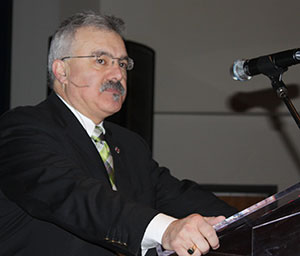 Michael Haykin speaks on the translation and influence of the King James Bible at CSU’s Staley Lecture Series.
“Our world is very different because of this Bible,” said Haykin. “This is the Bible that, from the time of John Bunyan, was used as they preached the gospel; this is the Bible that was used to preach during the Great Awakening; this is the Bible that was taken by missionaries like David Livingston of the great missionary movement of the 19th century; this was the Bible that was defended during the challenges and controversies of the early part of the 20th century.”
The events leading up to the first printing of the King James translation captured the audience at the Lightsey Chapel Auditorium, starting with William Tyndale’s efforts to translate and publish the New Testament in 1526 – some 80 years prior to the KJV’s release. “There is – almost a beehive of translation activity regarding the Scriptures during this time,” said Haykin. Thirty-four years later, in 1560, the Geneva Bible was published. Over the next 50 years, more than 120 editions of the Geneva Bible were published.
Haykin said those two historical translations laid the groundwork for the King James translation, which was published in 1611.
“The King James Bible has deeply permeated the English language,” he said. “If you compare the King James version to the Shakespearean corpus – written roughly at the same time – the Shakespeare can be deeply challenging, but the KJV has clarity even now.”
The mid-20th century to the present has been a time of massive translation activity. Four major English versions came out during that period: the Revised Standard Version, the New American Standard Version, the New International Version and the English Standard Version.
Haykin sees some challenges in the future for biblical translation. For about 300 years, the King James was used in churches. “The KJV was the version that could be memorized and used in congregational readings,” he said. “Today, you have many versions in a church.”
The other challenge is that there are about 2,000 people groups that still don’t have the Bible in their own language. “We need to give the people of God an accurate word, so they can understand the glories of God,” said Haykin. – CSU