

One of the things I enjoy most about serving as evangelism director for Savannah River Association is the opportunity to work with some of the most passionate and godly folks around, and the last several weeks have been no exception. On a recent Thursday, Larry Leming, SRBA mission ministries director, and I traveled to Atlanta and participated in a vision tour of the ministries being facilitated by Urban Atlanta Church Planting.
 Criss
CrissThe purpose of our trip was to explore opportunities to work with UACP to further our goals of assisting churches in our association in developing their own strategic partnerships, providing missions opportunities to SRBA churches with no mission partnerships, and ultimately enabling our churches to carry out the Great Commission through an Acts 1:8 strategy.
There are several benefits to these partnerships, both apparent and not so apparent. The most obvious benefit is the potential kingdom impact of reaching an urban center such as Atlanta for Christ. Some of the less obvious benefits are the opportunities for the members of our churches to gain ministry experience in reaching people in an urban context, the opportunity for us to strengthen existing relationships between and within our existing churches, and to forge new relationships.
Urban Atlanta Church Planting is a cooperative effort of Southern Baptists to intentionally plant healthy, reproducing congregations inside Atlanta’s perimeter. UACP is focused on beginning intentionally missionary congregations among all people groups living in the apartments, condos, and single-family housing communities inside of the I-285 perimeter, intentionally reaching unchurched and lost people.
We began our trip by meeting Jim Haskell, executive director and lead strategist for UACP. (Jim is a native of Hardeeville and the son of J.W. Haskell, former pastor of Hardeeville First Church and Maye River Church.) Jim presented the “big picture” vision of UACP. He also explained the present conditions inside of the perimeter and where God has already been working though UACP in Atlanta. Jim told us that approximately 877,000 people live inside of the perimeter and that it is estimated that more than 525,000 of those people are unchurched or have no religious affiliation. We also learned that 41 percent of the population lives in rented housing and that, typically, 95 percent of those living in multi-housing units do not attend church.
Only 28 percent of the total households inside the perimeter have children. This presents an interesting situation, because Baptists are traditionally more effective at and geared toward reaching married couples and households with children. Another interesting figure we learned is that 68 percent of the people living inside the perimeter are single, and 15 percent are single parents.
Among the traditional churches located inside the perimeter, many members do not live in their church neighborhoods, do not reflect the “people groups” living in their church neighborhoods, do not impact their church neighborhoods,, and do not know or relate to those persons who make the decisions that affect the neighborhood. As a result, many Baptist churches are dying, declining, or just holding their own. Ninety-two of 160 Atlanta Baptist churches have closed or moved outside the perimeter since 1960.
In response to this staggering situation, UACP has focused on reaching unchurched and lost people by beginning intentionally missionary congregations in these people’s communities. In an effort to accomplish their mission and to attempt to penetrate the lostness of urban Atlanta, UACP has endeavored to plant at least 50 churches with traditional organizational structures, to begin at least 50 cell and or house churches, to start at least 100 Bible study/fellowship groups, and to conduct at least 200 significant servant evangelism/acts of kindness events by 2014.
After hearing about the overall vision of UACP, we were introduced to Bill Murray – no, not that one – who is working to establish communities of faith within Atlanta’s “apartment nation,” those 41 percent of the population who live in multi-housing. Bill told us that one of the unique things about his ministry to these communities is that the residents are often moving from one apartment complex to another. The transient nature of this apartment culture presents both a challenge and an opportunity. The challenge is that one only has a limited time to reach these people and then disciple them. On the other hand, the opportunity is in the fact that when a person has been sufficiently discipled, he or she will reproduce this community of faith at their next apartment complex. Bill’s goal is to saturate his current apartment community with believers, disciples, small groups, and cell churches – all of which would be reproducing themselves – and to saturate apartment communities across Atlanta with an expanding network of similar communities of faith. There are opportunities to partner with Bill in prayer, and for groups of four to six to join in prayerwalking and serving through community events, such as pancake breakfasts.
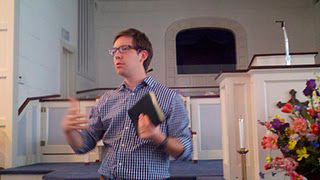 Cameron Ford of First Church of Chattahoochee, on Atlanta’s Upper Westside, explains his church’s missions ministry.
Our next stop was First Church of Chattahoochee, on Atlanta’s Upper Westside, where we met with Cameron Ford. Cameron caught us up on how they are reaching folks for Christ through the Upper Westside Mission, a church plant of First Church. Upper Westside Mission seeks to reach the people of three specific neighborhoods with the gospel through the formation of small groups meeting in homes. The vision for Upper Westside Mission is to have two or three healthy, growing groups meeting weekly in each neighborhood and to bring the groups together monthly or quarterly for a worship celebration service. As Upper Westside Mission gains momentum there are many opportunities for partners to come alongside with, such as community service projects and backyard bible clubs/VBS for the children.
Once we had a grasp on the basics of Upper Westside Mission, we moved on to the Sandy Springs area of Atlanta. There we met with Deane Johnson, who is leading Sandy Springs Community Church, which is focusing on strengthening families in the area by serving in the local elementary schools and hospitals, providing support groups for marriages and parenting, and providing an after-school program to help students with their schoolwork. Many of the parents in the community don’t speak English natively or don’t speak English at all, so serving their children is one way of helping meet the needs of these people. Sandy Springs Community Church is presently meeting about twice a month in an ESL school and is growing rapidly. There are many prospective partnerships that could be undertaken to support the ministry of Sandy Springs Community Church in their area.
The last place we visited was Washington Road Neighborhood Church, where we met Jimmie Jordan. Jimmie and Washington Road Neighborhood Church have a passion for reaching the destitute people in their neighborhood, the East Point community, which, like so many communities today, is plagued by crime and drugs. Washington Road Church would like to one day be able to minister to all of the needs of the people in their community by helping to provide food, clothing, and education for those in need. Jimmie has a passion to reach the young men of the community and to show them that they can change their lives through the power of Christ. His wife, Amelia, has a heart for young girls and women, and her ministry is focused on teaching these young ladies life skills, such as cooking. In an area plagued by crime and drugs, Washington Road Neighborhood Church seeks to be a light pointing the hurting to Jesus Christ. There are countless opportunities for partnering with Jimmie and Washington Road Neighborhood Church including prayer, community service events, and neighborhood outreach.
Of all the things that I took away from our time in Atlanta, the most impressive was the great lostness in the city and the fact that traditional ways of “doing” church have been unsuccessful in reaching these people. Our common model of church culture is not relevant to these people, but the gospel of Jesus Christ is. The Great Commission of our Lord calls us to go to the people and make disciples of them, not for us to call the people to ourselves. We don’t need a new model or method, but a resurgence of an old one. That method is the method that was given to us by the example of the Lord Jesus Christ, living in our communities and spending every day focused on reaching people with the gospel. I can assure you that Jim and the rest of the folks at UACP are doing just that, and my prayer is that we all will partner with them for the greatest kingdom impact – in Atlanta, in Beaufort and Jasper Counties, and across South Carolina.
For more information on missions opportunities through Urban Atlanta Church Planters, visit the UACP website at http://www.urbanatlantachurchplanting.com.
– Criss is missions engagement minister at Crosspoint Church, Bluffton.