
Editor’s note: We submitted questions to the CEOs of the seven ministry partners (institutions) of the South Carolina Baptist Convention regarding the recommendations in the report of the SCBC Great Commission Resurgence Task Force that deal with election of trustees to those institutions. Their comments can be found in a story beginning on page 1. In this Q&A, Anderson University president Evans Whitaker provides an expanded response to our questions.
COURIER: GCR task force recommendation 8 calls for SCBC ministry partner CEOs to have greater input in the selection of trustees by way of mutually agreed-upon nominees. How important is this proposal to your institution?
WHITAKER: The provision in recommendation 8 is not just important, it is essential to our university. It and recommendation 9 together are the only things in the GCR proposal that make it possible for the university to take a monetary cut and continue to flourish.
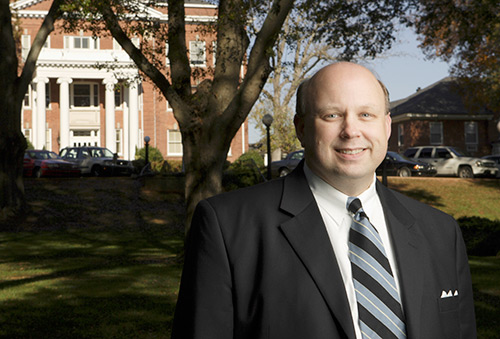 Anderson University president Evans Whitaker
Governing and setting the strategic direction of a Christian university with 2,700 students, an annual budget of more than $43 million, and a small endowment in these treacherous economic times requires a board that is not only biblically sound, but diverse in financial, legal, educational, spiritual and strategic planning expertise. A trustee board is like a team that must include people with various types of expertise and characteristics, including having an adequate number of trustees who have the capacity to make major gifts. Anyone who has had any recent experience in higher education administration will tell you that a key and fundamental purpose of trustee boards is to give and raise money. Our Baptist universities are no different.
Each year, we must provide millions in scholarships and periodically invest millions into our physical plant to stay current and competitive. Right now, most people would be astonished to know how much we need to invest in our physical plant in the next few years – not for luxuries, but for basic necessities like new plumbing and electrical infrastructure for century-old residence halls, not to mention classrooms and technology. To do that for any of our older buildings alone would be upwards of a million dollars each (and we now have more than 30 buildings on campus). I certainly mean no offense in this, but the convention’s support, while necessary and deeply appreciated, is inadequate to meet these needs.
Recommendation 8 gives us a “fighting chance” to not only replace the money we’ll lose from the convention, but to also develop a strong giving and fund-raising capacity on our board that the current nominations process does not adequately facilitate. We understand that not every trustee has the gift to solicit funds and not every trustee can make major gifts, but this recommendation will really help us in ensuring that we can work closely with the nominations committee to find more qualified Southern Baptists who can help us in this area.
The current nominations process has been in practice many years. I’m not personally aware of any updates to it. No doubt, everyone in the current nominations process has good intentions, and there is good mutual trust and respect between the committee and the institutions. But good intentions and mutual trust don’t necessarily equate to a good process – one that meets the institutions’ needs as well as the convention’s needs.
For example, in some years, we have been denied some individuals we recommended solely because our nominees were personally unknown to the committee. One year, all of Anderson’s nominees were rejected, and the reasoning we were given was that no member on the committee personally knew them.
In the view of a lot of folks, our convention’s vetting process for trustees could be strengthened greatly with the changes suggested in the GCR proposal. The GCR proposal ensures that the process would involve a deeper and more protracted face-to-face opportunity for the institution to dialogue with the nominations committee, respond to questions, gather important additional information, clarify information about a particular nominee, and justify the names of individuals we wish to serve on our governing board. That’s only fair. After all, our institutions are multimillion-dollar non-profit enterprises that have exceedingly serious missions, widespread reputations and huge constituencies, enormous accreditation and governmental requirements and reporting responsibilities. They deserve the very best and most capable board members we South Carolina Baptists can give them.
Contrary to what some have perceived, we are not asking that we be allowed to name our own trustees. We know that would not be approved by the convention, and there is no such provision in the GCR proposal. We are simply asking that, given the magnitude of our grave responsibility for the university’s ongoing operations and its future, our board and president should have the ability to come to respectful mutual agreement with the nominations committee. And we agree that the convention will retain its veto power over those nominees and its ability to remove trustees from our board for cause. This change poses no real threat to the convention’s ultimate control of the institutions.
In a nutshell, how the new process differs from the old process is this:
Under the suggested new plan, with one exception, everything remains the same, including that all South Carolina Baptists can submit names for consideration, some of which a president may choose to nominate. The exception is when a president’s nominee is rejected, instead of receiving a replacement by the committee who may be unknown to the institution, the committee goes back to the president and says, “Because this nominee is not acceptable to our committee, we ask that you give us another name from the list of the folks you’ve nominated and all the folks that have been nominated by other South Carolina Baptists so we can consider that individual.” No name would be officially nominated to the convention without the nominations committee’s approval, and the convention would be under no obligation to elect any nominee. It’s that simple.
This approach ensures that the institution is getting adequate numbers of trustees who know the institution well, and who can meet its need for a specific line of expertise and/or help it secure major gifts. Not all trustees will, or necessarily should, be wealthy or be able to raise money – but some should. The institutions are in the best position to identify these individuals from their previous experience with them.
Recommendation 9 calls for the inclusion of Baptists from outside South Carolina on the boards of the ministry partners. How important is the adoption of this provision for the future of your university?
In our view, recommendation 9 is inseparable from recommendation 8. The two work hand-in-hand, and both are essential to give us a chance to make up the money we will lose from the convention. If either of these recommendations were not in the proposal, the proposal would not realistically work for us. We would simply be giving up funding that we cannot afford to lose without a way to replace it.
Yet even without the funding issue, this proposal would be a valuable tool to help all our universities. We already know of solid Southern Baptists outside South Carolina who love our institution and who want to be involved and support the school. Trusteeship gives a small group of people deep insight into the mission, vision, and exhaustive needs of a university and an incomparable sense of responsibility that no other group associated with the university has. As a result, one of the things we know about people who make major gifts is that most develop that kind of deep commitment over time as governing board members. It’s a proven fact in the study of philanthropy.
In addition, this recommendation would also help us to not lose trustees who are on our board but who move from South Carolina to other states. Dr. Frank Page, former pastor of Taylors First Baptist Church, is a great example. When he moved to Tennessee to be president of the Executive Committee of the Southern Baptist Convention, he could no longer serve on our board as a Tennessee Baptist. Why would we as South Carolina Baptists not want to have the president of the Executive Committee of our national convention on our trustee board?
Under the suggested new plan, South Carolina Baptists would still make up 80 percent of our board. The other 20 percent would be made up of solid Southern Baptists who are deeply committed to our work, but who happen to live outside South Carolina.
If the GCR report is adopted as drafted, how will the loss of funding for your university affect your ability to award scholarships or other financial aid to South Carolina Baptist students (or other students) over the next five years? Will you have to cut the amount of financial aid you offer?
Again, if the plan is unaltered and recommendations 8 and 9 remain, the loss should be manageable over time. It would not disable us, unless we had no effective way to replace those funds. Without these recommendations, however, the further loss of funding (we’ve already been reduced by $244,000 per year over the last two years) would be substantial in terms of our ability to sustain the present number and amount of our scholarships for South Carolina Baptist students.
As sincerely and as humbly as I can say this, it would be hard for me, our board, most of our 12,000-plus alumni, students, parents and a lot of other folks who love this school to understand if the convention were to, in fact, cut our annual support and not give us this reasonable tool to make up the lost support. In my heart I don’t believe the messengers will do that.
We have a great convention and wonderful souls make it up. I know without a doubt that South Carolina Baptists want to be fair to their institutions and would never do anything to weaken them or trip them up. Because that’s the nature of our good people, I have faith our convention will approve the GCR proposal in its entirety. The trustee provisions within the GCR proposal amount to a “life raft” for the institutions – a way to make up the lost funding. If funding is cut, we will most assuredly need that life raft. We believe it will be adequate to transition to the recommended reduction in support from the convention.
If the GCR proposals regarding trustee selection are cut (by amendment from the floor) from the task force report, will you still be supportive of adopting the GCR report? Is your support of the GCR report dependent on the inclusion of recommendations 8 and 9?
I am supportive of the GCR recommendations in their entirety as they are presently written. Were recommendations 8 and 9 to be stricken from the final proposal, while in my heart I would want to remain supportive – because I am fundamentally supportive of anything that advances the cause of Christ – I think it would send a false message if I were to personally vote for a revised proposal. It would send a message that Anderson University could be as strong an institution in the future without adequate funding, and I sincerely don’t believe that.
Convention funding is very important to us, but we are willing to step out on faith and make a sacrifice for international missions in the hope that the convention will give us the tools we must have to replace the lost funding through the revised trustee process. I believe South Carolina Baptists want to support quality Christian higher education in reality and not in name only. That’s why I have great hope that they will recognize that the recommendations are reasonable and harmless and will uphold them as they are written.
How would you respond to critics of recommendation 9 who say it somehow represents an attempt to wrest control of the institutions away from the convention or for the institutions to “break away” from the SCBC?
It does not represent a break-away strategy. That’s a fact.
And incidentally, none of our institutions have any inkling of doing such a thing because we are thrilled to be Baptist and we love our convention! But if we were in reality trying to break away, we would need something far stronger than these GCR proposals, because the convention’s control over its institutions is ironclad.
Nevertheless, because of previous institutional separations that have happened in South Carolina Baptist life before our charters were revised in the early 1990s to give the convention ultimate and unquestionable control, I understand the natural inclination of some in our Baptist family to be concerned. But I would hasten to say in all honesty: It simply can’t happen.
More specifically, the charters of all our institutions were changed many years ago to align with a new state non-profit law that gives the convention ultimate control of its institutions in perpetuity. An institution can never choose to sever its ties with the convention.
Concerning your university and its future relationship to South Carolina Baptists, is there anything you would like to add?
I would like South Carolina Baptists to understand that right now our convention seems to be split on this vitally important issue. About half of our convention seems to favor designating more money to international missions. (The only way to do that is to reduce funding to our institutions and the ministries conducted out of the Baptist Building in Columbia.) The other half of the convention supports international missions, but feels that the institutions’ funding should not be cut. We appreciate and respect both perspectives.
The presidents of the institutions recognize this divide among our beloved South Carolina Baptist family. It seems to me that we have tried to approach this issue with balance. On one hand, we have tried to boldly stand up for the long-term financial and spiritual welfare of our institutions. On the other hand, we have had to face the reality that a lot has changed in our world and in our larger Southern Baptist family, economically and attitudinally, to the extent that many of our Baptist friends want to do more for the Lord’s work through international missions. As such, we presidents have tried to think beyond our institutions’ own immediate needs, as worthy as they are, to cooperate with all our fellow South Carolina Baptists to find a way to reasonably address the needs and hopes and desires of both groups. I think we have found that way in the GCR task force report and recommendations. The plan does not give the folks associated with either perspective all they desire, but it provides a healthy balance without further dividing the convention’s energy, focus and passion.
Some people may call that a compromise, but I don’t think it is, at least not in the way that some consider compromise a bad thing. Rather, it is simply a change that allows us to adapt to a new set of circumstances yet continue to work hand-in-hand with one another to accomplish our goals of reaching the world for Christ, and educating and serving people in light of our Christian faith and in the spirit and tradition of our Southern Baptist practices and doctrinal convictions. I don’t call that compromise. I call that a win-win solution – wherein everyone sacrifices something and everyone gains something. We’re not debating important theological matters here. We’re just making decisions about money and structure. That’s all. Whatever we decide, every penny we give is going to the Lord’s work. I find great joy and satisfaction in that.