
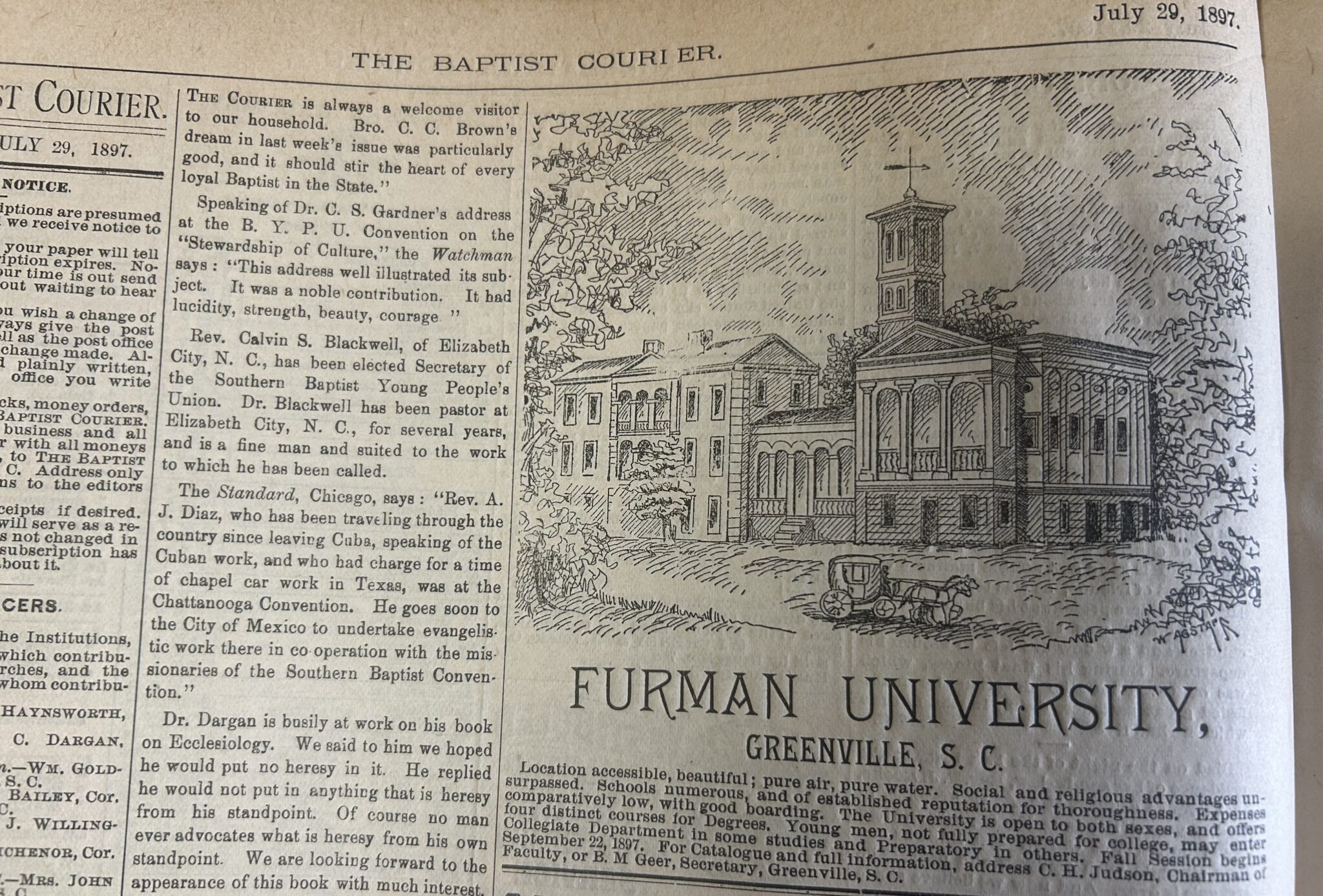
For a state so relatively small in size, South Carolina is graced with a variety of colleges and universities. Many of these institutions of higher learning owe a debt to the legacy of Baptist education in the state. South Carolina Baptists were pioneers not only in Baptist education, but in all kinds of education. Ironically, although Baptists in the early United States were often looked upon as unlearned, their commitment to theological education paid dividends for the Palmetto state.
When the Furman Academy and Theological Institution opened in 1826 in Edgefield, it was one of the very first Baptist institutions of higher learning in America. However, Baptists had already been shaping church and state in a litany of other ways. Legendary pastor of First Baptist Church of Charleston, Richard Furman, after whom the Academy was named, was known for letting young pastors stay at his home, lending them his personal library, and training them in Bible and history until which time they could begin more formal education. It was by Richard Furman’s personal recommendation that Jonathan Maxcy, the inaugural president of South Carolina College (later the University of South Carolina) was brought to Columbia in 1804. By almost all accounts, Maxcy was the most educated Baptist in America. Amazingly, he was just 24 years old when he was appointed president of Rhode Island College (later Brown University) in 1791. Maxcy brought the refined, classical learning of New England to the antebellum South.
Although originally from Massachusetts, Maxcy had a brother named Milton who lived in Beaufort, S.C. In Beaufort, one of Maxcy’s former students, W.T. Brantly, ran one of the first college preparatory academies in the South called Beaufort College. As a Baptist minister, Brantly wanted to help educate Baptist preachers, even establishing the Southern Education Society to pay for young men to attend university. One of his students, Basil Manly Sr., would eventually study in Columbia under Maxcy, become Furman’s successor at FBC Charleston, and serve as the second president of the University of Alabama.
Trained by Brantly as a child, Beaufort native Richard Fuller was so precocious that he studied in the Ivy League. In fact, when Richard Fuller matriculated to Harvard in 1820, he would be among only 9 percent of students in Cambridge from the South for the next 40 years. Fuller went on to become the third president of the SBC. However, Fuller’s significance in SBC life was not how he preached but to whom he preached. It was by Fuller’s preaching that a young James P. Boyce was saved at Beaufort Baptist Church where Fuller pastored. Boyce was eventually discipled by Manly, his first teaching job was at Furman Academy, and he eventually served as the first president of the Southern Baptist Theological Seminary in Greenville (alongside his former Princeton classmate Basil Manly Jr., who authored the Abstract of Principles).
And Southern Baptists did not simply promote education for men. William B. Johnson, the first president of the SBC (and the inaugural pastor of FBC Columbia, where Boyce took his first pastorate), founded Johnson Female Seminary in Anderson, S.C., in 1848, one of the earliest schools for women in the antebellum South. Later known as Johnson University, the school closed but was later resurrected as Anderson University.
A young William B. Johnson once admitted that most of his fellow Baptist preachers had little education and that some were “very ungrammatical in their language and coarse in their figures.” Two hundred years later, the quest to establish institutions of Baptist education has greatly edified not only Baptist churches, but the state of South Carolina as well.
— Obbie Tyler Todd is teaching pastor and theologian-in-residence at Cross Community Church in Beaufort, S.C., and adjunct professor of Church History at New Orleans Baptist Theological Seminary. Todd and his wife, Kelly, have twins, Roman and Ruby.