
Could creed, cult (meaning worship), and code be the answer to the cultural collapse of dehumanization happening around us?
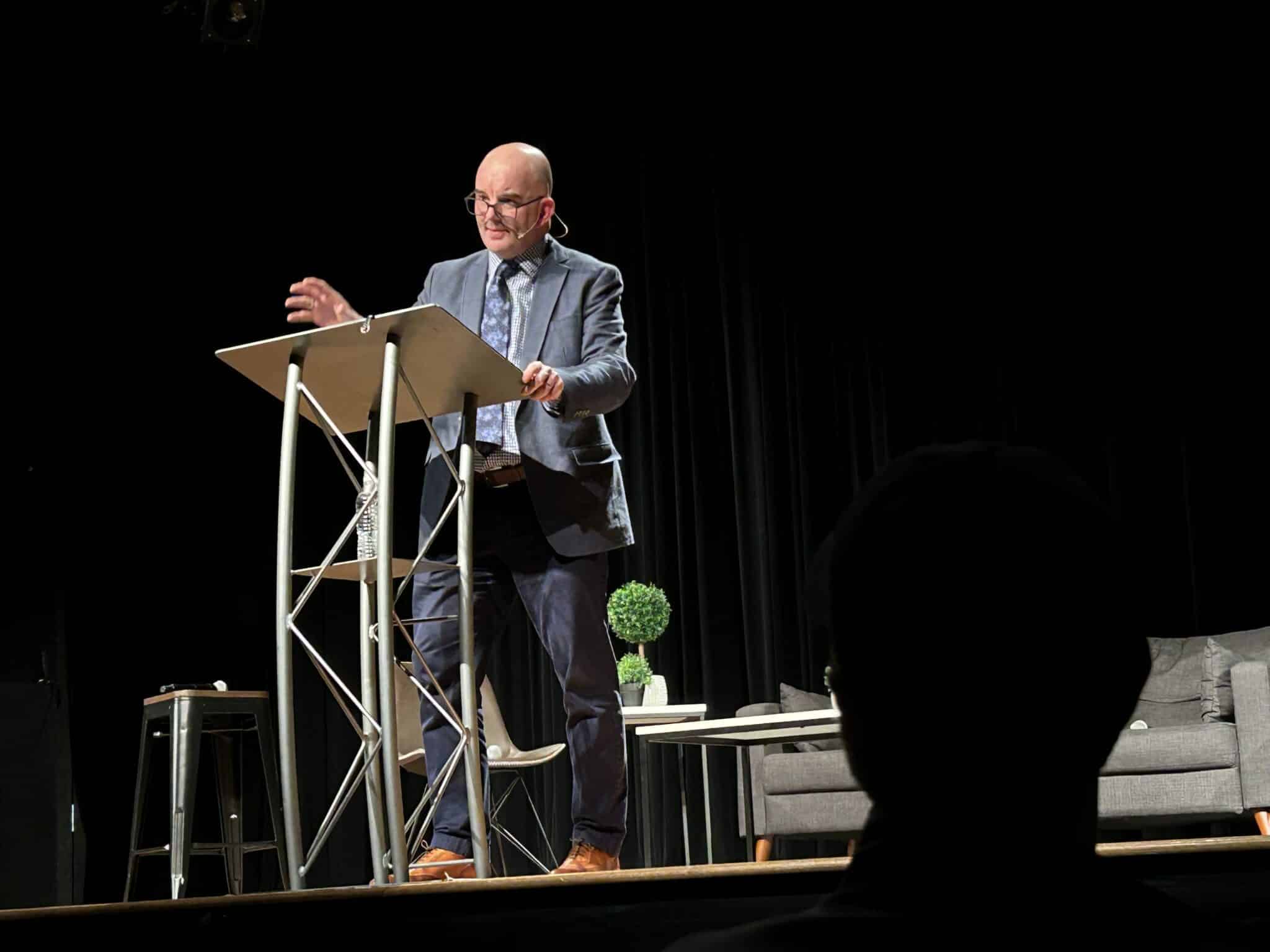
Carl Trueman, professor of biblical and theological studies at Grove City College and author of Strange New World, thinks so. Trueman spoke Tuesday night at North Greenville University (NGU) about the desecration of man, and he concluded his message with a simple solution to modern day dehumanization — the church. He said the proclamation of God’s Word (creed), the worship of the church (cult), and the hospitality of Christians (code) is the answer.
How the Church is the Answer to Modern Dehumanization
But why should the church care about what Trueman says about culture?
Trevor Hoffman, a pastor who attended Trueman’s speech, said, “These forces are not neutral; they are counter-formational and are reducing us to something beneath our humanity. That is exactly counter to what the church is given to do, to restore and perfect the image of God in man.”
Self-destructive actions occur every day: abortion, homosexuality, pornography, and the overuse and abuse of technology. And Trueman believes a root of these issues is the destruction of the image of God, which he calls the desecration of man.
In his speech Tuesday night, he said, “I hope what I’ve done this evening has at least persuaded you somewhat to take desecration seriously as a way of explaining the exaltation that is taken in the self-destructive patterns of behavior that characterize our society today.”
But Trueman didn’t leave listeners hopeless. He encouraged them to be part of the long-term solution.
Trueman declared, “But I hope that doesn’t cause any of you to despair. Because I think the answer is simple: The answer is Christ’s church. And everybody has a role to play in that church.”
But Trueman isn’t thinking of just the gathered church on a Sunday morning. He spoke of the ordinary practices of believers sharing meals together. He said, “Having someone in your home, sharing food with them, looking into their eyes, talking to them as another human being. That is a powerfully theological thing.”
He continued, “That is treating the other person not as a thing, not as an instrument for my gain, but as another person made in the image of God.”
Disenchantment
So, what exactly is the problem and how should we understand the growing rates of purposeless, self-destructive behaviors, and celebrations of evil that we see around us?
Trueman said some people, such as Rod Dreher, think that the world is like it is today because of disenchantment — which, in essence, is viewing the world through only what you can see, feel, touch, and calculate. Religion is done away with when the world is disenchanted.
Francis J. Beckwith, with WORLD news group, gives a helpful definition of disenchantment in a book review:
“Disenchantment, as Dreher defines it, is the perceptual state that results when a culture believes that all there is to the universe is what we observe through our senses, measure by our scientific instruments, and interpret through the lens of a materialist worldview. Anything else in our experience about which we may think we have immediate awareness — such as a sense of God’s presence, intrinsic beauty, the miraculous, the demonic, the providential, or the sacred — must be illusory and thus a social artifact of our imaginations.”
And although Trueman agrees with the sentiment of disenchantment, he believes there’s a deeper problem.
Trueman gave the example of abortion. People are no longer just treating abortion as a process or a means to an end. Rather, they are out on the streets celebrating their abortions.
“That’s more than disenchantment,” said Trueman.
The Desecration of Man
So, if the problem isn’t merely disenchantment, then what is it?
Trueman said, “We are not simply in a world of disenchantment; we live in a world of desecration above all — where the image of God, what it means to be human, is the primary target of that desecration.”
Trueman spoke of a few things that contributed to man’s desecration, including the industrial revolution. He said the industrial revolution swept away the idea of people as humans and turned them into things.
He quoted Karl Marx in The Communist Manifesto: “All that is solid melts into air, all that is holy is profaned, and man is at last compelled to face with sober senses, his real conditions of life, and his relations with his kind.”
Trueman said Marx isn’t saying that the intent of the industrial revolution was the desecration of man, rather that the industrial revolution desecrates man by process. It’s the natural outworking of it.
Another thing that has contributed to man’s desecration is expressive individualism.
He said that expressive individualism defines humans by their feelings. It’s the belief that true authenticity is being able to act on those feelings. This belief, Trueman said, transforms the nature of culture and relationships, because now anything that hinders you from acting on your feelings is seen as something that prevents you from being authentic. Institutions and traditions are no longer seen as holy and formative as they used to be.
Trueman said, “Expressive individualism — just to sort of cut to the chase — presses against tradition, presses against the notions of external authority, presses against all of those that past generations have considered to be sacred.”
Transgression
But it doesn’t stop with expressive individualism. Trueman said the nature of expressive individualism is transgression. Oscar Wilde, a famous British literary figure in the late 1800s, who was sentenced to prison for homosexuality, articulated the need for individuals to be rebels. Trueman said Wilde didn’t see his task as transmitting the sacred from one generation to the next, but rather he saw his task as an “overthrowal of the same.”
Trueman said, “For Wilde and for those who follow him in culture, established cultural values are sources and forces of inauthenticity. And transgressing them, breaking with them became a source of authenticity.”
But what does transgression have to do with desecration?
Trueman cited Percy B. Shelley who believed that we needed to get out from under Christian teaching to be truly authentic. The Christian faith is the object of transgression, and this ultimately desecrates man. This desecration culminates in the “slaying of god,” citing Friedrich Nietzsche, which results in the consequences of having to become God to make up for what is lacking. For Nietzsche, atheism can’t go on without bearing the consequences of life without God — the one who provided objective morality.
Becoming gods is ultimate human desecration, because people no longer accept their humanity, but seek to become divine. And in terms of others, Trueman said, “Nothing makes you feel more superior to a god than the smashing of its image.”
Three Areas Affected
Trueman said this transhumanism, which sees the natural limitations of being human as a problem, affects three core areas of life today: sex, procreation, and death. He said sex, which is the most intimate act between two humans, loses its sacredness and people are seen as objects. He said procreation loses its mystery and becomes merely a process. And death is trivialized, forgotten, and sought to be controlled through things like euthanasia.
What’s the answer?
Trueman said, “If the problem is desecration, then we have the answer. The answer is consecration.”
Where Do We Go From Here?
In a panel discussion following the speech, Trueman encouraged listeners by giving the example of the Cologne Cathedral in Germany which took over 600 years to build.
He said, “No single person involved on day one of construction believed that they would ever benefit from that building.”
Though Trueman said it would be great if revival happened tomorrow, he said, “Maybe it won’t, in which case we just need to keep plodding away, and that’s not a problem because we don’t do stuff for ourselves. We’re part of a community and we’re doing it for future generations.”
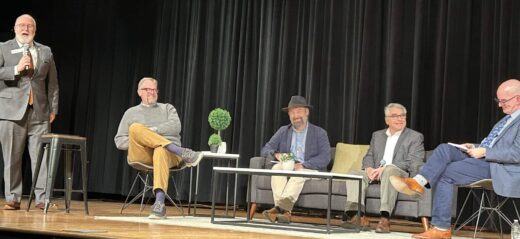
From left to right: Nathan Finn leads panelist discussion with Hunter Baker, Nick Higgins, Scott Culberson, and Carl Trueman.