
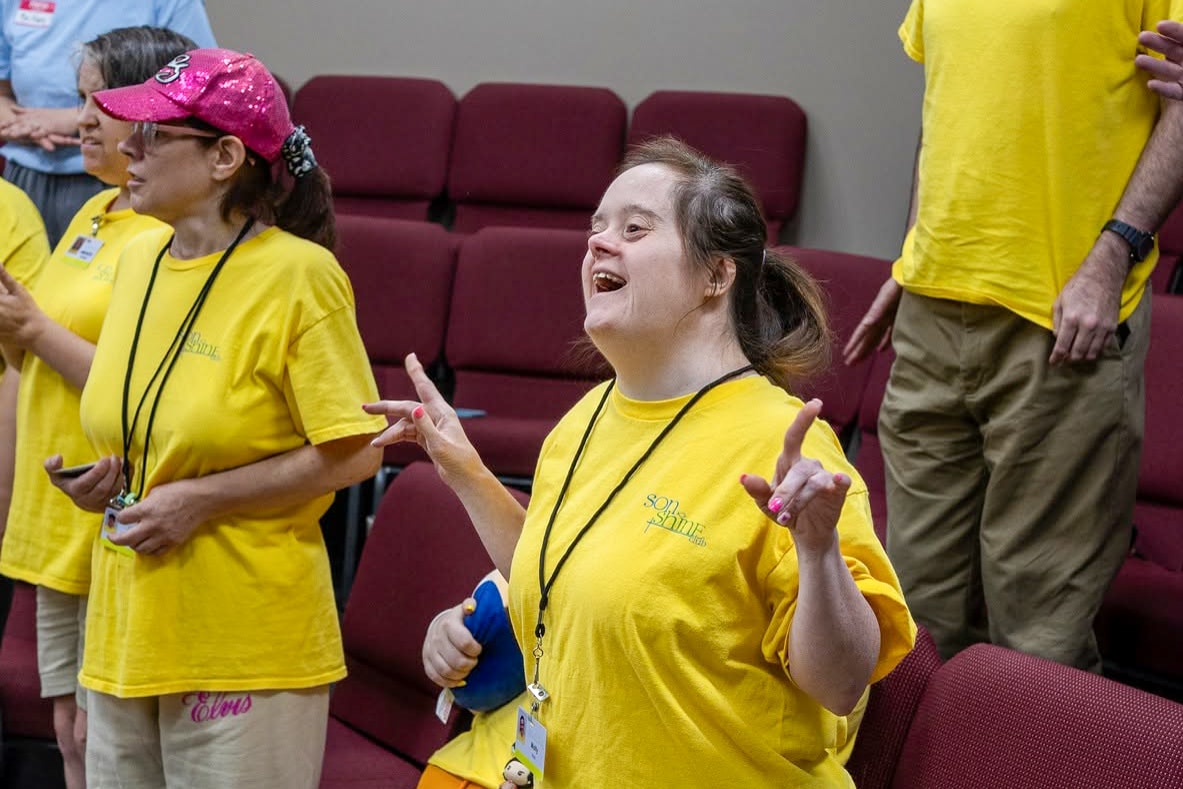
It comes from the Parable of the Banquet Table, where a master sends his servant out to invite more and more people to the table until every seat is filled. “The master said, ‘Go get everyone — those who are lame, get the deaf, get the cripple. Get everybody and bring them all around the table,’” Mike explained. “That’s what I envision a church looking like.”
That vision brought Thompson — executive pastor of Lake Bowen Baptist Church in Spartanburg, and a wheelchair user himself — to Washington, D.C. this year, where he led a breakout session at the Disability and the Church Conference hosted by Key Ministry. He wasn’t the only South Carolinian on the program. Laurie Thompson (no relation), a professor at Anderson University’s College of Christian Studies and member at Covenant Baptist Church, led her own breakout session.
“I was hit by a drunk driver when I was 14 years old,” Laurie said, “so I have lived as a partial paraplegic or paraplegic for the majority of my life. But I have not wanted that to be something that defined me.” It wasn’t until working through her doctoral research that she came across a statistic that people with disabilities are the largest unreached minority in the world, with approximately 2 in 7 U.S. families including a member with a disability. However, research also estimates that only 15-20 percent of evangelical churches have any form of disability ministry. “I thought, God is giving me an opportunity to speak out for those who may not be willing or able to speak for themselves.”

Overcoming Assumptions
At the conference, Laurie’s workshop focused on biblical identity as a mindset for disability inclusivity. “Oftentimes, the world looks at those of us with disabilities and measures our value according to what we’re able to do instead of the biblical identity of seeing ourselves the way that God sees us,” she said.
For Laurie, some of the challenges of navigating this inside the church have been combatting those assumptions. “A major assumption that’s being made is that if something is not said or requested, then it must not be needed. And that is not the case at all,” Laurie said. “Whether it’s me in a wheelchair or it’s a parent with a child with autism, the church has got to begin with conversations.”
She explained that it’s not just about getting people in the building, it’s about helping everyone experience the life that God intended. “We’ve all been created for worship and fellowship with God,” she said. “So, if there’s something standing in the way of a family coming to church, that demands something be done so that family can come worship and be a part of the family of God.”
Laurie’s heard it firsthand from families who have been told they aren’t welcome “because their children are a distraction.” At her home church, a young lady stood out. Laurie described Hannah as nonverbal but always standing in the front row for worship. “She would make noises, rock back and forth, and just smile. She was so happy,” Laurie said. “And I remember looking at her, thinking, She can’t understand this. What is she doing?” But as she watched Hannah over the course of the year, Laurie’s thoughts changed. “God taught me that even though Hannah was nonverbal, she was worshiping God. Hannah has a right to be in the service and worship her Maker just like we do.”
Developing Comprehensive Ministry Strategies
After attending the Disability and the Church Conference a few years earlier, Mike Thompson knew Lake Bowen Baptist needed to put a plan in place. “We don’t want you just to come. We’re not just welcoming you. We want you to know you’re wanted, and you’re needed, and you’re a viable part of our ministry,” Mike said. They started a program for special needs called WAVES, which stands for “Welcoming and Valuing Every Soul.” At the time, Lake Bowen only had one child with known special needs. But they wanted to pave the way to welcome more.
After meeting with staff from Church at The Mill, Lake Bowen Baptist started making changes. Within weeks, six or seven children with special needs began coming regularly. They converted two closets into a sensory needs room. Volunteers stepped up to help with the new preschool needs. People heard the stories and gave money to help. The SonShine Club, a faith-based non-profit for adults with special needs, began a new meeting location at the church, which led to a new class on Sunday mornings.
Mike attributes the growth to the dedication of Lake Bowen’s staff, but also to the congregation for their willingness to get involved. “They’re seeing the children and hearing the parents who are so appreciative,” Mike said. “As it goes into the congregation, it’s kind of like, these are our people. They’re in our community. People are excited to get involved with it.”
The church wanted to create inroads and infrastructure for people before they even arrived. “We have a lift in the student building to be able to get on the student stage. We don’t have any students in wheelchairs,” he said. “But I want any student that comes in to be able to see it — there’s a lift for you to get on stage. Maybe this kid can play guitar, maybe keyboard,” he said. But the goal is simple: “We’re trying to eliminate any obstacle from people being able to serve God.”
More Than Simple Accessibility
Both Laurie and Mike communicate that disability ministries aren’t just about accessibility, but about welcoming people to take their place among the body of Christ. “We want to provide an environment where you can come in, and we will deliver the gospel. But we don’t want to stop there,” Mike said. “We want you to be discipled in a small group, and then we deploy the Christ follower.” For Mike, that call to deploy includes all people and all abilities.
Bobby Howard, SCBaptist’s director of Adult Discipleship and Special Needs Ministry, led his own session on building a culture of inclusivity. His conviction is that disability ministry isn’t something a church does but part of who a church is. “If we are serious about Great Commission work,” he said, “we can’t neglect reaching and discipling these individuals and their families.”
“What I would love to see across the Southern Baptist Convention, especially in South Carolina, is that every church be equipped to bring an awareness to the church family,” Laurie said. It’s a topic being explored at the national level, as well. At the 2026 SBC Annual Meeting in Orlando, the Disability Ministry Task Force presented their findings after a 2025 motion called for the task force to study the availability of special needs ministry resources for churches.
Some of the recommendations involved increasing and promoting resources and training in state conventions, developing evangelism tools and strategies, and offering seminary classes and degrees in disability ministries. It’s a direction that Laurie has been hoping for. “I’m so excited to see the movement that is happening in our denomination,” she said, “to recognize and acknowledge this deficit of people with disabilities not being reached in the church, and an effort being made to reach them.”
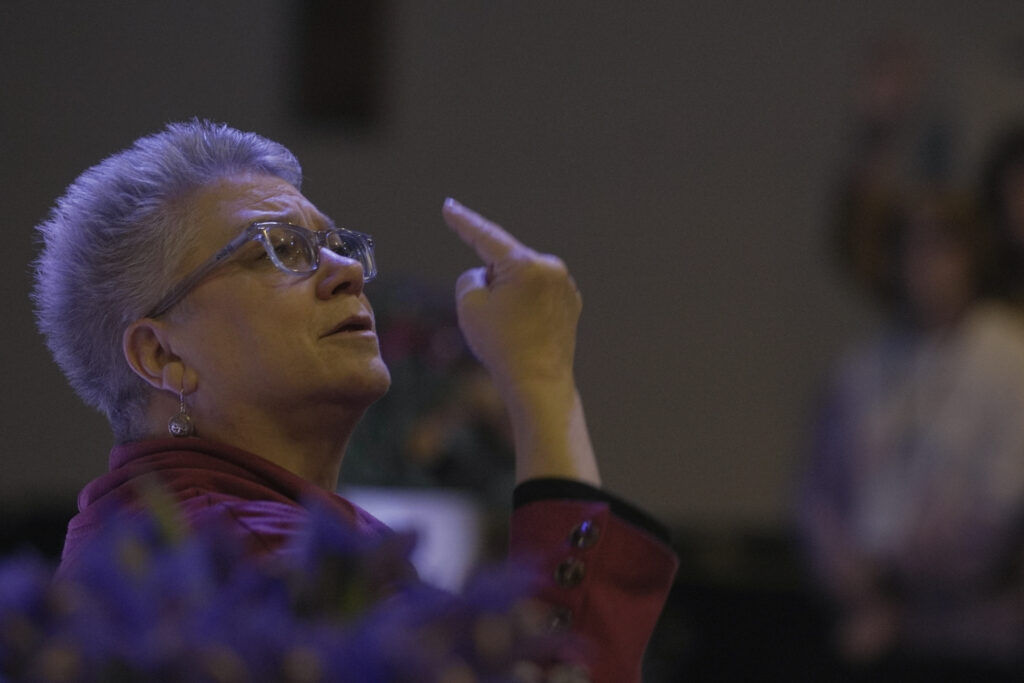
Mike has another dream. “I pray for the day to where we need an interpreter to interpret the person who is doing the signing — because they’re the one doing the preaching,” Mike said. “If God’s put something upon your heart and given you the gift of teaching, then we’ll provide the interpreter to the rest of the congregation. That is what being deployed is all about.”
— Anna Gardner serves as the creative editor for the SCBC. This article first appeared at SCBaptist.org.