
Every human life comes with limits, no matter how healthy or good. God made us limited humans on purpose, dependent on Him and other people. After sin entered the world, lots of other limits entered with it.
Why would anyone call these limits a gift? In the wisdom of Christ’s upside-down kingdom, He uses all these limits to help us know Him better and, in the process, to be changed into His likeness. Your most difficult limit may come in the form of a “thorn” like the one Paul talks about in 2 Corinthians 12:7–9. Your thorn may be a physical ailment, constant financial pressure, or anxiety and depression. Whatever it is, God can use it to platform His power in the places where you just don’t feel like you have what you need to perform, keep up or survive.
Stewarding your pain
Most of us don’t immediately think of our pain as something that can be stewarded. But our pain as believers is valuable. At the least, it offers information and experience in living with hope through difficulty that can help us in future pain. But if stewarded well, our pain can be a huge resource for others as they walk through the many struggles of living in a fallen world.
Through our pain, we learn of God’s faithfulness, tenderness, and nearness. It’s one thing to know God’s kindness in the abstract and to remind others of it as they suffer. It’s something entirely different to hear the voice of a person who has suffered the same kind of pain you are currently experiencing. Their encouragement and words of hope can bolster us like no one else’s because they’ve come out the other side of the dark tunnel with God and His praise still on their lips. They know the deep fears and losses that come with our particular type of pain and can speak directly into them.
Stewarding your energy
When talking about limits, I often have my clients do a drawing activity to help them visualize their energy output. Before we begin, I explain that we all have energy coins we get to spend in any given week. First, I have my client draw a square. In the middle of that square, they draw many small circles to represent the coins they have to spend on their God-given responsibilities. These are the essentials that cannot be compromised like kids, a spouse or a chronic illness.
 Outside the box they draw small circles for all the responsibilities that come and go depending on the season they’re in, such as a job or a specific commitment. Remember that these circles represent energy coins. We all have a limited number and must spend them wisely. And some of us might have more coins than others. Some other responsibilities might demand more attention at times, like transitioning to a new role at work or addressing a specific marriage struggle. During those months or years, you’ll need to draw a few more circles in your responsibility square, essentially transferring coins back from outside the square to the inside. This represents a redistribution of energy as the seasons and circumstances change.
This process provides a visual of the responsibilities in our lives. It helps my clients understand where they’re spending their energy. This will ebb and flow. But the picture they draw helps people answer questions like: Am I spending 15 coins in this area, or am I spending just one or two? Can I give more to the people outside the square? Or do my people inside the square need more from me right now? Using this exercise can help you remember and live more comfortably within your limits as you care for others.
Stewarding wisdom
Wisdom is a huge resource needed for any believer to help them learn how to manage their anxiety and depression. Wisdom is applying the Word of God to our lives in practical ways.
The Creator of all things knows all things about His creation. His wisdom and knowledge have a depth that far outreaches anything we will ever know or understand. We must go to the Wisdom Giver and ask Him how to spend our money, parent our children, move in and out of jobs, and treat our anxiety or depression.
But we also need to ask the Wisdom Giver how to steward our specific bodies. We all have different stories, genetics and heart idols that make each of us our own unique case. We must go to God and ask Him to give us wisdom about how to steward our bodies and their unique mix of characteristics. We ask for guidance about things like sleep patterns, medications and what workload we can manage.
Stewarding your life rhythms and anchors
Sleep, moving your body, fueling your body and connecting with the Lord are key rhythms or anchors for mental health. When these four areas are moving in the right direction, they can be a huge stabilizer for us. Neglecting a certain anchor can cause a rise in depression or anxiety.
Lack of sleep, interrupted sleep and inconsistent sleep patterns can be like lighter fluid on an already burning fire.1 The parts of your brain that help you be less anxious do not work as well when you lack sleep.2
Moving your body is the second life rhythm or anchor. Doing physical activity helps produce endorphins in the brain, which increase feelings of happiness and reduce pain.
Fueling your body is the third anchor for your mental health. This means eating healthy foods — ones that make your body feel good.
The final anchor for mental health is connection and time with the Lord. You might be thinking, Isn’t this the foundation of all mental health? Yes, that’s true. But these four areas must all be checked in their relationship to your anxiety and depression.
1 Eti Ben Simon, Aubrey Rossi, Allison G. Harvey, et al., “Overanxious and Underslept,” Nature Human Behavior 4 (2020): 100–110, https://doi.org/10.1038/s41562-019-0754-8 .
2 Simon, Rossi, Harvey, et al., “Overanxious and Underslept,” 100–110.
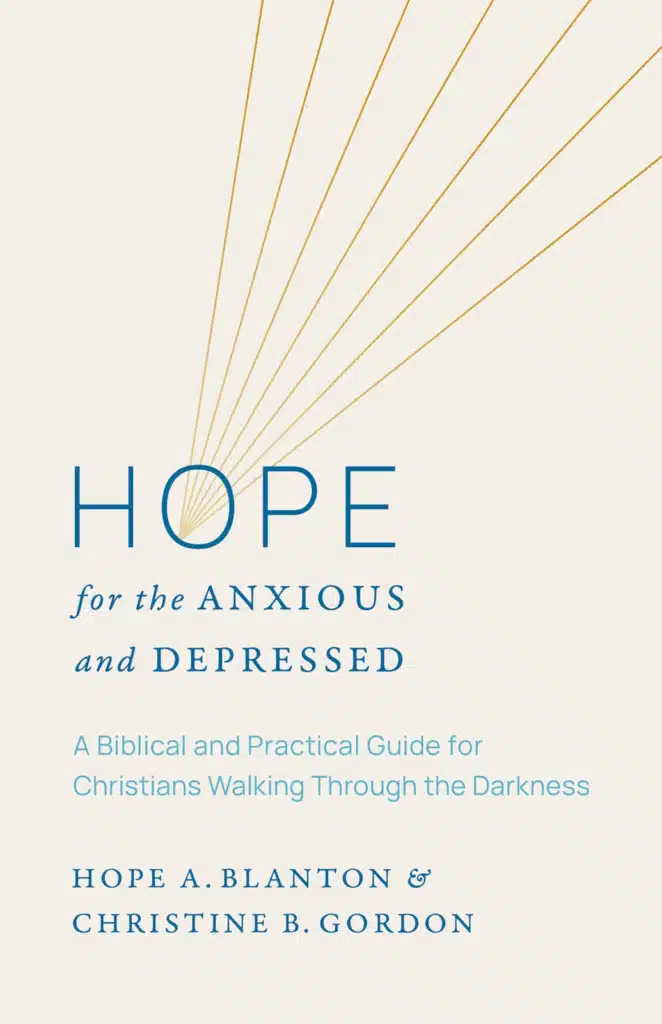
— Hope A. Blanton is a licensed clinical social worker with a private counseling practice in San Antonio, Texas. Christine is an adjunct professor at Covenant Theological Seminary in St. Louis. This article is an adapted excerpt from “Hope for the Anxious and Depressed” by Blanton and Gordon. Copyright 2026, B&H Publishing.