
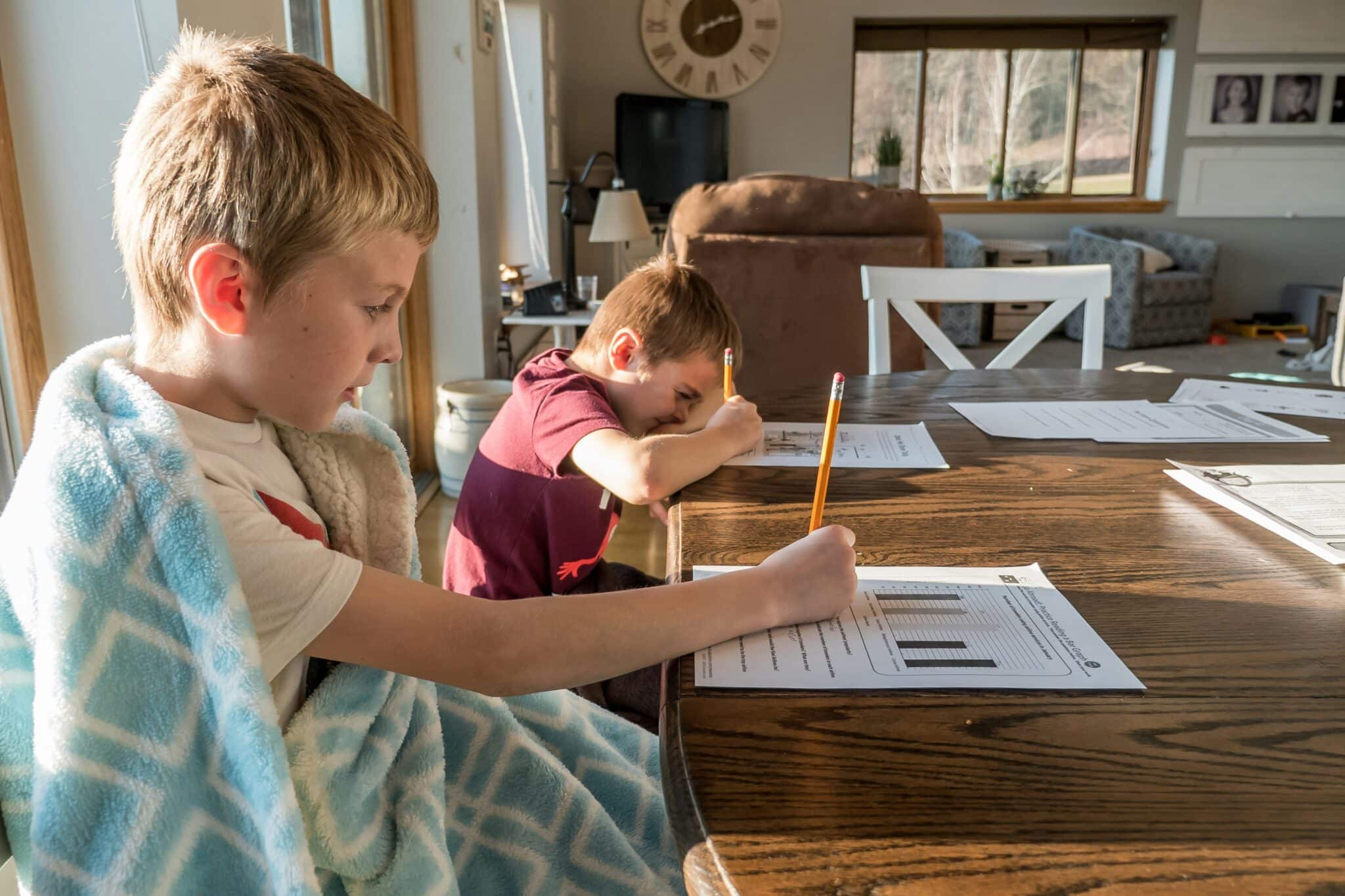
Homeschooling your kids is a fill-in-the-blank life experience. The prospective benefits and joys are so appealing. Attentive read-a-louds from hammock swings. Diligent and neat crafters. Nature walks with your teens as they identify bird calls. Family table discussions exploring deep theological questions about biblical manhood/womanhood. So you think, “Ok, I’ll give it a try. My kids will be best friends!” You jump in, following the curriculum of whatever resource is the most influential in your life. Then suddenly… WHOA!! Your perfect plans are spiraling out of control! Wild swinging hammocks and stick fights during Anne of Green Gables. Glitter glue litters a freshly mopped floor. Sulky teens on the trail because they would rather be listening to music. Table talk fights about modest clothing vs. “cute” fashions.
Homeschooling is not for the faint of heart because you are not only the teacher, but also their mom. You feel stressed, attitudes have to be checked daily (every hour), and you have a general feeling of fear and failure as you are wondering why you ever started this journey. Is this the good work that the Lord has given you? You are in survival mode — certainly not thriving. So you sit back and ask yourself if you should continue on this homeschooling path, because it’s not quite what you envisioned when you started.
When I was a new mom, I was given an article whose principle has stuck with me “Thrive! Don’t Just Survive.” The season of new motherhood tends to be generally seen as “survival mode.” After the blink of an eye, homeschooling could also receive similar classification. As a resident of South Carolina, I am legally responsible for each child’s four compulsory subjects, plus electives. That is eight subjects per student per year. Since I have four kids at various levels, that means I am responsible for 48 different class curriculums, grading, and oversight. All the while, I am trying to manage the household and other mom responsibilities. Chores and schoolwork alike, whatever you don’t monitor and follow-up on is probably not going to get done. So, if we step back and process the legal requirements of homeschooling our kids, homeschooling earns a reasonable “survival mode” season of life. Over the past 13 years of homeschooling, I have learned many valuable lessons that have spurred me on. These three tips have helped remind me of my calling to homeschool my kids, in faith. Not just to survive, but seeking to thrive.
Trust the Lord
God in His sovereignty has given your children to you! Unlike us, God knows all of our sins and all of their sins. He knows their quirks and preferences. He knows your past and baggage. He knows how we handle conflict and feel love. As a mom, you need to confidently trust God’s design regarding your family. This is especially true when your kids begin to fight your family rules, choices, and school structure. You must remember that God has given you the authority and responsibility to train up your children in the discipline and instruction of the Lord. You will not do this perfectly and you will make mistakes, but you must walk in faith. You are leading and guiding your children in your obedience to the Lord. And you can live this out confidently to the defiant child, the lazy child, and to the diligent child. When things get hard, you must rest in God’s sovereignty regarding your family, thus bringing a confidence in those little moments that your kids will come to respect and admire in you as their mom and their teacher.
Be mindful of the comparison game with other families. Sure, analyze and discuss other families and their routines and choices to spark ideas and implement tips where you may not be as gifted. But be careful not to try to mimic their life, or their schedules, or even their personalities. We can be encouraged and challenged by the lives of others, but we are to imitate Christ in our sphere of influence and our families. God has structured your family to function uniquely with all its various personalities and gifts (and weaknesses). Work within those parameters. Along the same vein, we are one body with many members. Therefore, we must live in the reality that our ears cannot see. There will be areas where you excel and thrive and hopefully find enjoyment in your work. If you love math and physics, the likelihood of your kids excelling in that subject is quite high. If your bent is nature and foliage identification, then your kids may find much delight in the natural sciences. So my challenge would be to keep that mentality in perspective as you teach your children and observe areas where other families thrive. Lead your family school with confidence, knowing and embracing the gifts you have and not coveting the gifts of others.
Practical Tips
Reduce decision fatigue. It is ideal not to change curriculum for every subject every year. Early in our homeschool journey, we settled into our math, spelling, grammar, and history curriculums. Each year, my kids would progress to the next level, regardless of their “grade.” And some of these curriculums would just roll into the next year. With those decisions made, I was able to spend more precious decision time on what to do for science and our beloved book lists. But what if your kids hate the chosen curriculum? Simple. Either punt it and choose another to try to stick with, or make your kid work through it. Teaching our kids to persevere when it’s hard is one of the ways we train them. Another benefit of settling into a curriculum is the order and predictability for the kids. They know the routine and what is required of them for certain subjects. This can be especially beneficial for building confidence and independence. They start to work independently and all subjects no longer need to revolve around you, thus freeing you up to be able to give more thought into another area of life.
Develop ownership. Has one of yours ever prompted you to do “school”? Is there ownership and excitement around your school environment from your kids? Establishing a rhythm that your kids anticipate and own is such a blessing to homeschool family life. You know how your kids tick and what motivates them. I have some independent kids who want to do everything on their own schedule. This is not life, so I have adapted our school day to help accommodate their independence within my framework. In the early years, I had to be the one establishing the regular learning times. As my kids have gotten older, we set aside a few school days to discuss the routine of our new school year. This is where we reestablish that I am the authority and ultimately responsible for their schooling in our family after a loose summer schedule. Once that is reestablished, they take a look at their responsibilities that I have listed for them and then we work out a weekly family calendar to fit in all our class and study times. One of my kids assigned her grammar lesson with me at 7:30 a.m. Because this was her choice that she committed to, she is up and ready to go on Wednesday mornings. (I tried to persuade her to choose another time.) But the sacrifice of extra morning time is worth it, because she owns her school work assignments and prompts me when it’s time for her class slot. Do your best to find those areas where you can train and develop your kids to confidently own their responsibilities in school and in family life.
Remember
Every posed question — How are you? Why do you homeschool? How are your kids? — can be answered at many different layers. Sometimes I’ll respond with “At which layer of the onion would you like me to answer that question?” Just like questions, the way we apply and live out our responsibility to teach and discipline our children varies from family to family. Some areas will have “bulb like” depth, while others will be “skin like” or just checking the boxes. You may feel unqualified and like you’re just surviving to get your student through each year, but remember that God is sovereign. He has uniquely established your family to walk in His ways and follow Him. Since He has called you to train and instruct your children, He will equip you for every good work. If homeschooling is that work, confidently walk in faith. Trust the Lord; reduce decision fatigue; and guide developing ownership to help your household (and mom) thrive in the daily grind of homeschooling. God is most glorified when we are most satisfied in Him and walk in a manner worthy of the gospel during our fill-in-the-blank homeschool journey. And hopefully that blank is rooted in joy.
“What gain has the worker from his toil? I have seen the business that God has given to the children of man to be busy with. He has made everything beautiful in its time. Also, he has put eternity into man’s heart, yet so that he cannot find out what God has done from the beginning to the end. I perceived that there is nothing better for them than to be joyful and to do good as long as they live; also that everyone should eat and drink and take pleasure in all his toil — this is God’s gift to man.” (Eccl. 3:9–13)
— Kelly Kaldenbach is a transplant from Florida to the Upstate of South Carolina. She and her husband, Barry, love their church family and homeschool community in Anderson, S.C.