
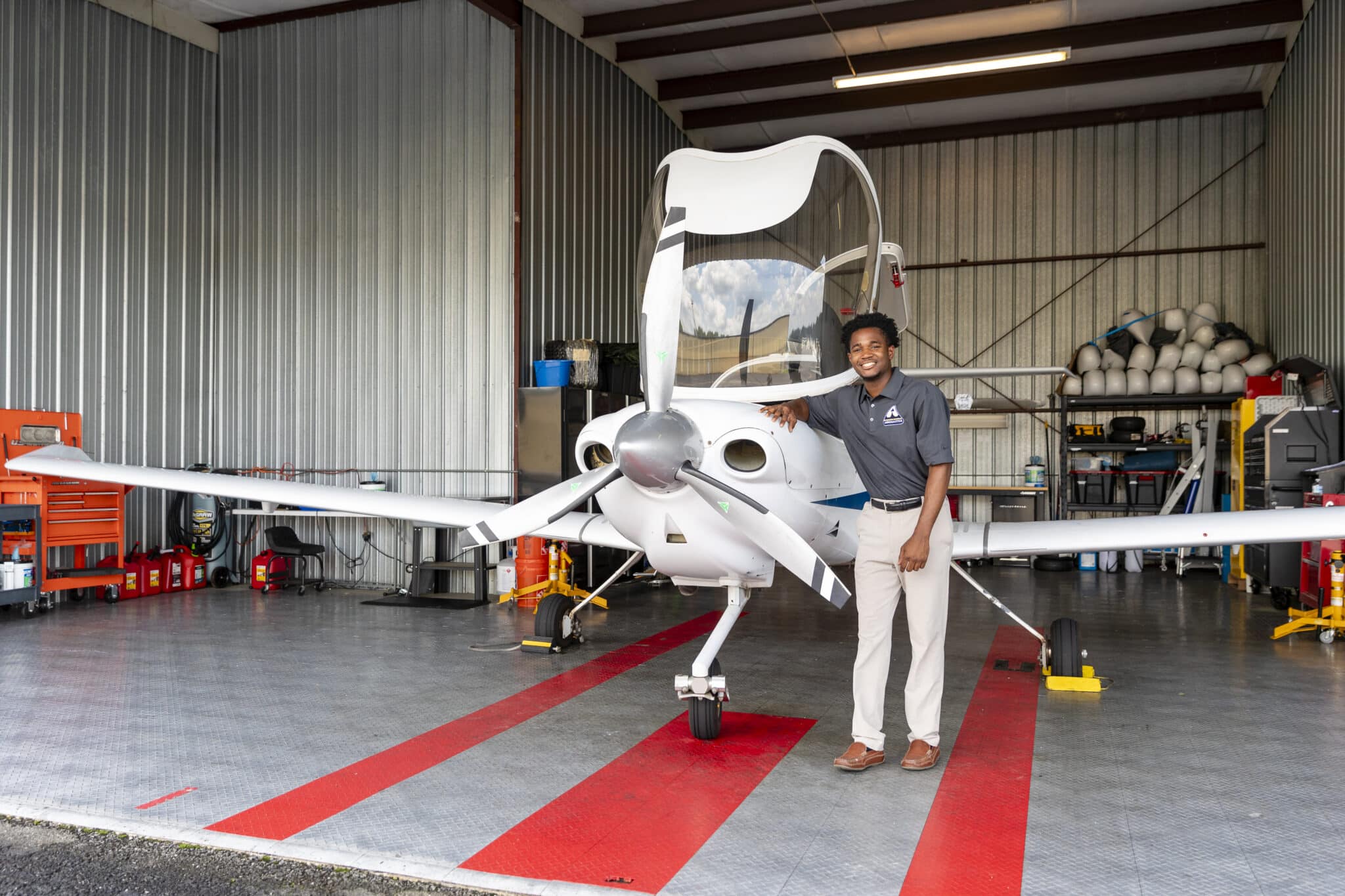
Charleston Southern University has received $1.25 million from the U.S. Department of Education to expand equipment and training capacity for its rapidly growing Aeronautics program, which includes equipment designed to prepare the next generation of professional pilots, air traffic controllers, and other aviation professionals.
The federal funding will support the purchase of:
-
Modernized flight simulators
-
Air traffic control tower simulators
-
A multi-engine Redbird flight simulator
-
Two commercial-grade drones
-
A mobile aircraft maintenance trailer
-
Temporary mobile office at Berkeley County Airport
-
Aircraft parts, maintenance tools, simulator furnishings, and other aviation supplies
The additional equipment bolsters CSU’s capacity to train students for careers across the aviation industry and has increased student pilot enrollment capacity by 10%.
“Ultimately, this investment allows us to keep the costs down for our students,” Professor Lloyd Richardson, chair of the CSU Aeronautics department, said. “We are thankful for this congressional support that gives aspiring aviators greater access to collegiate flight training when the industry demands highly trained professionals.”
The U.S. Bureau of Labor Statistics projects that employment opportunities will grow in the aviation field by 7%, with more than 16,400 job openings each year for airline and commercial pilots over the next decade. Professional pilots earn a median salary of $232,140.
Equally in demand are air traffic controllers.
The Federal Aviation Administration (FAA) has launched an aggressive effort to rebuild and expand the nation’s air traffic controller workforce. Its 2026-2028 workforce plan is to hire 12,563 highly trained air traffic controllers. Certified controllers earnings exceed $155,000 annually within three years of graduation.
For Charleston Southern—home to South Carolina’s only collegiate flight training program—these projections have only amplified its strategy to expand capacity in order to meet industry demand.
Launched in 2021 with only 19 students and one full-time faculty member, CSU’s Aeronautics program has grown to 216 students and faculty that includes four U.S. Air Force combat pilot veterans, a U.S. Air Force air traffic controller, and a U.S. Marine Corps veteran. In 2025, CSU purchased a flight school and completed a building expansion featuring classrooms, an auditorium, offices, and the Emory and Lisa Main Flight Simulation Lab.
This year, CSU launched an air traffic management degree, the first FAA-recognized Standard AT-CTI pathway in the state of South Carolina, creating a competitive collegiate pathway for students pursuing careers as air traffic controllers.
The late U.S. Senator Lindsey Graham was a strong advocate for CSU’s Aeronautics program and recognized the importance of expanding opportunities to prepare South Carolina students for careers in aviation. His support helped elevate the program’s importance at a national level. Earlier this year, he announced roughly $150 million in federal funding for South Carolina infrastructure and development projects as part of Congress’ third Fiscal Year 2026 appropriations package passed by both chambers.
“Lindsey believed in South Carolina, believed in its people, and believed in preparing our state to meet the challenges of the future,” said U.S. Senator Darline Graham. “His support for Charleston Southern’s Aeronautics program reflected that commitment. I am honored to continue his support and to see this investment help more students pursue careers in aviation and become part of a vital sector of our workforce.”
In addition to the professional pilot and air traffic management degree programs, CSU offers degrees in aviation maintenance managementand aerospace management. Through a partnership with Trident Technical College, students can complete a two-year program before continuing at CSU to earn their bachelor’s degree online.
To learn more about the various pathways provided within the CSU Aeronautics program, go to charlestonsouthern.edu/aeronautics.