
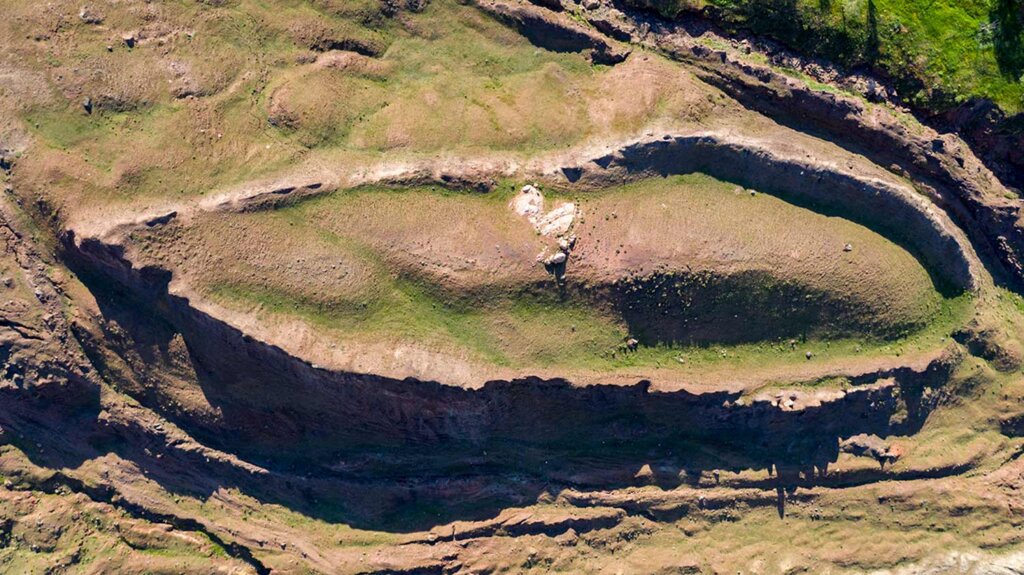
Readings from subterranean drilling and scans have produced results generating strong debate over whether the final resting place of Noah’s Ark has finally been discovered.
Located in the region of Mount Ararat, a 515-foot-long, boat-shaped formation was discovered by Captain Ilhan Durupinar through aerial photography in 1959. Matching the description in Genesis 6 of the ship built by Noah, it has remained a prominent site in the search for the ark’s final resting place.
Others say the site, named for Durupinar, is nothing more than natural formations underneath the surface. Preliminary scan results released on Oct. 27, though, include fragments of “ancient-appearing” charred wood alongside organized patterns, chambers and corridors at the site that scientists say are not geological.
“For me as a Christian, I could not hope for anything more than that this site would be Noah’s Ark,” Jim Parker, professor of Biblical Interpretation and Archeology at New Orleans Baptist Theological Seminary, told Baptist Press. “A find of this magnitude would be such an affirmation of the veracity of the historicity of the Genesis account and hopefully a builder of the faith of many who would learn about it.”
Rigorous work required
Parker took interest in the Durupinar site around 1988. He noted that, until this year, the consensus viewed the area as “a geological phenomenon, not an ancient wooden boat.”
“For the claim that this is Noah’s Ark,” he said, “there is the necessity of rigorous work to assemble the proofs supported by empirical evidence.”
Noah’s Ark Scans is chronicling the work and recounts how various scans in 2014, 2019, 2021 and 2023 showed “unusual linear subsurface structures” alongside right angles and “room-like chambers running the full length of the structure” that contrasted with the surrounding geology. Soil tests in 2024 included samples inside the structure that contained organic material nearly three times the amount outside of it. Ground-penetrating radar showed geometric patterns suggesting a natural geometric fold … or a buried decayed wooden ship.
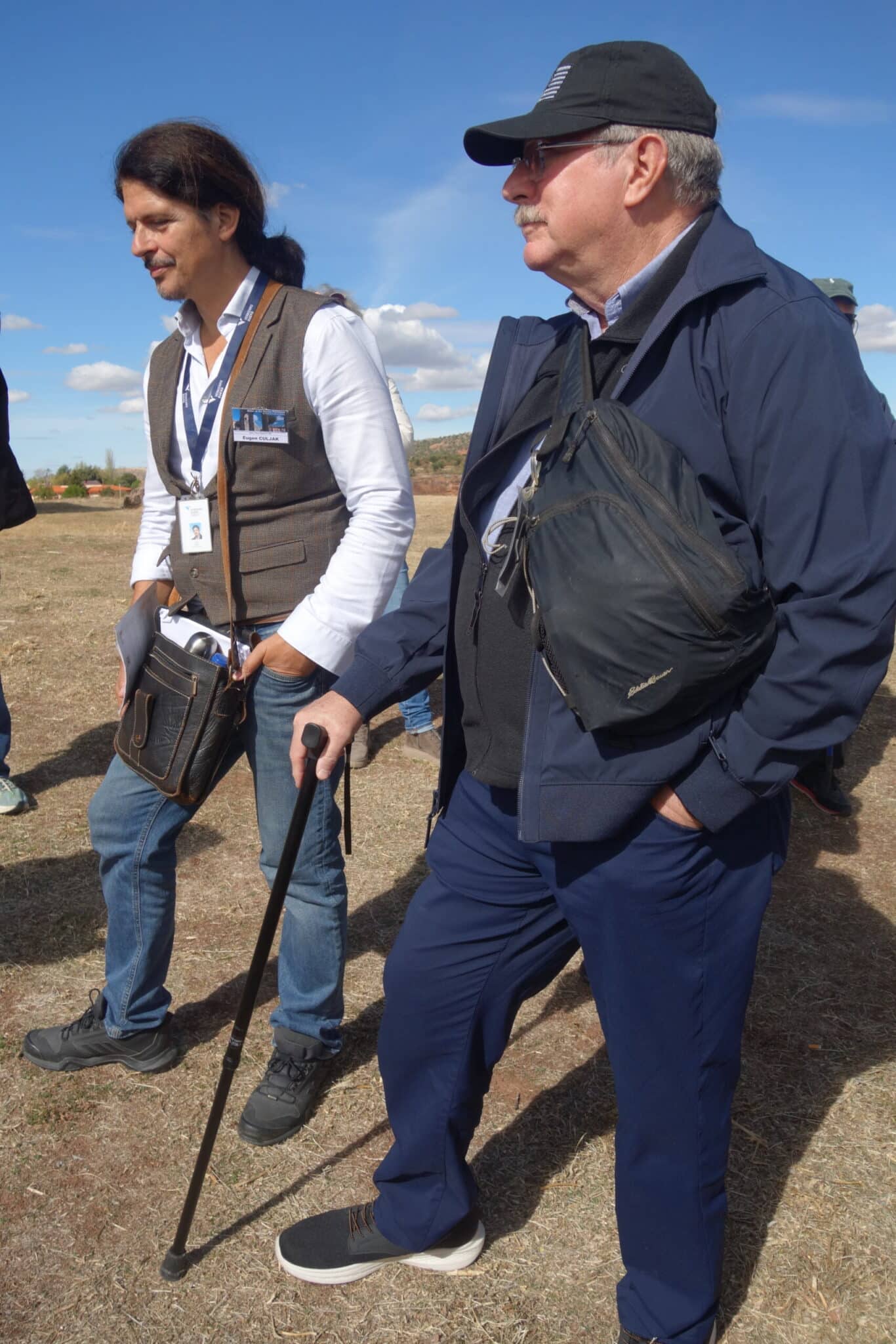
Jim Parker, professor of Biblical Interpretation and Archeology at New Orleans Seminary, stands with tour partner Eugen Culjak at an excursion site in Tiermes, Spain. (Photo courtesy of Jim Parker)
“I personally believe that the approaches that Dr. Cenker Atila and the Noah’s Ark Scans group are employing at Durupinar are an excellent way to recover evidence,” Parker said. “I read recently that they had made 12 core drills inside the formation and an additional four outside. This is a great approach as the cores should include valuable information about what is inside and outside the perimeter of the formation and at the maximum depth.
“In the reports I am reading, the group is also using a full spectrum of scientific specialties such as chemists and others to assess the findings. I also understand that there is a 2027 excavation season planned, and it is the intent of the team to use other geotechnical methods to help with the search for finds. This is all wonderful work, and I personally wish them success.”
Possible greatest archeological find
Large stones, some weighing several tons and standing over 10 feet high, are scattered throughout the Durupinar site. These drogue stones, as researchers have identified them, include a hole cut in the upper end through which ropes were placed for the stones to serve as drag anchors of ancient boats in heavy seas.
The stones are believed to be the ones that were tethered to the ark and cut loose as the floodwaters began to recede. Crosses carved on the stones are believed to have been added in later centuries by Armenian Christians.
Ken Ham, founder of Answers in Genesis, echoed Parker’s hope and caution over the findings.
“Obviously, we would be thrilled here at AiG if someone discovered the Ark — it would be perhaps the greatest archaeological find of all time,” he said. “But we also need to be careful not to fall for sensationalism or claims that aren’t grounded in careful observational science.
“… [O]ver the years, we’ve published many articles on this particular supposed Ark site. In short, no, we don’t believe Noah’s Ark has been found at the Durupinar site. But our faith in God’s Word does not rest on finding the Ark (as exciting as that would be!) — it rests on the truth of Scripture.”
Parker is fresh from a trip to Spain and Portugal. There, he and Israeli colleague Tsvika Tsuk presented their Tel Gezer project to the Frontinus Society at the Water in the Iberian Peninsula conference.
“There is a steep curve to proof,” he said. “For a project of this type to have any credibility, they must immediately publish the data relating to any findings to the larger community of geologists and archaeologists for peer review. For me personally, I would highly recommend that no claims be made about the identity of what this site is until all evidence is analyzed and the same has been peer reviewed.”
— Scott Barkley is chief national correspondent for Baptist Press.